The Question Beneath Every Battle
“I was grounded
~ The Waterboys, “The Whole of the Moon”, The Whole of the Moon
While you filled the skies
I was dumbfounded by truth
You cut through lies
I saw the rain dirty valley
You saw Brigadoon
I saw the crescent
You saw the whole of the moon”
If you’ve ever assembled furniture, repaired a bike, or built something with your hands, you know how a small mistake at the beginning can follow you all the way to the end. A measurement is off by an eighth of an inch and the frame never sits square. A bolt you thought was tight works itself loose ten miles down the trail. Bad assumptions have a way of collecting interest.
Something similar happens in the spiritual life. In the opening essay of this series, we started with the uncomfortable premise that Christians have been born into a world at war, a conflict that is both visible and invisible. Most days it doesn’t feel that dramatic. It feels like work, marriage, money, temptation, disappointment, distraction, and the steady pressure of trying to hold a life together. But underneath those ordinary pressures is another question: What story about God, myself, and this world am I actually living from?
Paul begins there.
“Stand therefore, having fastened on the belt of truth…” (Ephesians 6:14).
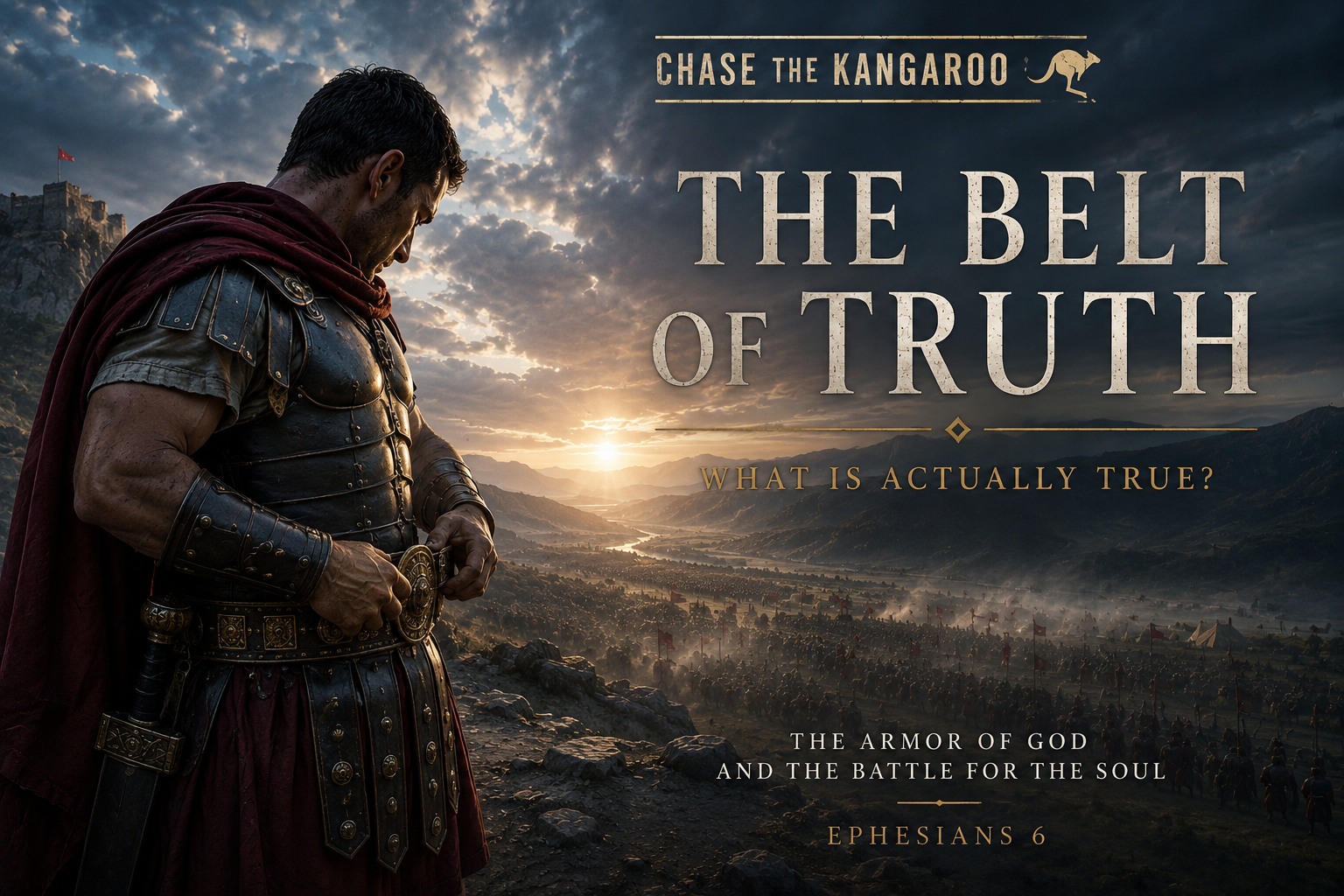
The belt seems like an odd first choice. A shield looks like armor. So does a helmet. A sword certainly looks useful in a fight. The belt is easy to overlook. For a Roman soldier, though, it was part of getting dressed and ready. It gathered clothing and equipment at the waist and could carry the sword and other gear.
We don’t need to make the historical image do more work than it can. The belt did not physically hold every other piece of armor together. Paul’s point is better than that. Truth comes first because nothing else in the Christian life works very well when we are wrong about reality. Righteousness depends on knowing what God calls good. Faith needs to know the God it is trusting. The Sword is of little use if we are more interested in making Scripture say what we want than hearing what God has said.
That makes truth more than an abstract theological concern. We live in a time when we are encouraged to speak our truth, follow our truth, sometimes even create it. Meanwhile, information arrives faster than we can make sense of it. News, social media, algorithms, advertising, political tribes, and the people in our own circles are all offering versions of reality. Some are true. Some are partly true. Some are nonsense delivered with remarkable confidence.
And some of the most damaging stories never arrive through a screen. We carry them around ourselves. I am what I accomplish. I am what I earn. I am the worst thing I have done. If people really knew me, they would think differently of me. God is disappointed with me. This thing I want will finally be enough. Leave those beliefs unexamined long enough and they begin making decisions for us.
Genesis tells us we should expect this. The first attack recorded in Scripture is not an act of violence. It is a question.
“Did God actually say…?” (Genesis 3:1).
That question is still with us. The enemy’s primary weapon is deception, and deception rarely needs to control a man outright. Distort what he believes about God, himself, or the good life, and his choices will begin moving in the same direction.
So before we talk about resisting temptation, surviving accusation, or standing firm under pressure, there is a more basic question to answer:
What is actually true?
Truth Is Reality Under God
Most of us assume we know the answer. We use the word constantly. We want truthful friends, truthful reporting, truthful testimony, and truthful answers. Yet when the conversation turns toward deeper questions about life, identity, morality, or God, the meaning of truth often becomes less clear.
Scripture begins from a different starting point than our culture. Truth is not something we invent, negotiate, or redefine. It is something we discover. It exists independent of our opinions, emotions, or preferences because reality itself originates with God.
For centuries, Christian thinkers have described truth in remarkably similar ways. Thomas Aquinas famously defined truth as the conformity of the intellect to reality (adaequatio intellectus et rei). Augustine likewise understood truth as that which reveals what actually is. Both men remind us that truth is not manufactured by the human mind. It is recognized by it.
The Bible takes this one step further. Reality itself has a source.
Genesis opens with a God who speaks the universe into existence. The world is not random or self-created. It is ordered because it reflects the character of its Creator. There is meaning because there is a Lawgiver. There is purpose because there is a Designer. True reality is ultimately God’s reality. He is the pillar of truth.
Then Jesus makes one of the most astonishing claims in all of Scripture.
“I am the way, and the truth, and the life” (John 14:6).
Notice what He does not say. He does not merely claim to teach truth or reveal truth. He identifies Himself with truth. Christianity is therefore not simply a philosophy that explains reality. It is centered on a Person who embodies reality itself.
C.S. Lewis captured this beautifully:
“I believe in Christianity as I believe that the sun has risen: not only because I see it, but because by it I see everything else.”
Truth becomes the lens through which everything else comes into focus.
This is why the Belt of Truth stands at the beginning of the armor. Before we can stand against evil, we must first learn to see clearly. We cannot live faithfully in a world we do not understand.
But if truth is reality as God reveals it, then we should expect the enemy’s first attack to be aimed not at our strength, but at our understanding of reality.
The First Lie Was a Question
The opening chapters of Genesis describe a world marked by clarity. Adam and Eve know who God is. They know who they are. They understand the boundaries God has established and the purpose for which they were created.
Then the serpent enters the story. His first weapon is not violence. It is a question.
“Did God actually say…?” (Genesis 3:1).
The question sounds innocent enough, but its purpose is not understanding. It is suspicion. The serpent is attempting to place distance between God’s Word and human trust.
The progression is subtle. Doubt becomes reinterpretation. Reinterpretation becomes contradiction. By the time Eve reaches for the fruit, the decisive battle has already taken place. She has accepted a different story about reality.
The lie is ultimately about God’s character. Perhaps God is withholding something good. Perhaps obedience is restrictive rather than life-giving. Perhaps independence is the path to flourishing.
The temptation is not simply to break a command. It is to believe a false story.
The same pattern appears throughout Scripture. Satan tempts Jesus by twisting God’s Word rather than rejecting it outright. Jesus answers each temptation by rightly understanding and faithfully applying Scripture. Later, Jesus describes the devil as “a liar and the father of lies” (John 8:44). Deception is not merely one of Satan’s tactics. It is fundamental to his nature.
Most lies are effective because they resemble the truth. A half-truth is often more persuasive than a complete falsehood because it borrows credibility from reality while quietly leading us away from it.
Every generation faces its own versions of the serpent’s question. We are constantly invited to reconsider what God has said about identity, purpose, success, happiness, and human flourishing. The voices change, but the strategy remains remarkably familiar.
If deception is the enemy’s primary weapon, it is no surprise that Paul begins the armor with truth.
Why Truth Comes First
“Stand therefore, having fastened on the belt of truth…” (Ephesians 6:14).
To modern readers, that image can seem underwhelming. We think of a belt as something that holds up our pants. It is useful, but hardly the piece of equipment we would expect Paul to mention first.
A Roman military belt belonged to the practical work of being dressed and ready. It gathered clothing and equipment at the waist and could carry the soldier’s sword and other gear. We should be careful, however, not to make Paul’s metaphor say more than the history allows. The belt did not physically hold every other piece of armor together.
The stronger point is theological. Paul begins with truth because the Christian cannot faithfully wear or use any of the armor while living inside a false understanding of God, himself, or the battle.
Without truth, righteousness can become self-righteousness. Faith can become confidence in an outcome God never promised. Scripture can become a tool for defending our own opinions. Even prayer can become an attempt to persuade God to bless our plans instead of bringing ourselves into agreement with His will.
This also explains why truth must come before behavior. Whether we realize it or not, every behavior begins with a belief. We do not behave according to reality. We behave according to what we believe is reality.
If a man believes his life has purpose, he will begin living with purpose. If he believes his life is meaningless, he will drift. If he believes his identity rests in Christ, he will face failure differently than the man who believes his worth depends upon success. And if he knows God as He has revealed Himself, faith has somewhere solid to rest. Truth tells us what is real. Faith, as we will see later in the armor, entrusts itself to the God who is true.
Behavior is the fruit. Belief is the root.
The enemy understands this well. He does not need to control every decision if he can influence the beliefs from which those decisions grow. Change what a man believes about God, himself, or the world, and his life will eventually follow.
Paul understands it too. Truth comes first because every response to the battle begins with some understanding of what is real.
At first, we might assume the Belt of Truth is simply about believing the right things. Either a statement is true or it is false. Either our doctrine is sound or it is not. Scripture certainly calls us to believe what is true, but it refuses to stop there.
The goal of the Christian life is not merely to hold true beliefs. It is to become a truthful person. God’s truth is meant to reshape not only what we think, but how we speak, how we act, what we love, and ultimately who we become. The belt is not simply something a soldier possesses. It is something he wears as he prepares to stand.
Before truth becomes our defense against the enemy, it must become the atmosphere in which we live. Over time, belief and character begin to agree. We become less divided, less performative, less driven by appearances, and more rooted in reality as God reveals it.
Anyone can profess the truth. The deeper question is whether the truth has begun to shape the kind of person we are becoming. The Belt of Truth is not fully fastened when we merely affirm what is true. It is fastened when truth increasingly becomes visible in the life we live.
Fastening ourselves to truth, then, involves more than believing the right things. It requires becoming the kind of people who live truthfully.
Truth Believed, Truth Lived
By this point, we have established that truth is reality as God reveals it. We have seen how deception works by distorting that reality and why Paul begins the armor with the Belt of Truth.
But there is another dimension to truth that is easy to overlook. Truth is not merely something we know. It is something we become.
Our culture tends to reduce truth to information. A statement is either accurate or inaccurate. An argument is either correct or mistaken. While that is certainly part of what truth means, Scripture consistently pushes us beyond intellectual agreement toward something much deeper.
The Bible speaks of truth not only as a body of knowledge but as a way of life.
David prays that God desires “truth in the inward being” (Psalm 51:6). Paul urges believers to “put away falsehood” and “speak the truth” to one another (Ephesians 4:25). John rejoices because his spiritual children are “walking in the truth” (3 John 4). In each case, truth has moved beyond the intellect and into the character of a person.
This is one of the insights William Gurnall, a seventeenth-century English pastor who wrote an enormous and enduring work on the Armor of God called The Christian in Complete Armour, develops at length. Gurnall argues that the Belt of Truth includes both truth in doctrine and truth in the heart. A Christian may affirm every article of the faith and still live a divided life. It is possible to defend sound theology while quietly nurturing pride, bitterness, greed, or hypocrisy.
Knowledge alone does not produce integrity.
The Pharisees illustrate this sobering reality. Few people in history possessed a greater knowledge of Scripture. They memorized it, taught it, debated it, and defended it. Yet Jesus repeatedly confronted them because their outward profession concealed an inward reality that had never been transformed. Their problem was not ignorance.
Their problem was image. They had become more concerned with appearing righteous than with becoming righteous. That temptation has not disappeared. We often devote more energy to managing how others perceive us than to honestly confronting who we are before God. We curate our reputation, defend our decisions, hide our weaknesses, and protect carefully constructed versions of ourselves. But a life built on appearance is still a life built on falsehood.
It was fragmentation. The opposite of fragmentation is integrity.
The English word integrity comes from the same root as integer, something whole and undivided. A person of integrity is not perfect, but he is becoming increasingly seamless. His public life and private life increasingly agree with one another. His words and actions tell the same story. He is becoming the same man whether anyone is watching or not.
We might call this a seamless life. A seam joins two separate pieces together. Integrity removes the seams between what we believe and how we live, between our public reputation and our private character, between the man others see and the man God sees. The Christian life is not meant to be stitched together from competing identities. Truth gradually makes us whole.
That is the direction in which truth always moves. It begins as something we learn. It becomes Someone we follow. Eventually, by God’s grace, it becomes something we embody.
Thomas à Kempis understood this well. In The Imitation of Christ, he writes, “Happy is he whom truth teaches by itself, not by figures and passing words, but as it is in itself.” His point is not that words are unimportant, but that words alone are never enough. Truth must move from the page into the person. It must reshape our loves, our habits, our decisions, and ultimately our character.
This is why Jesus does not simply invite people to adopt His teachings. He calls them to follow Him. The Christian life is not primarily the accumulation of theological information. It is the gradual reordering of an entire life around the One who is Truth.
That process is rarely comfortable.
Truth exposes our inconsistencies. It reveals the gap between what we profess and how we actually live. It uncovers the rationalizations we have learned to accept and the idols we have learned to protect. We often spend more energy managing perception than pursuing truth, preferring a flattering illusion to an uncomfortable reality because illusions rarely ask us to change.
Humility chooses the harder path. Pride asks, “How can I defend myself?” Humility asks, “What if this is true?” That simple question has the power to change a life.
It changes how we receive correction from a friend, how we respond to conviction from the Holy Spirit, how we read Scripture, and even how we pray. Instead of asking God to confirm our assumptions, we begin asking Him to expose them.
The Belt of Truth, then, is not simply about having the right answers. It is about becoming the kind of person who is increasingly incapable of living a lie.
That is the lifelong work of discipleship.
And yet, even men who sincerely desire to live truthfully discover another obstacle. The greatest struggle is often not the lies that come from the world around us, but the stories we have learned to believe within us.
That is where the battle moves next.
The Mind Is a Battlefield
If our behavior grows out of what we believe, then sooner or later the battle for truth gets very personal. It moves into the running conversation inside our own heads.
Paul tells the Romans to “be transformed by the renewing of your mind” (Romans 12:2). He tells the Corinthians to “take every thought captive to obey Christ” (2 Corinthians 10:5), while Peter tells believers to prepare their minds for action and remain sober-minded (1 Peter 1:13). Scripture keeps returning to the mind because what happens there does not stay there.
Something happens to us, and almost immediately we begin telling ourselves what it means. A meeting goes badly. A friend doesn’t call back. A son or daughter makes a decision we don’t understand. The doctor wants another test. Before long we have moved from the thing that actually happened to a story about what it means, what will happen next, what someone thinks of us, or what God is doing. We can make that trip so quickly that we never notice we have left the facts behind.
Psychologists have names for some of these habits: catastrophizing, mind-reading, emotional reasoning. Most of us don’t need the clinical vocabulary to recognize them. We assume the worst. We decide we know why someone did what they did. We take what we fear and quietly promote it to fact. The terminology may be modern. The problem isn’t.
Scripture has never treated the human mind as a perfectly reliable guide. Jeremiah warns that “the heart is deceitful above all things” (Jeremiah 17:9), and Proverbs warns us against leaning on our own understanding. We are capable of constructing remarkably convincing explanations for our fear, pride, resentment, and sin. Given enough time, we can even begin to call those explanations wisdom.
Feelings matter, but they cannot carry the weight of truth. Fear can sound like prudence. Shame can pass itself off as humility. Anger can feel righteous when what we are really defending is our ego. Despair is particularly convincing because it likes to call itself realism. Emotions tell us something about what is happening inside us. They do not always tell us what is actually happening.
Epictetus, a first-century Stoic philosopher who spent much of his life thinking about the relationship between circumstances, judgment, and human freedom, observed that “people are disturbed not by things, but by the views they take of them.” There is wisdom in that. Christianity simply refuses to leave the answer with better self-management. We are not trying to become men who can reason our way above every difficulty. We are trying to become men whose minds are being renewed by God.
That requires a habit that is both simple and difficult: learning to question our own interpretation. Is what I am believing actually true? “If I fail, I have no value.” “God must be disappointed with me.” “I’ll never change.” “My past defines my future.” Some of those sentences can live in us for years without ever being dragged into the light. They feel true because they are familiar. Familiarity, however, is not the same as truth.
Fastening on the Belt of Truth means refusing to let those old stories remain unchallenged. We bring them into Scripture. We name what is fear and what is fact. We ask where a belief came from and what kind of life it has been producing. We allow God to contradict us.
That last part may be the hardest. Most of us would rather have God confirm our reading of the situation than correct it. But renewing the mind requires exactly that kind of surrender. We learn to let what God has revealed tell us what is real, even when another story has been living in us for a very long time.
Truth Leads to Freedom
All this talk about truth can begin to sound restrictive. If truth exposes our rationalizations, challenges our assumptions, and tells us that some ways of living are simply wrong, where exactly is the freedom in that?
“If you abide in my word, you are truly my disciples, and you will know the truth, and the truth will set you free” (John 8:31-32).
Jesus connects freedom to abiding in Him. Christian truth is not a pile of correct information we master. It is finally rooted in a Person. The same Jesus who says the truth will set us free also says, “I am the way, and the truth, and the life” (John 14:6).
Our culture usually talks about freedom differently. Freedom means having fewer restraints, fewer people telling us what to do, more room to define life on our own terms. Christianity makes the strange claim that freedom is found not by escaping reality but by finally living inside it.
A fish is not made freer by leaving the water, and a train does not gain much by abandoning the tracks. Human beings are not exceptions to that basic logic. We were made by God and for God. Fighting the grain of reality may feel like independence for a while, but eventually the splinters arrive.
The same thing happens with the versions of ourselves we invent. Every false identity has to be maintained. Every mask eventually becomes a prison. The image that once protected us starts demanding that we keep performing it. Truth can feel dangerous because it threatens the arrangement. But there is enormous freedom in no longer having to pretend.
Augustine wrote that our hearts are restless until they find their rest in God. We know something of that restlessness. Careers cannot carry the weight we put on them. Neither can money, reputation, marriage, our children, or being thought well of. Even our own judgment fails us often enough to make the point. Reality eventually exposes whatever we have asked to be God for us.
Christ offers something sturdier. As we learn to see ourselves and the world in the light of what He has revealed, the divided pieces of life begin to come back together. A man catches a lie sooner than he used to. He can receive correction without immediately defending himself. He chooses honesty when managing the image would be easier. These are not spectacular victories, but they are signs of freedom.
And this brings us back to Paul’s belt. Truth comes first, not because the Roman belt somehow held the entire suit of armor together, but because every piece of the armor has to operate in the world as God says it is. Righteousness means what God calls righteous. Peace rests on what Christ has done. Faith trusts the God who has shown Himself trustworthy. Salvation is God’s rescue, not our self-improvement project. The Sword brings God’s Word into the particular fight in front of us. Prayer turns us toward the God who is actually there.
Truth does not do the work of all the other armor. It gives us the ground on which their work makes sense.
The serpent’s first recorded words were, “Did God actually say…?” We have been answering that question ever since. Not only with what we say we believe, but with the lives we build on those beliefs. That is what it means to fasten on the Belt of Truth.
Field Exercise: The Truth Audit
The battle for truth is rarely won in dramatic moments. It is usually won in quiet moments of honesty before God. This week, set aside twenty minutes with your Bible, a journal, and enough silence to examine the stories shaping your life.
Work slowly through these four questions.
- What story am I living as though it were true? Look beneath your behavior and ask what belief is driving it. Where do you find your identity, security, or hope? What assumptions about God, yourself, or the world have quietly become settled convictions?
- Does that story agree with what God has said? Open the Scriptures and compare your assumptions with God’s Word. Don’t ask, “How do I feel?” Ask, “What is actually true?”
- What fruit has this belief produced? Every belief eventually shapes a life. Has it led you toward faith or fear, peace or anxiety, humility or pride, obedience or self-reliance? Follow the fruit back to the root.
- What is one truth I will believe and one act of obedience I will practice this week? Choose a single verse to meditate on throughout the week, and identify one concrete action that demonstrates you believe it. Truth is never meant to remain an idea. It is meant to be lived.
Don’t rush this exercise. The goal is not to complete a checklist but to allow the Holy Spirit to expose falsehood and deepen your confidence in what is true.
Battle Prayer
Father, You are the God of truth, and too often I have believed lesser stories. Search me and expose every lie I have accepted about You, about myself, and about this world. Renew my mind through Your Word. Give me the humility to receive correction, the courage to obey what You reveal, and the grace to become a man whose life is anchored in Christ, who is the Truth. Fasten the Belt of Truth around my heart so that I may stand firm in every battle. Amen.
The Full Armor of God
- Series Overview: Born Into A War
- The Belt of Truth
- The Breastplate of Righteousness
- The Shoes of the Gospel of Peace
- The Shield of Faith
- The Helmet of Salvation
- The Sword of the Spirit
- Prayer
- Stand Firm


Leave a Reply