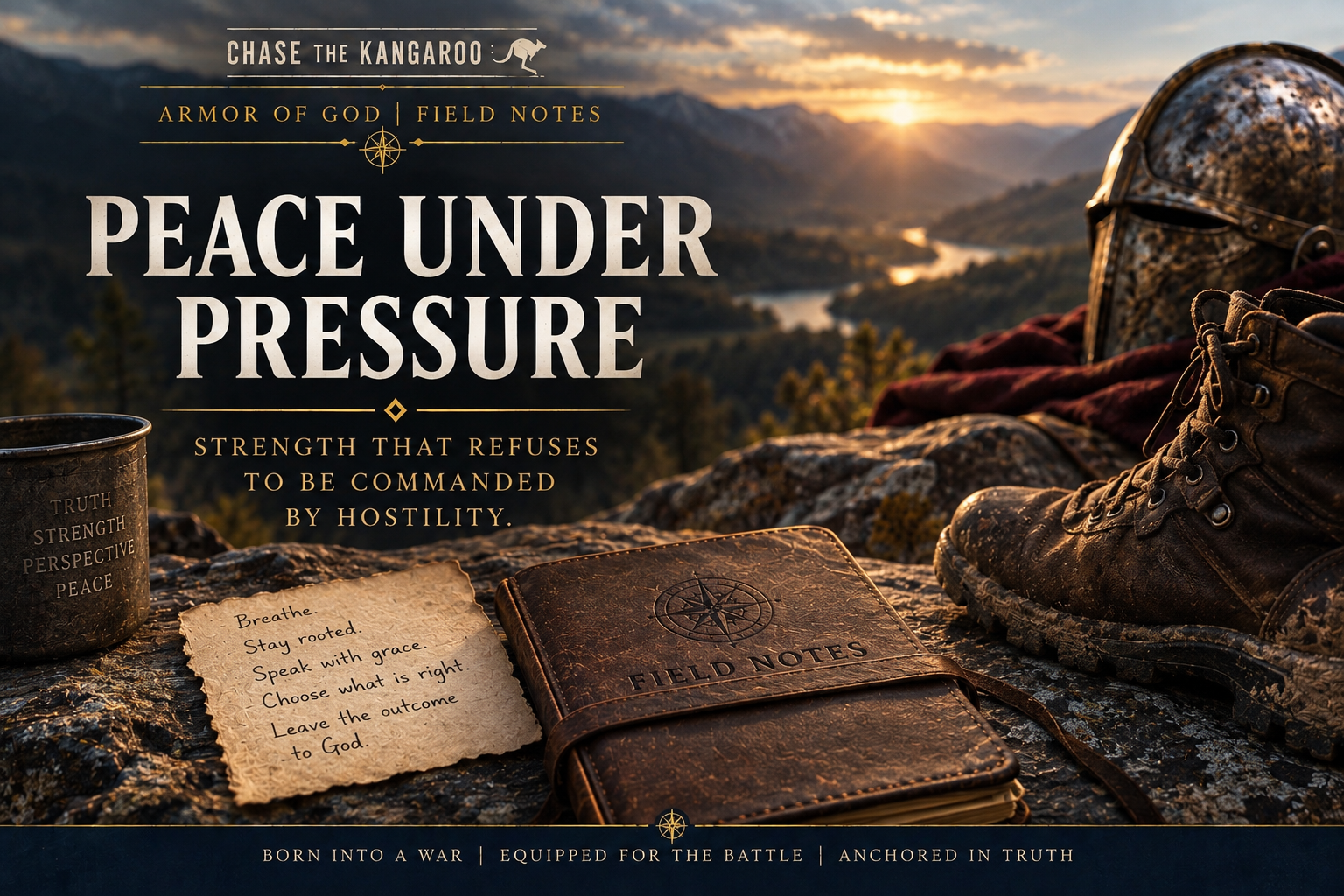
Strength That Refuses to Be Commanded by Hostility
“I will forgive your wrongs, I am able”
~ 16 Horsepower, “Black Soul Choir,” Sackcloth ‘n’ Ashes
“Whoever is slow to anger is better than the mighty, and he who rules his spirit than he who takes a city.”
~ Proverbs 16:32
You can usually feel the moment when a conversation changes.
Someone says something that lands wrong. Maybe it is your wife, your boss, a friend, one of your kids, or the guy sitting across the table. Sometimes it comes by email, which gives you the added benefit of being able to reread the offending sentence several times and get a little angrier each time.
Your jaw tightens. Your heart rate picks up. You start composing the answer before the other person has finished talking. Or maybe you go the other direction. You shut down, decide there is no point, and leave the room mentally before you leave it physically.
Either way, the ground has changed.
While writing about the Shoes of the Gospel of Peace, I kept coming back to the idea that peace is not the absence of difficult ground. It is what makes us ready to cross it. Christ has made peace between us and God, which gives us somewhere solid to stand when everything around us becomes unsettled.
But there is a particular kind of difficult ground most of us encounter regularly: another person.
What does peace look like then? And what does it require when backing down would be the wrong thing to do?
We May Have Strength Backward
I don’t think Christian peace requires a man to become passive. There are times when we need to confront someone, establish a boundary, protect another person, correct something that is wrong, or simply say no. Some truths need to be spoken even when we know speaking them will make the room uncomfortable.
Jesus certainly wasn’t conflict-avoidant. He confronted hypocrisy, rebuked his own disciples, refused manipulation, overturned tables, and stood before men who possessed the power to kill him without surrendering the truth to make the situation easier. Yet he also refused to let hostility determine who he became.
We sometimes treat strength and restraint as opposites. Scripture doesn’t. Proverbs makes a startling comparison:
“Whoever is slow to anger is better than the mighty, and he who rules his spirit than he who takes a city.”
Taking a city looks like strength. Proverbs says there is another kind.
The Stoics saw something similar. Marcus Aurelius, the Roman emperor and philosopher, repeatedly reminded himself that another person’s behavior did not have to take possession of his own judgment. Epictetus worked the same ground from another direction: I cannot control another person’s conduct, but I remain responsible for what I do with it.
There is wisdom there, and it raises an uncomfortable question. If someone knows exactly what to say to make me lose control, who is controlling whom?
A man is not stronger because another man’s anger can make him angry on command.
Christian peace doesn’t require us to give up strength. It keeps that strength from being commandeered by whatever hostility happens to be in front of us.
When the Alarm Goes Off
There is more going on in those moments than a moral decision. Our bodies are involved too.
Under pressure, the body’s threat systems can mobilize quickly. Heart rate changes, muscles tighten, attention narrows. We prepare to fight, get away, or sometimes simply shut down. Under enough stress, some of the flexible, reflective thinking we need most in a difficult conversation can become harder.
None of that means you have failed spiritually because your heart is pounding. Your body is telling you something. The trouble begins when I feel threatened quietly becomes therefore I know what I should do.
Your nervous system can sound the alarm. It does not get to issue the orders.
For me, that makes awareness part of strength. I need to recognize when I’m getting angry or shutting down, when I want to win more than I want to understand, or when I’m already constructing the sentence that will hurt the other person as much as his sentence hurt me.
That isn’t surrendering to emotion. It is knowing the terrain.
Seneca recommended delay as a remedy for anger. Don’t give the first surge immediate permission to become action. Two thousand years later, that remains useful advice.
But the goal isn’t to work myself into some perfectly calm state before I act. Sometimes obedience comes with a pounding heart. Sometimes courage feels exactly like fear while you are doing the thing you know needs to be done.
The point is to remain free enough that fear, anger, pride, or adrenaline isn’t making the decision for me.
Sometimes that means the strongest thing I can do in the first ten seconds of a conflict is nothing. Not because I’m afraid to act, but because I haven’t yet decided what faithfulness requires.
Peace Gives Us Room
This is also where Christianity eventually parts company with the Stoics.
The Stoic wants to regain command of himself. There is much we can learn from that discipline, but the Christian is trying to do something more. We are trying to return command to Christ.
Paul describes two very different kinds of lives in Galatians 5. One produces enmity, strife, fits of anger, rivalries, dissensions, and divisions. The other produces love, joy, peace, patience, kindness, goodness, faithfulness, gentleness, and self-control.
I’ve always found that last one interesting. Self-control is something the Spirit produces.
So Christian self-control isn’t just gritting our teeth while rage burns underneath. Nor is the goal to become so detached that nothing bothers us. It is learning to bring our strength, emotions, words, and reactions increasingly under the government of the Spirit.
That is where the Shoes of Peace become practical.
When a conversation becomes hostile, my standing with God isn’t suddenly up for negotiation. My worth doesn’t depend on winning the argument. I don’t need the other person to admit I’m right before I can be secure, and humiliating him will not restore something his insult supposedly took from me.
Christ has already made peace.
That gives me enough room to figure out what is actually happening. Am I defending something that needs defending, or has my pride been hit? Is there a truth that needs to be said? Am I trying to help, or am I trying to win? Somewhere in there is the question that matters most:
What does obedience require next?
The answer won’t always be gentle in the way we commonly use that word. I may need to speak plainly, apologize, say no, end the conversation for now, or stand my ground knowing the other person will remain angry.
Peace doesn’t make the decision for us. It gives us enough footing to make it without being driven entirely by the pressure of the moment.
Sometimes Peace Stands Its Ground
This matters because Christians can turn peacemaking into another name for avoidance.
Keeping everyone happy isn’t peace. Neither is refusing to establish a necessary boundary because confrontation makes us uncomfortable. Thomas Aquinas made the useful observation that peace involves concord, but concord itself is not necessarily good. People can agree together about something evil.
Sometimes peace requires disagreement.
Jesus told his followers, “Blessed are the peacemakers.” He also told them, “Blessed are those who are persecuted for righteousness’ sake.” Apparently, peacemaking does not guarantee that everyone will appreciate what we are doing.
Peter gives us an even sharper picture of Jesus under pressure:
“When he was reviled, he did not revile in return; when he suffered, he did not threaten, but continued entrusting himself to him who judges justly.”
That last part matters. Jesus didn’t refuse retaliation because the injustice didn’t matter. He entrusted judgment to his Father.
There is freedom in that. I can confront what is wrong without assuming that I must personally settle every score. I can establish a boundary without turning it into punishment. I can tell someone a hard truth without using that truth as a weapon.
The difference isn’t always visible from across the room. I may be firm in all three cases. The deeper question is what is driving me.
Peace gives us room to confront without contempt, protect someone without enjoying the destruction of the person we oppose, and refuse retaliation without pretending the wrong was acceptable.
This is where the larger Armor of God series keeps pressing on me. The armor doesn’t merely protect what we fight for. It begins to determine how we fight.
Don’t Bring the Battlefield Home
Near the end of Romans 12, Paul writes:
“Do not be overcome by evil, but overcome evil with good.”
I used to hear the second half of that verse as something close to “be nice anyway.” But overcome is a much stronger word than that. Paul is talking about resistance. He is simply refusing to let evil choose the weapons.
There is more than one way to lose a conflict.
We can win the argument and still be overcome by it.
If another person’s deception makes me deceptive, his contempt makes me contemptuous, or his anger gives mine permission to take over, then the battlefield outside has gotten inside. Something has been lost even if everyone else in the room thinks I won.
Thomas à Kempis understood that the harder test isn’t remaining peaceful around peaceful people. It is remaining settled among difficult, contrary people. That is where peace stops being an abstraction.
It brings me back to one of the questions that emerged while writing the Shoes essay:
Can another person’s disorder recruit me into disorder?
I don’t think that question is answered once. Most of us answer it hundreds of times in smaller situations: the sharp email, the meeting where somebody takes credit for your work, the argument with your wife when you’re both tired, the driver who cuts you off, the person who keeps pushing the same button because experience has taught him that it works.
Those moments are doing something to us. Every conflict is not merely something we get through. It is also something in which we practice becoming a particular kind of person.
We can practice the old response again. Or we can begin practicing something different. We can notice what is happening before reacting, return to what is true, tell the truth without contempt, stay when fear says run, leave when pride says stay and win, or apologize without adding the paragraph explaining why we were mostly justified.
That is part of readiness too. We prepare for difficult ground before we get there.
Field Exercise: Enter the Room Wearing Peace
There is probably a real conflict in your life right now. Use that one.
Before the conversation, spend a few minutes paying attention to what is already happening in you. What are you afraid will happen? What response are you rehearsing? When you picture the person or situation, do you want to attack, withdraw, shut down, or simply give in so the whole thing will go away?
Then try to separate courage from reaction. What needs to be said or done? Where are you tempted to retaliate? Where are you tempted to avoid what needs doing? What would strength governed by Christ’s peace look like here?
Before you enter the room, return to what is already settled. Christ has made peace between you and God. Your standing with him will not be decided by what happens next, and you do not have to win in order to be secure.
Then go have the conversation.
When you feel the alarm go off, notice it. If you need a moment before answering, take one. Return to what is true and ask:
What does faithfulness require next?
Then do that.
It may mean telling the truth or holding the boundary. It may mean listening or apologizing. It may mean confronting something that needs to stop, walking away from a conversation that has become destructive, or staying in a difficult conversation when every part of you wants out.
The other person may not respond well. Peace isn’t a technique for controlling the outcome.
It is part of the armor you wear into it.
Keep Your Footing
Proverbs began by making an unusual comparison: the man who rules his own spirit is better than the man who takes a city.
Most of us will never take a city. But we know what it is to sit across from someone who makes us angry, frightened, defensive, or desperate to win. That is ground we are asked to take all the time.
The Shoes of the Gospel of Peace don’t make that ground peaceful. They prepare us to cross it without letting it decide who we become.
Peace doesn’t weaken a man. It frees him to use his strength well. He can tell the truth, hold a boundary, protect what needs protecting, admit when he is wrong, withstand another person’s anger, and accept the cost that comes with obedience.
There will be times when standing firm means refusing to move. There will be others when it means having the courage to take the first step toward someone else.
We don’t have to roll over. We don’t have to strike back.
We need to keep our footing.
And when the room gets hot, our strength still needs to belong to Christ.
The Full Armor of God
- Armor of God Series Overview: Born Into A War
- The Belt of Truth
- The Breastplate of Righteousness
- The Shoes of the Gospel of Peace
- Peace Under Pressure | Field Note
- The Shield of Faith
- The Helmet of Salvation
- The Sword of the Spirit
- Prayer
- Stand Firm


Leave a Reply