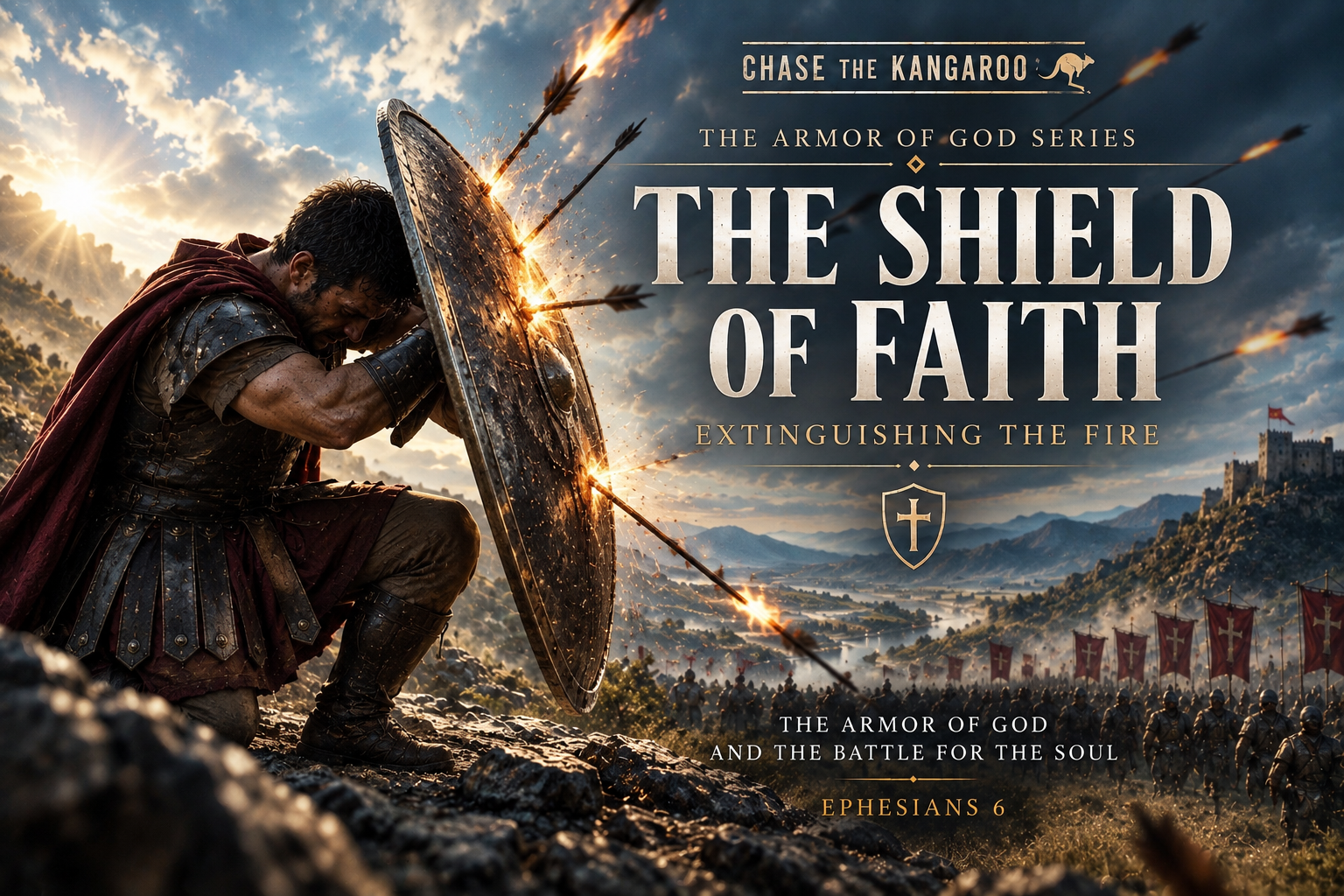
“Scarred, scourged, tattered
~ Lone Justice, “Belfry”, Shelter
Vessels frayed and frail
The shield of Faith is battered
But it will not lie down
To let defeat prevail.”
Trusting God When You Cannot See What Comes Next
A shield that has never been struck has never been battle tested. Either it is new, or it has yet to be taken up.
Paul’s shield is not decorative. It is meant to take the hit. By the time he reaches it in his description of the armor of God, the soldier is already dressed for what is coming. The belt is fastened. The breastplate is in place. His feet are fitted and ready. Then Paul writes, “In all circumstances take up the shield of faith, with which you can extinguish all the flaming darts of the evil one” (Ephesians 6:16).
The shield is already in hand before the arrows start flying.
Most of us would prefer to know where the arrow is coming from before deciding how to defend ourselves. Life rarely gives us that luxury. We do not know which phone call will change the week, which temptation will find us tired and vulnerable, which relationship will disappoint us, which prayer will remain unanswered, or which carefully made plan will come apart. You do not need decades of life behind you to know what it feels like when circumstances collide with what you thought you understood about God. Sometimes it is the first serious collision between expectation and reality. Sometimes it is one more blow against a shield that already bears the marks of use.
William Gurnall, the seventeenth-century English pastor who wrote extensively about the armor of God in The Christian in Complete Armour, observed, “It is not the having of a shield, but the holding and wielding of it, that defends the Christian.” His distinction is worth sitting with. We can believe the right things about God and still fail to rely upon them when life presses hard. I can believe God is good while responding to a particular disappointment as though it proves He isn’t. I can believe in His providence and still live as though everything depends upon my ability to control what happens next.
Gurnall went further and called faith “armour upon armour,” because the shield also protects what the soldier is already wearing. There is something important in that image. Truth may tell me what is real, but fear can make me question it. Righteousness may call me back to obedience, but failure can tempt me to hide instead of repent. Christ may be my peace, but chaos can still make control look safer than trust. Faith does not replace any of those things. It keeps me relying upon them when they come under fire.
The Shield of Faith, then, is not simply something we believe we possess. It is reliance upon God in the place where trust is actually being tested.
A Reality Larger Than What We See
Long before Paul put a shield in the hands of the Ephesian believer, God called Himself one.
In Genesis 15, Abram has already left home in response to God’s call. He has taken enormous risks and lived with enormous promises. Yet the promise at the center of his future, the son through whom God has said He will build a people, remains unfulfilled. Abram is getting older. So is Sarai. The distance between what God has promised and what Abram can see is getting harder to ignore.
God comes to him and says, “Do not be afraid, Abram. I am your shield.”
Before God explains how the promise will be fulfilled, He gives Abram something more fundamental: Himself.
That changes the way we understand faith. Its strength does not come from our ability to believe hard enough. God is the One being trusted. The Psalms return to the same language again and again, describing Him as shield, refuge, rock, and fortress. Biblical faith is never finally faith in faith. It is trust directed toward someone outside ourselves.
God is the Shield, but faith is my reliance upon Him. That trust has to become my own. I can learn from another man’s faith, be strengthened by it, and sometimes lean heavily on him when my own confidence is weak, but no one else can trust God for me. My wife cannot. My pastor cannot. The men sitting beside me on Wednesday morning cannot. Paul’s command is personal in that sense: I have to take up the Shield and entrust myself to the God who has given Himself to me.
Hebrews gives us another dimension: “Now faith is confidence in what we hope for and assurance about what we do not see” (Hebrews 11:1). That can sound like an invitation to believe something without evidence, as though faith requires us to leave reality behind. But the writer of Hebrews is describing a reality larger than the portion we can presently see. The chapter will go on to describe people who ordered their lives around what God had revealed even when circumstances had not yet caught up with the promise.
There is a connection here to truth. Truth tells us what is real. Faith puts its weight on that reality when what we can see, feel, or predict seems to be telling another story.
Paul makes the same point when he looks back at Abraham in Romans 4. Abraham knew the facts of his situation. He did not need to pretend that age was irrelevant or that the promise was easy to explain. His faith included those facts inside a larger reality: God had spoken, and God was able to do what He had promised.
That is considerably different from optimism. Optimism says things will probably work out. Faith may have no grounds for making that prediction. A diagnosis can be serious. The money can actually be gone. A relationship can really be broken. We can make a terrible decision and live with consequences that prayer does not simply erase. Faith does not require us to rename any of those things. It asks a harder question: Can God still be trusted here?
Watchman Nee, the Chinese Christian teacher whose writing repeatedly returned to the believer’s reliance upon the accomplished work of God, described a relationship between fact, faith, and experience. Faith does not give our present experience the authority to overrule what God has revealed.
There is a mountain in front of us. Faith does not tell us there isn’t. It remembers there is also God.
When God Doesn’t Make Sense
Habakkuk knew what it was like to live inside that tension.
He looked around Judah and saw violence, injustice, destruction, and conflict. He had been crying out to God about it, apparently for some time, and nothing seemed to change. His opening question is painfully familiar: “How long, Lord, must I call for help, but you do not listen?”
Then God answers him, and the answer creates a bigger problem. God tells Habakkuk that the Babylonians are coming. This violent and ruthless nation will become an instrument of judgment against Judah. Habakkuk had been trying to understand why a holy God seemed to tolerate the evil around him. Now he has to understand why that same God would use a nation even more wicked than Judah to accomplish His purposes.
Habakkuk’s problem is not that he has stopped believing in God. In some ways, the problem exists precisely because he believes. He knows enough about God’s character to be troubled by what he sees. The pieces do not seem to fit.
Many of us eventually arrive at some version of that place. We know the Christian answers. We may have repeated them to other people. Then something happens that those answers do not seem to touch as easily as they once did. A prayer goes unanswered for years. Someone we love suffers despite all the prayers we offered. A door we were certain God was opening closes. We try to do the right thing and watch someone else prosper by doing the opposite.
Habakkuk does not solve that tension by pretending it does not bother him. He questions God. He waits. He listens. Most importantly, he keeps the conversation with God rather than allowing his confusion about God to drive him away from God.
By the end of the book, his circumstances have not become more promising. He can imagine fig trees without blossoms, vines without grapes, failed crops and empty stalls. His response is not that these things no longer matter. He says that even then he will rejoice in the Lord (Habakkuk 3:17–18).
George MacDonald, the nineteenth-century Scottish writer and minister who later had a profound influence on C.S. Lewis, pressed toward something similar in The Higher Faith. MacDonald resisted reducing faith to confidence in our own understanding of God’s promises. Ultimately, the believer must trust God Himself. Oswald Chambers comes at the same problem from another angle in “Gracious Uncertainty,” arguing that certainty about God does not require certainty about what He will do next.
There is freedom in that distinction. We are allowed to say, “I do not understand what God is doing.” We are allowed to admit that we are disappointed, frightened, or angry. None of that requires us to decide that God has ceased to be trustworthy. Presumption trusts my forecast of God. Faith trusts God.
When the Outcome Isn’t Ours to Choose
Shadrach, Meshach, and Abednego stand in front of a furnace knowing exactly what obedience may cost them. Nebuchadnezzar gives them another opportunity to bow before his image. Their answer in Daniel 3 contains one of Scripture’s clearest pictures of faith stripped of its demand for a particular outcome. God is able to deliver them. They believe that without qualification. But if He does not, they still will not bow.
They know what God can do. They do not presume to tell Him what He must do.
Hebrews 11 eventually takes us to the same place. The chapter begins with confidence in realities we do not yet see, then tells the stories of people who lived that way. Some conquered kingdoms, escaped the sword, saw weakness turned to strength, and watched the dead returned to life. If the chapter ended there, it would be easy to conclude that sufficient faith produces extraordinary outcomes. It does not end there.
Others are tortured. Others endure imprisonment and persecution. Some lose everything. Some are killed. Hebrews places all of them in the same story of faith. The difference in their circumstances is not presented as evidence that one group trusted God more successfully than the other.
That changes what we mean when we say faith works. Faith cannot be measured simply by whether the thing we wanted happened. Sometimes the faithful walk out of the fire. Sometimes faithfulness means refusing to bow even when we do not know whether we will.
Gurnall understood the armor in much the same way. The Christian is not necessarily protected from suffering. God preserves His people in it. The armor was never a promise that the Christian would avoid wounds, opposition, grief, or loss.
Lone Justice’s battered shield begins to look different from this angle. Its scars are not evidence that it failed. They are evidence that it has been where shields are needed.
When the Arrow Catches Fire
Paul could have described ordinary arrows. Instead, he gives us flaming ones.
Gurnall treated these attacks broadly, dividing them into what he called enticing and affrighting temptations. Some frighten us, discourage us, or push us toward despair. Others come from the opposite direction. They offer us something we want. Either way, the danger is not limited to the initial strike. Fire spreads.
Something happens, and almost immediately we begin deciding what it means. The prayer remains unanswered, and disappointment starts suggesting that God is not listening. We fail again, and failure begins telling us that change is impossible. The future becomes uncertain, and fear insists that we have to take control.
But sometimes the dart feels less like an attack than an opportunity. We are tired, lonely, angry, resentful, or simply worn down from doing what we know is right. Something we would normally recognize as temptation begins to look reasonable. A compromise seems harmless. Revenge starts looking like justice. Lust makes obedience seem unnecessarily restrictive. Resentment tells us that forgiveness asks too much. We begin wondering whether obedience to God is really worth what it is costing us.
The event, desire, disappointment, or fear may be completely real. The interpretation growing around it may not be.
Scripture gives us a complicated picture of where these false interpretations come from. We contend with our own disordered desires, with a world that forms us in ways opposed to God, and with a genuine spiritual adversary. Peter warns that the devil prowls like a lion looking for someone to devour, then tells suffering Christians to resist him, “firm in your faith” (1 Peter 5:8–9). Peter does not tell them that suffering proves the adversary has won. Nor does he tell them that faith will remove every hardship. He tells them how to stand within it.
The enemy doesn’t merely want the arrow to hit. He wants it to catch.
C.S. Lewis understood how quickly our internal weather can change the way reality looks. In Mere Christianity, he describes one dimension of faith as “the art of holding on to things your reason has once accepted, in spite of your changing moods.” He is not dismissing emotion, and he certainly is not dismissing reason. He is acknowledging something most of us know from experience: fear, exhaustion, loneliness, desire, anger, or disappointment can change how convincing the truth feels.
Anyone who has lain awake at three in the morning knows the experience. The problem that seemed manageable at dinner can feel permanent in the dark. Nothing about God has changed, and perhaps nothing about the problem has changed either, but fear has altered the proportions. What we know to be true suddenly feels less substantial than what we are afraid might happen.
Faith places what we know of God between the attack and the conclusions the attack wants us to draw. The Shield does not mean nothing ever hits you. It means what hits you does not have to set you on fire.
There will also be times when we are slow to raise it. An arrow gets through. Fear catches. For a while, perhaps longer than we want to admit, we believe the story it tells us. Scripture has room for that too.
A desperate father in Mark 9 brings his suffering son to Jesus after years of watching him endure something the father cannot fix. When Jesus speaks to him about belief, the father does not manufacture certainty. He answers, “I believe; help my unbelief!”
It may be one of the most honest prayers in Scripture. He brings Jesus the faith he has and the doubt he cannot get rid of.
Thomas Aquinas wrote about faith as grounded in divine truth rather than the believer’s fluctuating sense of certainty. Otherwise we can end up watching ourselves instead of trusting God, measuring whether we feel faithful enough and worrying about every doubt as evidence that something has gone wrong. A trembling hand can still hold a shield.
Some of what Paul describes has parallels outside Christianity. The Stoics understood the importance of refusing to let circumstances dictate character. They emphasized distinguishing what we can control from what we cannot, governing our judgments, and choosing right action despite hardship. Modern research on psychological hardiness has found similar value in commitment, appropriate control, and learning to encounter difficulty as challenge rather than only threat.
There is wisdom there. But Christian faith eventually takes us somewhere resilience alone cannot. Resilience asks whether I can withstand the pressure. Stoic practice asks what remains within my control and what right action requires. Faith asks whom I am trusting inside the pressure.
Paul begins his instructions about the armor with “be strong in the Lord and in his mighty power” (Ephesians 6:10). The center of gravity is outside us. The goal is not to become so internally strong that nothing can shake us. It is to become increasingly reliant upon God, including when we have reached the edge of our own ability to manage what is happening.
That leaves the hardest question behind all of this. If God is trustworthy, what are we supposed to do with suffering? Why did He allow this? Why didn’t He stop it? Why does He sometimes seem absent precisely where we need Him most?
Christianity does not answer by telling us suffering is unreal or unimportant. It takes us to the Cross.
Whatever else we mean when we say God can be trusted, we are talking about the God revealed in Jesus Christ. God did not remain safely outside human suffering. In Christ, He entered it. Good Friday looked, from nearly every visible angle, like defeat. The Messiah was dead, His followers scattered, and the powers that opposed Him appeared to have won.
The Resurrection did not make Friday less terrible. It revealed that Friday did not have the authority to tell the whole story.
Paul can therefore write in Romans 8 about trouble, hardship, persecution, famine, nakedness, danger, and sword without pretending any of them are small. His confidence is not that Christians will avoid them. It is that none of them can separate us from the love of God in Christ Jesus (Romans 8:35–39).
Perhaps this is the deepest protection the Shield offers. Faith does not always protect the circumstance. Sometimes the loss remains a loss. The wound leaves a scar. The prayer is answered differently than we hoped, or we continue waiting without an answer we can understand. The Shield protects something deeper: our reliance upon God within the circumstance. Suffering does not get to become separation. The present moment does not get the final word on who God is.
This is why the battered shield is such a fitting image. Its scars do not necessarily tell us that faith failed. Some may mark the very places where faith held.
That promise is far stronger than “everything will turn out the way I want.” Faith does not know everything God will do next. It knows the character of the God who will be there when next arrives.
And that knowledge has to keep coming from somewhere. Paul writes that “faith comes from hearing, and hearing through the word of Christ” (Romans 10:17). In its context, Paul is speaking about hearing the proclaimed gospel, not offering a technique for manufacturing more faith. Still, the connection is important. Christian faith has content. God has acted, God has spoken, and the good news about Christ tells us what He has done.
The Shield and the Word belong together. We cannot keep trusting a God of our own invention. Faith has to be formed and corrected by the God who has revealed Himself. Paul has one more piece of armor to place in the soldier’s hand: “the sword of the Spirit, which is the word of God” (Ephesians 6:17). We will need it.
Keep the Shield Raised
Faith is personal, but it was never meant to become private. John Bunyan understood that in The Pilgrim’s Progress. Christian has to walk his own road, but for part of that road he walks beside Faithful. Faithful cannot make Christian’s pilgrimage for him, yet his companionship, testimony, and courage matter to Christian’s journey. The same is true for us. No one can carry my Shield for me, but I was never meant to carry it alone. There are times when another believer reminds me what is true because fear has made it difficult for me to see clearly, prays when I have run out of words, or simply stands beside me long enough for me to raise the Shield again.
For the next week, choose one place where your trust is actually under pressure. Not a hypothetical problem or someone else’s struggle. Choose the situation that keeps returning to your mind, the temptation that keeps finding the same opening, the uncertainty you keep trying to control, or the disappointment that has begun to affect the way you think about God.
Field Exercise: Keep the Shield Raised
Keep a simple Faith Journal around that one thing. Start with what actually happened. Resist the urge either to minimize it or make it worse than it is. Then pay attention to the story growing around it. What is this situation tempting you to believe about God? Put that beside what you know to be true about Him and ask what trusting Him requires of you now.
That may require action. It may mean waiting. It could mean repentance, a difficult conversation, asking someone for help, resisting a temptation, or continuing to pray when you are tired of praying. Sometimes it may mean refusing to make tomorrow’s decision out of tonight’s fear.
Do not keep the exercise entirely to yourself. Share that place of pressure with one trustworthy Christian. Tell him where trust is being tested and what story the situation is tempting you to believe. Ask him to pray with you, remind you of what is true, and help you notice when fear or temptation is beginning to write the story. He cannot carry your Shield, but he can stand beside you while you raise it.
Then ask one more question: What has God actually said?
That question keeps faith tied to reality instead of wishful thinking. It also keeps us from confusing God’s promises with our predictions about what He ought to do. We return to Scripture and hear again the story of the God we are trusting.
The Shield was never meant to hang on the wall. It belongs between us and the incoming fire, which means learning to raise it before we know where the next arrow will come from. When something does hit, we can pay attention to the story it is trying to ignite. When our hands tremble, we keep holding on. And when the Shield bears marks from battles we would rather not have fought, we do not mistake those scars for failure.
A battered shield can still be raised. We may not know what happens next. Faith never promised us that knowledge. But we can know whom we have trusted.
Battle Prayer
God, You are my shield. I do not know everything You are doing, and I cannot see what comes next. Keep me from mistaking my fear for the truth or my preferred outcome for Your promise. When the arrows come, teach me to trust Your character. When what I see seems to contradict what I know of You, keep me near You rather than allowing my confusion to drive me away. When my hand trembles, help me raise the Shield again. Bring me back to Your Word, to Jesus, to the Cross, and to the empty tomb. You have been faithful. Teach me to trust You here. Amen.
The Full Armor of God
- Series Overview: Born Into A War
- The Belt of Truth
- The Breastplate of Righteousness
- The Shoes of the Gospel of Peace
- The Shield of Faith
- The Helmet of Salvation
- The Sword of the Spirit
- Prayer
- Stand Firm


Leave a Reply