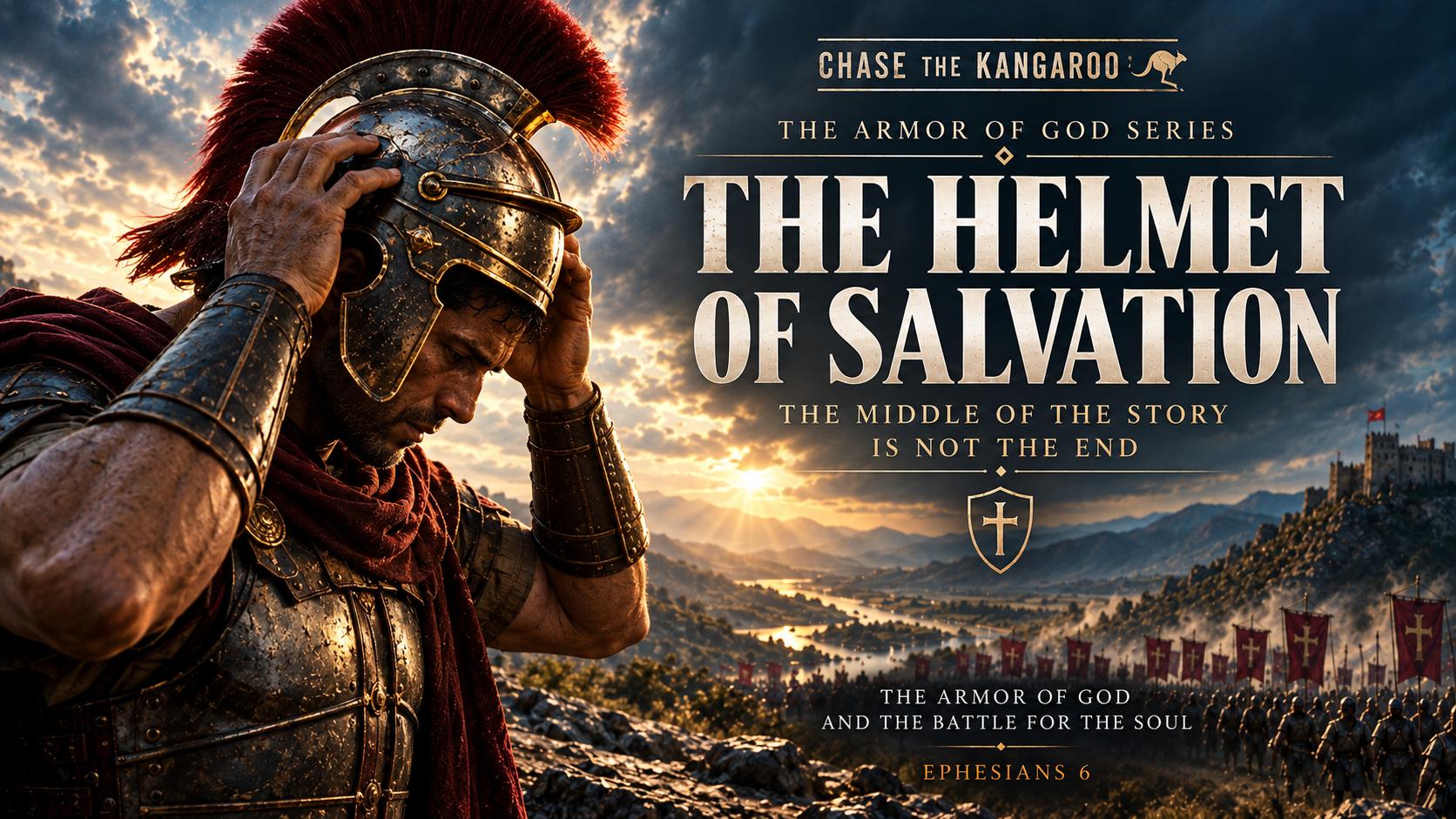
“The time has come to realize forgiveness
~ The Choir, “The Time Has Come,” Bloodshot
The time is now to forgive somebody else
We can’t undo the damage done
The day is new, here comes the sun
The time has come to forgive / Your sorry self”
Why Does a Saved Man Need Salvation?
Why would Paul tell a saved man to put on salvation?
By the time he reaches the armor of God in Ephesians 6, Paul has already told his readers that they have been chosen in Christ, adopted, redeemed, forgiven, and sealed with the Holy Spirit. They were dead in their sins, but God made them alive with Christ. Their salvation was not something they were still trying to earn. It was a gift they had already received.
Yet Paul tells these same Christians to “take the helmet of salvation” (Ephesians 6:17).
The command comes in the middle of a warning about spiritual warfare. Paul is describing the schemes of the devil, the forces of evil, and the need to stand firm against an enemy who has no intention of leaving God’s people alone. The helmet belongs to that conflict.
The question, then, is not simply why salvation matters. It is why a man who already belongs to Christ must still take it up as protection.
That warfare does not always look the way we expect. There are moments when evil is unmistakable, but much of the battle takes place in the ordinary terrain of a man’s life. The devil deceives and accuses. The world offers its own account of what matters, what makes a life successful, and what a man must become to have worth. The flesh still pulls toward old desires, old habits, and familiar ways of protecting ourselves. These enemies reinforce one another, often so naturally that we hardly notice what is happening.
A man sins again after promising God he was finished with it. His marriage is harder than he expected. The career that once gave him purpose begins to stall. His children make choices he cannot control. His body starts giving him reminders that he is not thirty anymore. Someone he loves gets sick. A prayer goes unanswered longer than he thought possible. He looks back over years of decisions and wonders what might have been different.
None of those things is imaginary. Christianity does not require us to pretend they are.
The danger comes when something true about the present begins claiming authority over the whole story. I failed becomes I am a failure. I am suffering becomes God has abandoned me. I have fought this habit for years becomes I will never change. Eventually even death makes its claim: This is where every story ends.
That is the kind of blow a helmet is made to take.
Paul gives us an important clue in another letter. Writing to the Thessalonians, he uses the same image but makes the helmet more specific: “for a helmet the hope of salvation” (1 Thessalonians 5:8). The context is again vigilance and spiritual readiness, but Paul is looking forward. God has not destined His people for wrath, he says, but to obtain salvation through Jesus Christ.
The enemy cannot undo the resurrection of Jesus or rewrite what Christ accomplished on the cross. But he can attack our confidence in those realities, using failure, suffering, temptation, and fear until what stands immediately before us seems more authoritative than what God has said.
Paul’s choice of a helmet begins to make sense when we consider how easily that happens. We can believe in salvation and still allow our circumstances to persuade us that God has abandoned us, that change is impossible, or that the future holds nothing worth hoping for.
A saved man still needs to take up the helmet because he is living in a battle where his confidence in God’s saving work will be tested.
The Helmet Belongs to God
Long before Paul told a Christian to put on the helmet of salvation, Isaiah saw a vision of God putting it on Himself.
The scene in Isaiah 59 is not peaceful. Truth has stumbled in the streets. Justice is nowhere to be found. Those who turn away from evil make themselves targets, and the Lord sees that there is no one to intervene. So God enters the fight Himself. Isaiah describes Him putting on righteousness as a breastplate and “a helmet of salvation on his head” (Isaiah 59:17).
We have already encountered this passage in the Breastplate of Righteousness. Paul did not invent the armor in Ephesians 6 simply by looking at a Roman soldier and turning his equipment into a convenient illustration. At least two of the pieces come from a much older vision: Isaiah saw God Himself dressing for battle.
God does not put on salvation because He needs to be saved. He wears salvation because He is coming to save. Isaiah’s helmet belongs to a warrior God entering a situation human beings cannot repair for themselves. The surrounding chapter is filled with injustice, violence, lies, darkness, and people groping their way forward as though they have no eyes. The answer is not that they need to become more resilient. God acts.
It is easy to turn the Helmet of Salvation into a Christian version of mental toughness. Guard your thoughts. Stay positive. Remember who you are. Don’t let discouragement get to you. There may be useful advice buried in those ideas, but none of them is salvation.
Before salvation becomes something we put on, it is something God does.
That pattern runs through Scripture. Israel stands at the edge of the Red Sea with Pharaoh’s army behind them and nowhere to go, and Moses tells them to stand firm and see the salvation of the Lord. David repeatedly describes God as his salvation when enemies surround him. Isaiah looks at a world where justice has collapsed and sees God putting on armor.
Centuries later, Paul describes people who are dead in their sins, following the course of this world and living under the influence of “the prince of the power of the air.” They carry out the desires of the flesh and are unable to rescue themselves from the condition in which they live. Then Paul interrupts the description with two words: “But God.”
God makes the dead alive with Christ (Ephesians 2:1–5).
Christianity does not begin with a man discovering enough strength to fight his way free of the devil, the world, and his own flesh. Before Paul ever tells the Christian to stand against the devil, he reminds him that he was once caught in the same rebellion. He did not rescue himself from enemy territory.
Watchman Nee saw something important in the order of Ephesians. Before Christians are told to stand in chapter six, Paul says that God has raised them with Christ and seated them with Him in the heavenly places in chapter two. Nee built much of his understanding of the Christian life around that sequence, developed in Sit, Walk, Stand. The believer does not fight his way toward a position in Christ. He learns to live and stand from a position Christ has already secured for him.
That does not make the battle imaginary or the wounds painless. It tells us where our confidence comes from when the battle reaches us.
The Helmet of Salvation is not confidence in my ability to hold everything together. It is confidence in the God who entered the battle to save, who raised Christ from the dead, who made us alive with Him, and who has promised to finish what He began.
Isaiah saw Him wearing the helmet first. Only then does Paul tell us to put it on.
Already, Now, and Not Yet
For many Christians, salvation has a date attached to it. We remember when we first believed, when we were baptized, when we finally understood grace, or when faith stopped being something inherited from our parents and became our own. We say that we were saved, and there is good biblical reason to speak that way. Paul tells the Ephesians, “by grace you have been saved through faith” (Ephesians 2:8). Something decisive has happened.
But that is not the only way the New Testament talks about salvation.
Paul can write about those who “are being saved” (1 Corinthians 1:18), and he can tell the Romans that “salvation is nearer to us now than when we first believed” (Romans 13:11). Peter speaks of believers awaiting a salvation “ready to be revealed in the last time” (1 Peter 1:5). Salvation has a past, a present, and a future because God’s rescue is larger than the moment we first believed.
Ephesians itself contains that tension. In the opening chapter, Paul describes believers as chosen, adopted, redeemed, and forgiven. They have received an inheritance and have been sealed with the Holy Spirit. None of that is presented as wishful thinking about what God might someday do.
Yet even the Spirit’s presence points forward. Paul calls Him the guarantee of our inheritance until we acquire possession of it. We possess something real while still waiting for its completion.
Biblical hope is not crossing our fingers and wondering whether things might work out. Its confidence rests in the character and promise of God. The Christian looks forward because something decisive has already happened behind him: Jesus Christ died and rose from the dead.
William Gurnall, the seventeenth-century Puritan pastor whose The Christian in Complete Armour examines Paul’s teaching on spiritual warfare at extraordinary length, understood hope as essential protection for the Christian. A soldier needs it because the battle can be long. God’s promises do not always arrive on the timetable we would choose. Suffering continues. Prayers seem unanswered. Sin takes longer to uproot than we expected. Hope sustains the believer while he waits for what God has promised but has not yet brought to completion.
Paul describes that waiting vividly in Romans 8. Creation groans. We groan. Even those who have the firstfruits of the Spirit still await “adoption as sons, the redemption of our bodies.” Then Paul says something that initially sounds strange: “For in this hope we were saved” (Romans 8:24).
We have been adopted, yet we await adoption in its fullness. We have been saved, yet we hope for salvation. We have eternal life, yet we still die.
God’s purpose is not merely to forgive our past and then help us manage ourselves until we die. Salvation reaches backward to our guilt, inward to the people we are becoming, outward into our lives and relationships, and forward to the resurrection of our bodies and the restoration of all things. The gospel announces not merely that God has saved us from something, but that He is bringing us somewhere.
One of the enemy’s most effective weapons is not necessarily getting a Christian to deny what God did twenty years ago. It may be persuading him that what God did then has very little to say about what is happening now.
The marriage is still difficult. The temptation came back. The diagnosis did not change. The son still will not call. The job disappeared. The prayer remains unanswered. The grave is still there.
The devil can point to what remains unfinished and suggest that God has stopped working. The world can tell us to stop waiting on promises we cannot see and build our security out of what we can acquire, control, or achieve. The flesh is more than willing to settle for whatever relief is immediately available.
Hope refuses those invitations, not because the Christian knows how the next chapter will unfold, but because he knows the One who has promised to bring the story to its proper end.
Our hope rests in what Christ has already accomplished and what God has promised to complete. Neither depends upon our ability to control the circumstances between them.
Christ has died. Christ has risen. We belong to Him now. Christ will come again, the dead will rise, and God will finish His rescue.
We live between those realities, and that space between the already and the not yet is where we are told to stand.
The Battle for the Head
A soldier wearing a helmet does not expect to avoid every blow. He wears it because he knows some of those blows will be aimed at his head, and he intends to survive them. The helmet does not remove him from the battlefield. It protects him while he stands his ground.
Paul’s choice of imagery is worth considering alongside what he has already written about the Christian mind. Earlier in Ephesians, he warns against the futile thinking of those who have not come to know Christ. He describes an understanding darkened by ignorance and hearts hardened against God. Then, speaking to believers, he tells them to be “renewed in the spirit of your minds” (Ephesians 4:23). In Romans 12, he urges Christians not to be conformed to this world but to be transformed by the renewal of their minds.
Paul does not explicitly say that the helmet represents the mind, and we should be careful not to make that assumption. The helmet represents salvation. But the same apostle who tells Christians to put on salvation also recognizes that the way we think can either reflect or contradict the life God has given us.
John Mark Comer explores this conflict in Live No Lies, drawing on the ancient Christian understanding of three enemies: the devil, the world, and the flesh. The devil deceives, the world shapes our assumptions about reality, and the flesh carries desires that are not always interested in what God says is good. These are not three entirely separate battles. They reinforce one another.
Consider a man who has spent years measuring his worth by his work. The world has taught him that achievement earns respect and that a man’s value is closely tied to his usefulness. His flesh enjoys the recognition, influence, and security that success provides. When he loses his position or finds himself passed over for a promotion, the disappointment is real. But another thought begins to take shape beneath it: Without this, I’m nobody. The enemy does not need to invent the man’s disappointment. He only needs to exploit the meaning the man has begun attaching to it.
C.S. Lewis understood how subtle such attacks could be. In The Screwtape Letters, he imagines an experienced demon instructing a younger one in the art of tempting an ordinary Englishman. Much of their work involves manipulating attention, exploiting irritation, encouraging self-importance, and gradually distorting the man’s understanding of himself and others. Lewis’s demons rarely need to introduce something spectacularly evil. They are content to work with ordinary circumstances and the interpretations their subject brings to them.
That is one reason spiritual warfare can be difficult to recognize. We may expect a confrontation with evil to feel dramatic, when much of the struggle involves thoughts we have entertained so frequently that they no longer seem questionable.
Joyce Meyer has spent much of her ministry addressing this problem. In Battlefield of the Mind, she examines how worry, suspicion, fear, insecurity, and habitual negative thinking can influence the way Christians live. Her emphasis on recognizing destructive patterns is useful because thoughts seldom remain isolated from the rest of our lives. What we repeatedly believe influences what we anticipate, how we respond to other people, and what we eventually do.
Yet the Christian life is not an exercise in eliminating every unpleasant thought or replacing every negative emotion with a positive one. Some fears concern genuine dangers. Some grief reflects genuine loss. Some guilt points toward something we need to confess and make right. And sometimes an unwanted thought appears without our having invited or endorsed it.
The question is what authority we allow that thought to acquire.
Paul addresses the struggle over truth and allegiance in 2 Corinthians 10:3–5. Although we walk in the flesh, he writes, we do not wage war according to the flesh. Our weapons have divine power to destroy strongholds, including arguments and lofty opinions raised against the knowledge of God. He concludes by describing the taking of “every thought captive to obey Christ.”
Paul is addressing opposition to the knowledge of God, not providing a clinical description of every thought that passes through an individual’s mind. Still, his language gives us an important principle for the interior battle: thoughts, arguments, and assumptions are not exempt from examination. They must answer to Christ.
Christians were studying the interior struggle long before modern psychology developed its vocabulary. In the fourth century, Evagrius Ponticus, a monk living in the Egyptian desert, paid close attention to the thoughts that disturbed his prayer and threatened his faithfulness. He identified eight recurring categories of tempting thoughts: gluttony, lust, love of money, sadness, anger, acedia or spiritual listlessness, vainglory, and pride.
Evagrius understood that temptation often begins before a person has made a conscious decision to act. A suggestion enters the mind, perhaps through a memory, a desire, an imagined conversation, or an interpretation of something that has happened. The thought may be dismissed, entertained, resisted, or gradually welcomed. What begins as a passing suggestion can become a familiar way of understanding the world.
His response was to learn to recognize these patterns. In the Antirrhetikos, later translated into English as Talking Back: A Monastic Handbook for Combating Demons, he organized hundreds of biblical responses to particular temptations. The work was intended to help monks recognize the thoughts troubling them and answer those thoughts with Scripture.
We will return to that handbook when we take up the Sword of the Spirit. For the moment, I am interested in what Evagrius had to do before he could answer a thought. He had to notice it, understand what it was suggesting, and recognize where it might lead.
That sounds simple until we consider how quickly we accept our own interpretations. We become angry and immediately begin justifying the anger. We feel rejected and assume we know what another person intended. We experience temptation and either surrender to it or become ashamed that it appeared at all. Fear arrives, and before long we are treating a possibility as though it were a certainty.
The seventeenth-century Benedictine writer Augustine Baker approached this struggle through the experience of prayer. In Holy Wisdom, he describes the disturbing thoughts that can enter the mind even when a person sincerely desires to attend to God. Baker distinguishes the appearance of such thoughts from deliberately consenting to them. He also warns that struggling too forcefully against unwanted thoughts can sometimes make them more persistent.
His distinction matters beyond the immediate setting of prayer. An unwanted thought is not necessarily a chosen belief or deliberate act. Some thoughts require repentance because we have welcomed and cultivated them. Others deserve no more attention than is necessary to recognize them and let them pass. Learning the difference is part of Christian discernment, and it prevents the examination of our thoughts from becoming another source of self-condemnation.
We may not always know whether a particular temptation has been intensified by the devil, encouraged by the world, or drawn from our own flesh. Often several influences are involved. We do not need to identify the precise source before asking whether the thought deserves our agreement.
A temptation may reveal something we need to resist. A recurring fear may reveal something we need to entrust to God. A guilty conscience may call us to confession and repentance. But none of those experiences possesses the authority to overturn what Christ has accomplished.
We do not have to believe everything we think, and we do not have to be frightened by everything that enters our minds. We can learn to recognize deception, acknowledge our own desires, and examine the assumptions the world has taught us, while remaining anchored in something more reliable than our immediate experience.
But examining a thought eventually brings us to a deeper question. When the devil accuses, the world measures, and the flesh insists upon its own version of reality, whose judgment has the authority to tell us who we are?
Whose Am I?
When Dietrich Bonhoeffer wrote Who Am I? during his imprisonment in 1944, he was trying to reconcile the man others believed him to be with the frightened and exhausted man he knew within himself. His guards saw composure and confidence. He experienced longing, weakness, uncertainty, and fear. Both descriptions seemed true, yet neither could fully answer the question.
Bonhoeffer had lost much of what ordinarily helps a man understand himself. His freedom was gone. His work had been interrupted. His future was uncertain, and his circumstances were controlled by men who could take his life. Even his reputation for courage could not settle the questions he was asking.
Near the end of the poem, Bonhoeffer surrendered the matter to God. In one English rendering, the closing line reads:
“Whoever I am, thou knowest me; O God, I am thine!”
He did not need to settle every contradiction within himself before he could know to whom he belonged.
We spend much of our lives assembling an identity from the things we do, the relationships we maintain, the responsibilities we carry, and the judgments other people make about us. We are husbands, fathers, sons, friends, employees, business owners, leaders, and providers. These identities are not necessarily false or unimportant. They describe genuine responsibilities and relationships, many of which God has entrusted to us.
But they are not strong enough to bear the full weight of telling us who we are.
A man who has spent thirty years building a career may discover how much of himself he has invested in his position when retirement arrives. A father may struggle when his children no longer need him in the same way. A husband may find that conflict in his marriage threatens not only the relationship but his understanding of himself as a good man. Someone who has always been physically capable may feel strangely diminished when age or illness begins taking away familiar abilities.
The losses are real, and they deserve to be taken seriously. But when an important part of life changes, we can begin questioning our entire worth. We have allowed something valuable to become something ultimate.
The world encourages this confusion. It constantly supplies new ways to measure ourselves through success, appearance, influence, wealth, recognition, and personal fulfillment. Even when those measures contradict one another, they share a common assumption: a man’s identity is something he must establish, maintain, and defend.
Our flesh often cooperates. We enjoy being admired. We want to be competent, respected, desired, and needed. We may even begin using our Christian lives to construct another identity, taking pride in our discipline, biblical knowledge, service, or apparent spiritual maturity. Then comes failure, criticism, disappointment, or loss, and the whole structure begins to shake.
Paul established a different foundation in the opening chapter of Ephesians. Before he tells Christians how to live, how to treat one another, or how to resist the devil, he tells them what God has done for them in Christ.
God chose us in Christ before the foundation of the world. He predestined us for adoption through Jesus Christ. In Christ we have redemption through His blood and the forgiveness of our trespasses. We have obtained an inheritance and have been sealed with the promised Holy Spirit.
Paul is not describing qualities the Ephesians have achieved or identities they have constructed for themselves. He is describing God’s actions toward people who have received His grace. Throughout the passage, he repeatedly returns to the same location: in Christ.
Salvation has brought us into a relationship we could never have established on our own. Our belonging is not a reward for becoming sufficiently good, successful, useful, or spiritually accomplished. It is a gift received through Christ.
Paul develops that relationship further in Romans 8. Those led by the Spirit of God are children of God. They have received the Spirit of adoption, by whom they cry, “Abba! Father!” And if they are children, Paul says, they are heirs, heirs of God and fellow heirs with Christ.
There is a security in that language that achievement can never provide. A child does not earn his place in the family by being the most impressive person in the room. His belonging comes from the relationship itself. That does not mean his conduct is irrelevant, or that a loving father never corrects him. It means correction takes place within a relationship that is already established.
C.S. Lewis explored a related idea near the conclusion of Mere Christianity. In Book IV, Chapter 11, Lewis argues that the attempt to secure our identity by concentrating upon ourselves ultimately defeats its purpose. We discover the people we were meant to become through surrender to Christ, rather than through continually trying to establish our own significance.
Lewis was not advocating the disappearance of personality. He believed that belonging to Christ makes genuine individuality possible. We cease trying to manufacture an identity that must continually be defended and begin receiving our lives from the One who made us.
Watchman Nee approached the matter through the relationship between God’s accomplished work and our experience of it. In The Normal Christian Life, he argues that the believer must learn to stand upon what God has done in Christ even when feelings and circumstances seem to contradict it. Faith does not create the saving work of Christ. It receives what Christ has accomplished and learns to live accordingly.
Our conduct matters, and our lives must increasingly reflect that calling. But we do not establish our belonging through a successful performance of the Christian life.
When life is going well, we may assume God is pleased with us. When we struggle, we wonder whether He has withdrawn. When we resist temptation successfully, we feel secure. When we fail, we question whether we ever belonged to Him. Before long, our confidence rests less on the work of Christ than on our ability to produce evidence that we deserve to be called Christians.
The same Paul who celebrates adoption and grace calls believers to put away falsehood, abandon bitterness, resist sexual immorality, and live in a manner worthy of their calling. Salvation does not make obedience unnecessary. It establishes the relationship within which obedience becomes possible.
Nor does belonging to Christ erase our other responsibilities. A Christian remains a husband, father, friend, worker, neighbor, and citizen. But those identities no longer have to carry a burden they were never meant to bear. They become places where we live out our belonging to Christ rather than competing sources from which we must continually manufacture our worth.
Bonhoeffer could not reconcile everything others believed about him with the weakness and uncertainty he experienced in prison. Nor could he secure his future through courage or conviction. He entrusted the question of his identity to God because he knew to whom he belonged.
That belonging matters most when the evidence of our own lives seems to argue against it. A genuine failure can expose something that needs to change, but it can also become the beginning of a much more destructive conclusion about who we are.
When Failure Becomes a Name
There is a difference between acknowledging that we have done something wrong and allowing that wrong to define who we are. The distinction can be difficult to maintain, particularly when the failure is serious, the consequences are painful, or the same sin has returned after years of trying to overcome it.
A man loses his temper with his wife or children. He knows he was wrong, and perhaps he has apologized for the same behavior before. He may need to ask forgiveness again, repair whatever damage he has caused, and take responsibility for changing the habits that led him there. But somewhere in the aftermath, another judgment begins forming. He no longer thinks only about what he did. He begins thinking about what kind of man he must be.
I’m a terrible husband. I’m failing my children. I haven’t changed at all. Maybe I never will.
There may be legitimate guilt underneath those thoughts. Something happened that should not have happened. But guilt can become the opening through which a more destructive conclusion enters. Instead of directing the man toward repentance and restoration, the failure begins persuading him that repentance and restoration are no longer possible.
In Genesis 3, Adam and Eve disobey God, and their immediate response is to hide. They become aware of their nakedness, cover themselves, and retreat when they hear God approaching in the garden. When God confronts them, blame follows. Adam points toward Eve, and Eve points toward the serpent.
Their sin is real, and God does not dismiss it. But something else has happened. Their relationship with God, with one another, and even with themselves has changed. Shame has entered the story, and hiding seems safer than being known.
Shame can persuade a man that exposure is more dangerous than continuing in the behavior he wants to escape. He conceals what is happening because he fears what others will think. The secrecy makes honest relationships more difficult, and isolation removes some of the very help he needs. Eventually, the distance between the person he presents to the world and the person he knows himself to be becomes exhausting.
Brené Brown’s research on shame offers a useful contemporary observation here. Brown distinguishes guilt, which concerns behavior, from shame, which concerns the self. In her framework, guilt says that something I did was wrong, while shame tells me that something is fundamentally wrong with me. She also describes how shame thrives in secrecy and disconnection.
Brown is not giving us a theology of sin or salvation, and we should not ask her research to do that. Scripture has more to say about human guilt, repentance, forgiveness, and reconciliation than psychology alone can establish. But her work helps describe why a man who desperately needs confession and community may feel compelled to avoid both.
Conviction tells the truth about sin. It exposes what we have done, calls us to repentance, and directs us toward the mercy and holiness of God. It may be deeply uncomfortable, particularly when repentance requires confession, restitution, accountability, or a difficult change in behavior. But conviction does not ask us to conclude that Christ’s saving work has become irrelevant to our lives.
Condemnation reaches for something more final. It takes a real failure and uses it to challenge the man’s standing before God. It suggests that the sin has revealed his true identity, that forgiveness is exhausted, or that his future can only repeat his past.
The accusation becomes particularly convincing when it contains an element of truth.
Perhaps he really has failed his family. Perhaps he has been dishonest, unfaithful, selfish, or cowardly. Perhaps he has spent years returning to an addiction that has damaged his health, finances, or relationships. The Christian answer is not to deny those facts or minimize their consequences. Grace does not require us to call evil good.
But neither does truth require us to accept every conclusion that can be built upon a genuine failure.
Paul’s declaration in Romans 8 is particularly important here: “There is therefore now no condemnation for those who are in Christ Jesus.”
In the preceding chapter, Paul has described the terrible power of sin and the inability of human effort to provide deliverance. His answer is not greater confidence in human determination, but deliverance through Jesus Christ. Romans 8 then announces that condemnation no longer governs those who belong to Him.
Later in the chapter, Paul returns to the language of accusation. He asks who can bring a charge against God’s elect and who has the authority to condemn them. His answer directs us to Christ, who died, was raised, and now intercedes for His people.
Repentance may require confession, restitution, accountability, and changes that are painful and difficult. But the authority to pronounce the final verdict belongs to God, not to the accusation that follows a failure.
Revelation 12 describes Satan as “the accuser of our brothers,” one who accuses them before God day and night. Accusation is not incidental to the biblical picture of spiritual warfare. It is one of the ways the enemy seeks to undermine God’s people.
And accusation does not always begin with an obvious lie. Sometimes it begins by repeating a truth until the man can hear nothing else.
You did it again. You hurt someone who trusted you. You have struggled with this for years.
Those statements may be true. They may require confession and action. But the accusation moves toward another conclusion: This is who you are. This is who you will always be. God must be finished with you.
That final judgment challenges the authority of the gospel itself.
A man may need to say, without qualification, I was wrong. I sinned. I caused harm. I need to change. Those admissions are not threats to his salvation. They are part of learning to live truthfully before God. But he does not have to add, Therefore I am beyond redemption.
Forgiveness does not necessarily erase legal, financial, relational, or physical consequences. A marriage may take years to rebuild. Trust may not return quickly, and some relationships may never be restored in this life. An addiction may require treatment, accountability, changed circumstances, and years of persistent work.
Romans 8 offers a different foundation. The God who justifies is the One before whom the accusation must finally stand. Christ has died, risen, and intercedes for His people. And Paul goes on to declare that neither death nor life, neither things present nor things to come, nor anything else in creation can separate those who belong to Christ from the love of God.
The man who has failed still needs to repent. He may need to confess something he has hidden, seek help he has resisted, or begin repairing damage he would rather forget. But he can undertake that work without allowing his failure to become his name.
Because old ways of thinking rarely disappear the moment we recognize them, he will also need to learn how to live within the salvation he has received. That is where the renewal of the mind becomes more than an idea. It becomes part of the long work of Christian formation.
The Mind Must Learn to Live There
Knowing what is true about ourselves in Christ does not mean we have learned to live as though it is true. A man can understand that he has been forgiven and still spend years punishing himself for something God has forgiven. He can believe that God is his Father and still approach Him with the suspicion that love must continually be earned. He can recognize a destructive habit, sincerely repent of it, and find himself returning to the same behavior when life becomes difficult.
Salvation has changed his relationship with God, but years of thinking, desiring, and behaving in certain ways do not necessarily disappear when he becomes a Christian.
Paul understood this tension. Earlier in Ephesians, after describing everything God has accomplished through Christ, he tells believers that they must no longer live as the Gentiles do, “in the futility of their minds” (Ephesians 4:17). He describes people whose understanding has been darkened and whose lives have become shaped by desires that lead them away from God. Then he reminds his readers that this is not the way they learned Christ.
They have been taught to put off the old self, which belongs to their former manner of life, “to be renewed in the spirit of your minds,” and to put on the new self, created after the likeness of God in true righteousness and holiness (Ephesians 4:22–24).
Paul is writing to people who already belong to Christ. Yet he expects them to participate in an ongoing process of change. The old patterns are not simply harmless leftovers from a former life. They can continue influencing how a Christian interprets his circumstances, responds to temptation, treats other people, and understands God.
Romans 12 describes the same struggle from another angle. Paul urges believers not to be conformed to this world but to be transformed by the renewal of their minds. The contrast is important because both conformity and transformation involve formation. We are being shaped by something, whether we recognize it or not.
The world is not content merely to present us with occasional temptations. It surrounds us with assumptions about what makes life meaningful, what deserves our attention, what we should fear, and what we must possess to be satisfied. Those assumptions are repeated through entertainment, advertising, social media, workplace expectations, political loyalties, and the ordinary conversations of people around us. Over time, ideas we might once have questioned can begin to feel like common sense.
Our flesh often welcomes the arrangement. We discover ways of thinking that protect our pride, excuse our appetites, justify resentment, or promise relief from discomfort. Some of these patterns become so familiar that we scarcely recognize them as choices anymore.
This is one reason spiritual warfare cannot be reduced to identifying an occasional lie and replacing it with a Bible verse. The enemy may exploit thoughts and desires that have been reinforced over decades. A man may recognize the truth of Scripture and still discover that his first reaction to criticism is defensiveness, his first response to uncertainty is fear, or his first instinct when wounded is to withdraw.
The truth has reached his understanding, but it has not yet shaped all of his responses.
Dallas Willard devoted much of his work to this problem. In Renovation of the Heart, he describes spiritual formation as the transformation of the whole person, including thought, feeling, will, body, relationships, and the habits through which we ordinarily live. Willard was concerned that Christians could become knowledgeable about their faith while remaining largely unchanged in the ways they responded to everyday life.
For Willard, spiritual formation was not simply a matter of accumulating religious information or exercising enough willpower to behave better. The whole person needed to be brought increasingly into harmony with the life of Christ.
Consider resentment. A man may know that Scripture commands forgiveness and still rehearse an offense whenever he has a quiet moment. He remembers what was said, imagines what he should have said in response, and constructs arguments that justify his anger. The original injury may have been genuine, but repeated attention keeps it active. Eventually, he can enter a room and interpret almost everything the offending person does through the memory of that injury.
He may sincerely believe in forgiveness while continually practicing resentment.
Or consider anxiety about money. A man may believe that God is trustworthy, yet his mind has spent years interpreting uncertainty as danger. When an unexpected expense arrives, his thoughts immediately move toward catastrophe. He imagines losing his home, failing his family, or becoming dependent on someone else. His body responds to the threat he anticipates, and the resulting distress makes the imagined future feel even more convincing.
He may know the words of Jesus about worry without yet knowing how to live peacefully in the presence of uncertainty.
Modern neuroscience offers another way of understanding why change can be so difficult. Our brains learn through repetition. Patterns of thought and behavior that we practice over years can become familiar and increasingly automatic, even when they are harmful. A man who has spent decades interpreting criticism as rejection may respond defensively before he has considered what was actually said. Someone who has learned to expect disappointment may approach every uncertain situation with fear, even while sincerely believing that God is trustworthy.
What we believe shapes how we behave, and how we repeatedly behave can reinforce what we believe. Over time, the two can become difficult to separate. We develop familiar ways of interpreting circumstances, responding to people, and protecting ourselves. Some of those patterns were established long before we became Christians. Others developed gradually through experiences we scarcely noticed were shaping us.
This helps us understand why Paul places such importance on the renewal of the mind. In Romans 12:2, he calls believers to be transformed rather than conformed to the patterns of this world. In Ephesians 4:23, he speaks of being renewed in the spirit of our minds. Paul is not describing a superficial change in attitude. He is calling Christians to learn an entirely different way of understanding and living in the world, one shaped by the truth they have received in Christ.
Neuroscience does not establish the theological meaning of Paul’s teaching, but it helps illuminate why this work requires patience and practice. Recognizing a false belief does not necessarily undo years of living according to it. We must learn to recognize the assumptions beneath our reactions, examine them against Scripture, and practice responses that reflect what we now know to be true. Through the work of the Holy Spirit, our understanding, desires, and conduct can increasingly come into agreement with the life God has given us.
A man struggling with addiction may understand the damage his behavior is causing. He may hate what it is doing to his marriage, health, or relationship with God. Yet when stress, loneliness, exhaustion, or a familiar circumstance returns, the desire for immediate relief can become overwhelming. The behavior may be followed by guilt and shame, which encourage secrecy and isolation. That isolation, in turn, can make the next temptation harder to resist.
The Helmet of Salvation does not cure addiction, remove the need for treatment, or substitute for accountability, counseling, community, and practical changes to the circumstances that sustain the behavior. Nor does it excuse the harm a man may have caused. But it protects him from accepting the conclusion that his present struggle has already determined his future.
If a man believes he will always return to the same behavior, he may stop resisting before the temptation has fully arrived. If he believes his failures have made him unworthy of help, he may withdraw from the very relationships through which help could come.
Salvation gives him a reason to continue the difficult work of change without making his success at that work the foundation of his relationship with God.
We do not transform ourselves in order to persuade God to save us. Because God has saved us, we can begin learning to live differently. And that learning requires participation.
Recognizing a habitual response is only the beginning. A man who becomes defensive whenever he is corrected may need to examine what he believes criticism means about his worth. He may also need to practice listening before answering, acknowledging what is true, and seeking forgiveness when he responds poorly. Over time, those ordinary acts of obedience can become part of learning to live according to what he believes.
The Christian disciplines serve this same larger purpose. Prayer, Scripture, confession, worship, silence, fasting, and life within a faithful community are not techniques for earning salvation. They create opportunities to attend to God, confront what is false, practice obedience, and become increasingly receptive to the work of His Spirit.
Some changes may come quickly. Others require years of patient attention, repeated repentance, practical adjustments, and the help of other people. Progress may be uneven, and a familiar struggle may return at a moment when we thought we had finally moved beyond it.
That does not mean renewal is imaginary. It means we are still being formed.
Paul tells us that the old self is not the only life available to us. We have learned Christ. We have been made new in Him. And the mind that once learned to live according to the old life can, by the grace of God, learn to live according to the new.
There is, however, a particularly dangerous form of discouragement that emerges when the work has continued for a long time. A man may no longer doubt that God can change people in general. He may simply have stopped believing that God will change him.
John Bunyan gave that kind of despair a name.
The Captain Named Past-Hope
John Bunyan understood that despair could be as dangerous to a Christian as temptation. In The Pilgrim’s Progress, he gave us Christian and Hopeful imprisoned by Giant Despair in Doubting Castle. In another allegory, The Holy War, Bunyan imagined the human soul as a city called Mansoul, threatened by Diabolus and his armies.
Among the attacking forces were companies of Doubters, each organized around a particular assault on Christian confidence. One company was called the Felicity Doubters. Its captain bore the name Past-Hope, and his standard-bearer was Mr. Despair. Bunyan later stationed Past-Hope at Eye-gate, one of the entrances to Mansoul.
That placement is worth considering. Eye-gate was an entrance through which the city could be attacked, and Bunyan placed a captain named Past-Hope there. What we see can become the means through which we are persuaded to abandon hope in what God has promised.
A man looks at his marriage and sees years of unresolved conflict. He looks at his children and remembers decisions he wishes he could change. He looks at his own life and sees habits he has fought without overcoming, opportunities he has squandered, and relationships that may never be restored. The evidence is not necessarily false. Some losses are permanent, and some consequences remain despite sincere repentance.
But Past-Hope asks the man to reach a conclusion the evidence cannot establish: that because the past cannot be changed, the future has already been decided.
Bunyan gives that temptation a memorable name. The Christian must learn to recognize it because despair can begin sounding remarkably like an honest assessment of reality.
The devil can exploit that confusion. He does not need to persuade a man that God is incapable of saving people. He only needs to convince him that his own circumstances have become an exception. The world reinforces the argument with its familiar measurements of success, usefulness, age, achievement, and opportunity. The flesh contributes its own weariness, sometimes preferring the familiar disappointment of surrender to the uncertainty and effort of beginning again.
I’ve tried before. I’ve prayed about this. I’ve made promises I couldn’t keep. I’ve asked for forgiveness. I’ve started over more times than I can remember. Why should this time be different?
There is no simple answer to that question, and we should be suspicious of anyone who offers one too quickly. Some circumstances do not improve the way we want them to. Some relationships remain broken despite sincere repentance. Some illnesses are not healed. Some consequences cannot be reversed. Faithfulness does not guarantee that every story will reach a satisfying resolution in this life.
The Helmet of Salvation directs our hope toward something more secure than the outcome of any particular circumstance.
Past-Hope does not necessarily demand that a man abandon his beliefs. He may continue attending church, reading Scripture, praying, and affirming the doctrines he has always believed. But beneath those practices, he may have quietly surrendered the expectation that God’s grace can still accomplish anything meaningful in his life.
He believes in salvation, but he has stopped expecting much from it.
Paul’s words in Romans 8 offer a different understanding of hope. After describing the suffering of the present age and the groaning of creation, he writes that “in this hope we were saved.” Then he explains that hope concerns what we do not yet see. If we already possessed everything we hoped for, there would be no reason to hope. Instead, Paul says, “we wait for it with patience.”
That patience is not passive resignation. It is the endurance of someone who knows that the present condition of things is not their final condition.
Paul himself knew something about a past that could not be erased. Before becoming an apostle, he had persecuted the church. He had approved of Stephen’s execution and sought to imprison followers of Jesus. His conversion did not undo those events or return the lives and years that had been lost. Yet he did not allow his history to become the final explanation of what God could do with him.
Writing to the Philippians, Paul speaks of forgetting what lies behind and straining forward to what lies ahead. He is not describing amnesia or indifference toward his former life. Elsewhere, he remembers his persecution of the church with remarkable honesty. But he refuses to let his past determine the limits of his obedience in the present.
He presses on because Christ Jesus has made him His own.
Paul’s confidence does not come from believing that he has finally mastered himself. He explicitly says that he has not already obtained everything or become perfect. He continues because Christ has taken hold of him, and the future toward which he is moving rests in that relationship.
A man who has made a mess of something important may need to begin there. He may not be able to recover the years he has lost or restore every relationship he has damaged. But he can confess what remains unconfessed, make restitution where possible, seek help, practice obedience, and take responsibility for the life that is still before him. The fact that he cannot change yesterday does not mean he has been relieved of responsibility for tomorrow.
Nor does it mean that tomorrow belongs to his failures.
The enemy takes something that is undeniably true about the past and uses it to make a claim about a future he does not control. The man begins living as though the verdict has already been delivered, even while God continues calling him to faithfulness.
The Helmet reminds him that his future is not secured by the number of opportunities he has remaining, the strength he can summon, or the record of his previous attempts. His hope rests in the saving work of Jesus Christ and the promises of a God who has not abandoned what He began.
And those promises reach considerably further than the possibility of a better tomorrow.
For all the ways we fear that our failures have diminished the future, there is another enemy that seems to make the argument unavoidable. Our bodies grow older. Our strength diminishes. People we love die. Eventually, every earthly opportunity comes to an end.
If salvation is truly the hope Paul tells us to wear, it must have something to say about that enemy as well.
The Redemption of Our Bodies
There comes a point in a man’s life when mortality stops being an abstract theological subject. It may happen when he buries a parent, watches a close friend endure cancer, or receives a diagnosis of his own. Sometimes the realization arrives more gradually. His knees hurt after activities that once required no recovery. He notices that his strength has diminished, that his eyesight is changing, or that the faces looking back at him in old photographs belong to a younger man he can scarcely remember being.
We can laugh about some of these changes, and often we should. But beneath the humor is the recognition that our bodies are moving in a direction we cannot ultimately reverse.
The world has an uneasy relationship with that reality. It celebrates youth, strength, beauty, independence, and productivity while spending enormous resources trying to delay the visible signs of aging. There is nothing wrong with caring for our bodies or making use of medical advances. But when physical ability and usefulness become measures of personal worth, growing older can begin to feel like a gradual loss of identity.
The flesh resists its limitations. We want to remain capable, desirable, independent, and in control. We do not like being reminded that we are vulnerable or that much of what we have built will eventually pass into other hands.
And the devil has an ancient weapon available to exploit those fears: death.
Paul calls death “the last enemy” in 1 Corinthians 15:26. He does not describe it as a natural friend or a harmless transition that Christians should simply learn to welcome. Death is an enemy because it belongs to the brokenness of a world subjected to sin. It separates people who love one another, brings suffering and grief, and reminds us that human strength cannot preserve the life we have been given.
Even Jesus wept at the tomb of Lazarus. He knew what He was about to do, yet He did not treat the grief surrounding death as foolish or unnecessary. Christian hope does not require us to pretend that death is anything less than terrible, but it does require us to remember that death is not sovereign.
In Romans 8, Paul describes creation groaning as it waits to be set free from its bondage to corruption. He includes Christians in that groaning. Even those who have received the firstfruits of the Spirit continue to wait eagerly for “adoption as sons, the redemption of our bodies.”
We have already considered adoption as part of our present identity in Christ. Paul says that we have received the Spirit of adoption and can approach God as our Father. Yet in the same chapter, he speaks of adoption as something we still await. The relationship is established, but its full consequences have not yet been revealed.
Among those consequences is the redemption of our bodies.
Salvation is not merely the rescue of an invisible soul from a disposable physical existence. God created human beings as embodied creatures, and His purposes for us include the bodies He made. The resurrection of Jesus is not simply evidence that life continues after death. It is the beginning of God’s victory over death itself.
Christians sometimes speak about heaven as though the ultimate hope were to escape the physical world and spend eternity as disembodied spirits. Scripture gives us a larger picture. Paul looks toward resurrection. He expects what is perishable to put on the imperishable and what is mortal to put on immortality. The final victory is not achieved by abandoning the body but by God’s transforming power overcoming its corruption.
In 1 Corinthians 15, Paul builds his argument around the resurrection of Christ. If Christ has not been raised, he says, Christian faith is futile, sin remains undefeated, and those who have died in Christ have perished. Paul is unwilling to soften the implications. Without the resurrection, the gospel cannot deliver what it promises.
“But in fact Christ has been raised from the dead,” he declares, “the firstfruits of those who have fallen asleep.”
Christ’s resurrection is not an isolated miracle that happened to one extraordinary person. It is the beginning of a harvest. What God has done in raising Jesus points toward what He has promised to do for those who belong to Him.
Augustine devoted the final book of The City of God to the eternal destiny of God’s people. In Book XXII, particularly Chapters 20 and 21, he defends the resurrection of the body against those who regarded it as impossible or absurd. He insists that God’s saving purpose includes the restoration and transformation of the body itself.
Augustine’s argument matters because he refuses to treat the body as something God’s saving purpose must eventually discard. The body that suffers corruption is not beyond the Creator’s power to redeem. Resurrection belongs to the fulfillment of God’s purposes for the whole person.
C.S. Lewis explored a similar hope through imagination. In The Last Battle, the concluding book of The Chronicles of Narnia, the familiar world reaches its end, but the characters discover that the end of what they have known is not the end of reality. Lewis imagines a world more substantial, more alive, and more enduring than the one left behind.
Lewis was writing a story, not offering a detailed account of the resurrection. But his imagination helps expose how easily we assume that the world we presently experience defines the limits of what God can accomplish.
We have difficulty imagining life without decline because decline is all we have ever known. We cannot picture a body untouched by disease, weakness, or death because every body we have encountered is subject to them. Even our happiest experiences are marked by the knowledge that they will end.
But the Christian’s hope does not depend upon his ability to imagine what resurrection will be like. It depends upon the resurrection that has already occurred.
As a man grows older, he may begin interpreting his declining abilities as evidence that his life is becoming less meaningful. The world reinforces that fear by measuring value through productivity and independence. The flesh resents the loss of control. And the enemy can exploit both until the man begins to see his remaining years as little more than a gradual surrender to death.
Yet Scripture does not measure a person’s worth by physical strength, usefulness, or the number of years remaining. Nor does it describe the Christian’s future as a steady movement toward nothingness.
Paul acknowledges the deterioration of our present bodies without allowing that deterioration to determine the meaning of our lives. In 2 Corinthians 4, he writes, “Though our outer self is wasting away, our inner self is being renewed day by day.” He goes on to describe present affliction in light of an eternal glory that outweighs it.
Paul is not minimizing suffering. His own life included beatings, imprisonment, deprivation, danger, and persistent physical hardship. He understood that the body could be wounded and weakened. But he also understood that what was happening to his body in the present did not reveal the whole of what God intended for him.
There is a difference between decline and destination.
A Christian may become physically weaker while continuing to grow in patience, wisdom, generosity, and faithfulness. He may lose responsibilities that once defined his days while discovering new opportunities to love and serve. He may become dependent upon others without becoming less valuable to God or less fully a member of Christ’s body.
And when physical decline finally reaches its unavoidable conclusion, the promise of salvation does not expire.
The devil can point to the grave. He can remind us of everyone we have buried, every body that has failed, and every human effort that has proved powerless to prevent death. The evidence of mortality surrounds us, and none of it should be denied.
But the grave of Jesus Christ is empty.
Paul’s answer to death is not that Christians are strong enough to endure it or sufficiently spiritual to rise above their grief. His answer is that Christ has defeated it. Because Christ has been raised, those who belong to Him have a future that death cannot cancel.
This does not remove the sorrow of losing someone we love. It does not make a terminal diagnosis less serious or relieve us of the responsibility to care for the suffering. Christian hope gives us permission to grieve honestly while refusing to believe that grief has revealed the final truth about our future.
God’s saving purpose is not limited to making our present circumstances more manageable. He is bringing His people toward a restoration more complete than anything they could accomplish for themselves.
The same God who entered the battle wearing the helmet of salvation has promised to finish His work. The victory Christ accomplished through His death and resurrection will one day be revealed in its fullness.
And when Paul describes that final victory in 1 Corinthians 15, he reaches back to the prophets and announces that death itself will be swallowed up.
“O death, where is your victory? O death, where is your sting?”
That is not the language of a man pretending the battle is harmless. It is the confidence of someone who knows how the battle ends.
Put On Salvation
Paul’s command to take up the Helmet of Salvation is not an invitation to manufacture confidence in ourselves. He has already told the Ephesians where their salvation comes from, what Christ has accomplished, and whose power makes it possible for them to stand. Now he tells them to take that salvation into a battle where everything around them may seem to contradict it.
We know something about those contradictions. We have confessed sins that returned, endured disappointments we did not expect, and watched circumstances unfold despite our prayers for something different. We have discovered how quickly a failure can become an accusation and how easily the passage of time can persuade us that certain things will never change. We have also begun to recognize that growing older brings questions no amount of determination can finally answer.
The Christian is not asked to dismiss those experiences. He is called to understand them within a larger story.
The same Paul who tells us to put on salvation also calls it the hope of salvation in 1 Thessalonians 5:8. Our confidence rests in what Christ has accomplished and what God has promised to complete. We have been redeemed, forgiven, and brought into the family of God. We are being formed into the likeness of Christ, often through a longer and more difficult process than we expected. And we await a resurrection in which even death will surrender its claim upon us.
This hope does not relieve us of responsibility for the present. There are sins to confess, relationships to repair, temptations to resist, and habits that need to change. Some of that work will require the help of other people, and some will continue for the rest of our lives. But we undertake it as people who belong to Christ, not as people attempting to make ourselves worthy of His rescue.
Isaiah saw God wearing the helmet of salvation because God Himself was coming to save His people. Centuries later, Paul tells Christians to take up that same salvation as they stand against the schemes of the devil. What began with God’s initiative remains dependent upon His faithfulness.
We may not know how the next chapter of our lives will unfold. We cannot recover every lost opportunity, repair every broken relationship, or prevent the suffering that comes with living in a fallen world. Yet we know something about the ending that no present circumstance can reveal. Christ has risen from the dead, and those who belong to Him have been promised a share in His resurrection.
That is why we can stand, even when the battle continues.
The middle of the story is not the end.
Take Action
Field Exercise: Who Gets the Final Word?
The Helmet of Salvation is not meant to remain an idea we admire. It is protection we must learn to wear, particularly when our circumstances, thoughts, or failures begin challenging what God has said.
This week, identify one recurring thought or conclusion that has been influencing how you understand yourself, your relationship with God, or your future. It may concern a failure you cannot forget, a fear you repeatedly entertain, a temptation that has become familiar, or a disappointment that has begun to shape your expectations.
Rather than immediately arguing with the thought or trying to suppress it, spend some time examining it through the following practice.
Receive. Begin with what God has already given you in Christ. Read Ephesians 1:3–14 or Romans 8:1–17. Notice what God has done, rather than beginning with an assessment of how well you have performed.
Remember. Consider what salvation means for the situation you are facing. What has Christ accomplished that remains true regardless of your present feelings or circumstances?
Recognize. Pay attention to the thought itself. What is it asking you to believe about God, yourself, or your future? Is it exposing something that requires repentance, or turning a genuine difficulty into a conclusion Scripture does not support?
Renew. Return to Scripture and examine the thought in light of what God has revealed. Do not search merely for a verse that makes you feel better. Look for the truth that addresses what you have actually been believing.
Retrain. Identify one concrete response that would bring your behavior into closer agreement with that truth. It may involve confession, asking forgiveness, seeking accountability, changing a habit, or having a difficult conversation.
Repeat. Do not assume that one exercise will undo years of thinking or behaving in a particular way. Return to the practice when the thought reappears. Learn to recognize it sooner, respond more faithfully, and receive God’s grace when you fall short.
As you work through this exercise, keep one question before you:
Where have I allowed something in the middle of my story to tell me how the story ends?
The purpose is not to deny the reality of your circumstances or convince yourself that every difficulty will disappear. It is to learn to face those circumstances without surrendering the authority that belongs to God.


Leave a Reply