Modern life has taught us to treat stress like an enemy.
We reduce it, manage it, avoid it, track it, medicate it, complain about it, and occasionally blame it for eating tortilla chips over the sink at 10:17 p.m. Some of this is reasonable. Chronic stress can grind a person down. Too much pressure for too long does not make us noble. It makes us tired, reactive, inflamed, and unpleasant to sit next to at dinner.
But there is another mistake on the other side. If we decide all stress is bad, we begin organizing life around the removal of every demand. We soften every edge, eliminate every inconvenience, and mistake ease for peace. A stress-free life sounds peaceful until you realize nothing grows there.
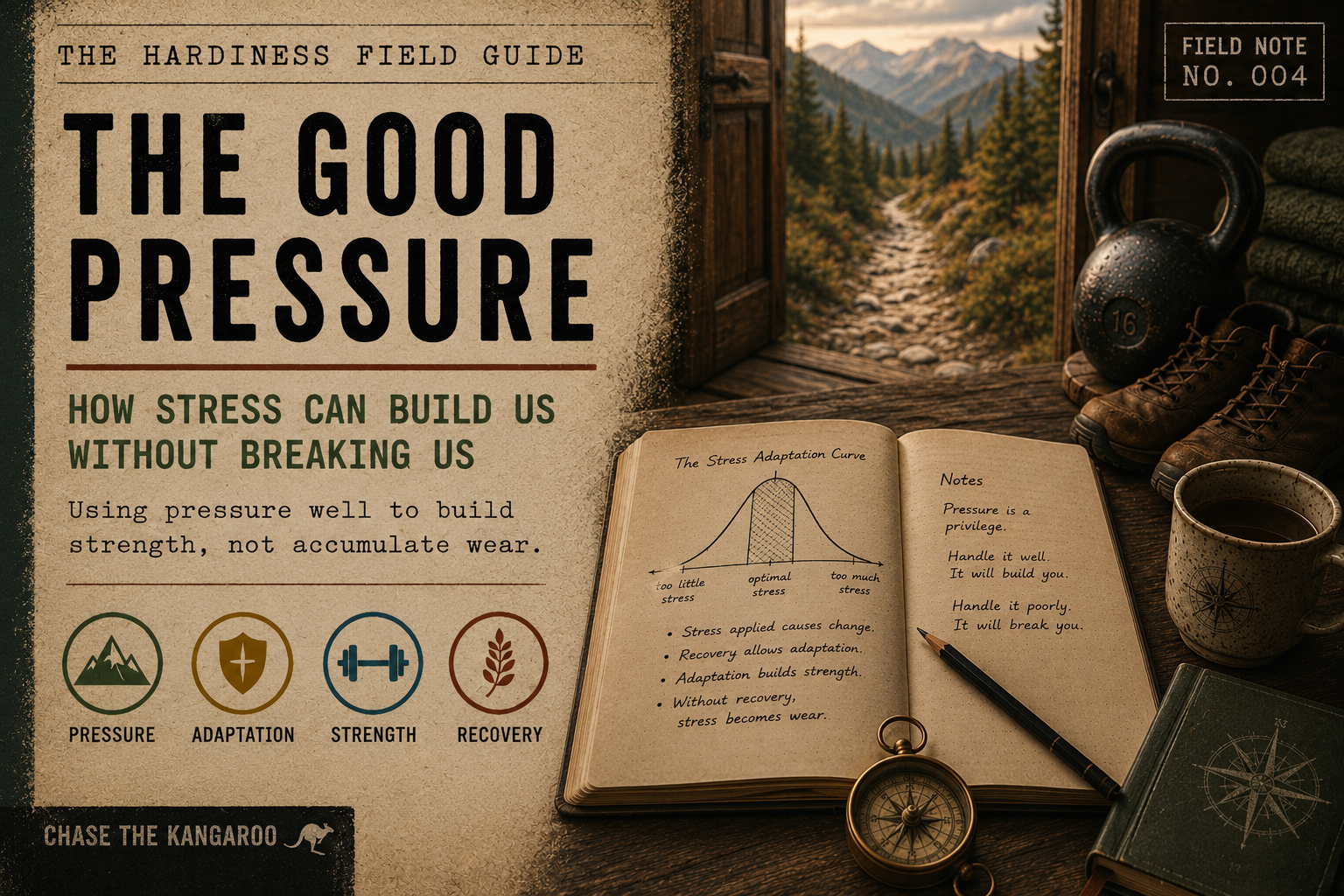
Dr. Paul Taylor’s The Hardiness Effect gives us a better frame. The question is not whether stress is good or bad in some absolute sense. The better question is what kind of stress, in what amount, for what purpose, with what recovery. Taylor points toward a simple but important idea: the right dose of challenge can strengthen us, while too much can break us down and too little can leave us undertrained.
That is the heart of hormesis, though the word sounds like something you might need a laboratory coat and a waiver to discuss. In plain terms, hormesis means that a small, manageable dose of stress can make a living system stronger, while a larger or prolonged dose of that same stress can cause harm. Exercise is the easiest example. Lift the right weight and the body adapts. Lift foolishly, too often, too heavy, with no recovery, and something in your lower back may file a formal complaint.
The lesson is not that stress is automatically good. The lesson is that pressure needs wisdom.
The Sweet Spot
Taylor’s “sweet spot” of stress is one of the most useful ideas in this whole trail from The Hardiness Effect. Too little stress produces little benefit. The right amount produces adaptation. Too much leads to diminishing returns and eventually harm. That pattern shows up everywhere once you begin to see it.
Sunlight can support health, but too much burns. Fasting can reorder appetite, but self-punishment distorts it. Cold can train composure, but hypothermia is not character development. Strength training builds capacity, but reckless training injures. Focused work sharpens the mind, but unbroken work without rest hollows a person out. Even hard conversations follow the pattern. Avoid them all and relationships weaken. Force them constantly and every room becomes a courtroom.
This is where modern culture tends to lose balance. On one side, comfort teaches us to avoid pressure until ordinary demands feel threatening. On the other side, the self-improvement world can turn pressure into theater, as if every man needs to begin the morning by plunging into ice water, sprinting uphill, and whispering Stoic quotes to a kettlebell.
The answer to a soft age is not stupidity with better branding.
The better path is wise pressure. The kind that asks enough of us to build strength, but not so much that it turns into vanity, injury, burnout, or another way to avoid the life we are actually responsible for living.
The Body Knows This First
The body often understands truth before the mind admits it. It knows that strength does not grow without load. It knows the heart and lungs need demand. It knows balance, mobility, endurance, and power are not maintained by intention alone. A person can read about fitness for years and remain winded by a hill. At some point, the body requires participation.
This is one reason physical training matters beyond appearance. A walk, a ride, a row, a heavy lift, a long stretch, a hill climbed slowly but honestly, these are not merely health behaviors. They are reminders that we are embodied creatures. We do not think, pray, work, love, and endure as floating minds with calendar apps. We do these things in bodies that can be either trained or neglected.
The point is not to turn CTK into a biohacking site. There are plenty of places online where a man can be told his mitochondria are disappointing and his sleep score has moral implications. Still, there is education worth keeping here. The body adapts to what it repeatedly experiences. If it repeatedly experiences only chairs, cars, screens, convenience food, artificial light, and low demand, it adapts downward. If it experiences wise challenge and real recovery, it often adapts upward.
Recovery matters as much as pressure. No load, no growth. No recovery, no growth either. The body builds during the rhythm of stress and repair, not through constant strain. That rhythm is easy to forget in a culture that swings between indulgence and intensity. We either avoid the hard thing entirely or turn it into a campaign.
But the body is not impressed by campaigns. It responds to repeated, sensible practice.
The Soul Has a Sweet Spot Too
The same pattern appears in the soul, though we need to speak carefully. The Christian life is not a self-improvement project with Bible verses attached. We are not saved by effort, intensity, discipline, suffering, or the ability to tolerate discomfort with a noble facial expression. Grace is not earned by grit.
Still, grace does not make formation unnecessary. The New Testament never promises a life of ease. James writes of trials producing steadfastness. Paul writes of suffering producing endurance, character, and hope. Hebrews speaks of discipline yielding peaceful fruit. Peter writes of tested faith. The pattern is not “go chase suffering.” It is more grounded than that: testing will come, hardship is real, obedience will cost something, and endurance is part of Christian maturity.
The soul does not mature through constant strain, but it does not mature through constant ease either.
This is where older disciplines still have something to teach us. Our age often questions the need for them. Why fast when food is available? Why choose silence when there is always something worth hearing? Why guard Sabbath when there is more work to do and more life to optimize? Why practice simplicity when convenience is within reach?
Those practices were never meant to make life smaller. They created space where desire could be examined and reordered. They taught the body and soul that not every appetite is an emergency, not every opportunity is an obligation, and not every form of rest is found by adding more comfort.
Dallas Willard’s old line is helpful here: grace is opposed to earning, not effort. Effort has its place. Not as a way to earn God’s love, but as a way of cooperating with the kind of life grace makes possible. Brother Lawrence found holiness in ordinary tasks. Franklin’s virtues remind us that temperance, order, resolution, industry, and tranquility are practiced in daily life. Marcus Aurelius, from a different tradition, reminds us that the obstacle is often the material we are given to work with.
The point is not to mix all these voices into one soup and pretend they are saying the same thing. They are not. But they do share a sober recognition that human beings are formed through practice, and practice requires resistance.
The Right Kind of Hard
The wise question is not simply, “Is this hard?” Plenty of things are hard and still foolish. The better question is, “Is this the right kind of hard, in the right amount, for the right purpose?”
That question changes the whole conversation. A hard workout may strengthen the body. Reckless training may injure it. Fasting may reorder appetite. Self-punishment may deform it. Silence may heal attention. Isolation may deepen avoidance. Honest conversation may build courage. Needless conflict may feed the ego. Work discipline may build capacity. Overwork may hollow the soul. News awareness may inform us. Constant exposure may leave the nervous system buzzing like a cheap fluorescent light.
This is why wisdom matters more than intensity. Modern life often tempts us toward extremes. We drift in comfort until we feel guilty, then overcorrect with severity. We live passively, then try to become heroic by Tuesday. We avoid pressure for months, then decide the answer is a complete personal revolution involving new shoes, new supplements, a new journal, a new morning routine, and the kind of grocery list that requires a translator.
But growth usually comes through something quieter. The right stress, repeated over time, with recovery. A little more weight. A little more honesty. A little more silence. A little more courage. A little more restraint. A little more patience. Enough pressure to wake up the system, not so much that the system collapses.
That is the good pressure.
It does not flatter us. It trains us. It exposes where we are weaker than we thought and stronger than we feared. It teaches the body to adapt, the mind to stay, and the soul to endure without becoming hard.
A CTK Challenge: Find the Sweet Spot
The point is not to admire the idea of wise pressure. The point is to practice it. For the next week, choose one small stressor in three areas: body, mind, and soul. Keep it manageable. Do not turn it into a personal documentary. The goal is not drama. The goal is discernment.
For the body, choose one physical challenge that asks a little more of you than comfort does. Walk hills, lift weights, row, ride, stretch, do a cold finish to a shower, or add one steady Zone 2 effort. It should be enough to feel like training, not enough to make you limp into the next day like you fought a mule and lost.
For the mind, choose one attention challenge. Read for twenty minutes without checking your phone. Work single-tasked for one focused block. Write by hand. Sit in silence. Let the mind resist and then settle. Attention is trainable, but it does not return to strength while being fed constant interruption.
For the soul, choose one obedience challenge. Pray before reaching for the phone. Apologize where you have been delaying. Fast from one comfort. Serve quietly. Practice Sabbath restraint. Tell the truth kindly. Do the good thing you already know to do but keep postponing.
At the end of the week, ask better questions than “Was this hard?” Ask whether it strengthened you or merely exhausted you. Ask whether you recovered well. Ask whether it made you more present, patient, courageous, honest, or useful. Ask what kind of pressure your life has too much of, and what kind it does not have enough of.
That last question may be the most revealing. Some of us do not need more intensity. We need recovery, sleep, prayer, and a few honest limits. Others do not need more comfort. We need movement, truth, silence, and a little chosen difficulty before life chooses difficulty for us.
The Good Pressure
Comfort cannot train us by itself. Chaos cannot heal us by itself. Somewhere between softness and overload is the good pressure: the wise weight that strengthens without crushing, challenges without consuming, and teaches us to carry more without becoming less human.
This is not stress worship. It is not a baptized version of grind culture. It is not a call to make life harder for the sake of sounding serious. It is a call to recover a wiser relationship with pressure, one that understands both human limits and human capacity.
The easy road will keep offering itself. So will the frantic road. One promises comfort without growth. The other promises strength without rest. Both are lying, though one wears slippers and the other wears a heart-rate monitor.
The better road is older and steadier. It receives comfort with gratitude but does not obey it. It accepts hardship without romanticizing it. It trains without boasting. It rests without disappearing. It understands that strength is not built by avoiding pressure, and it is not preserved by living under constant strain.
The good pressure does not crush the soul.
It teaches it how to stand.


Leave a Reply