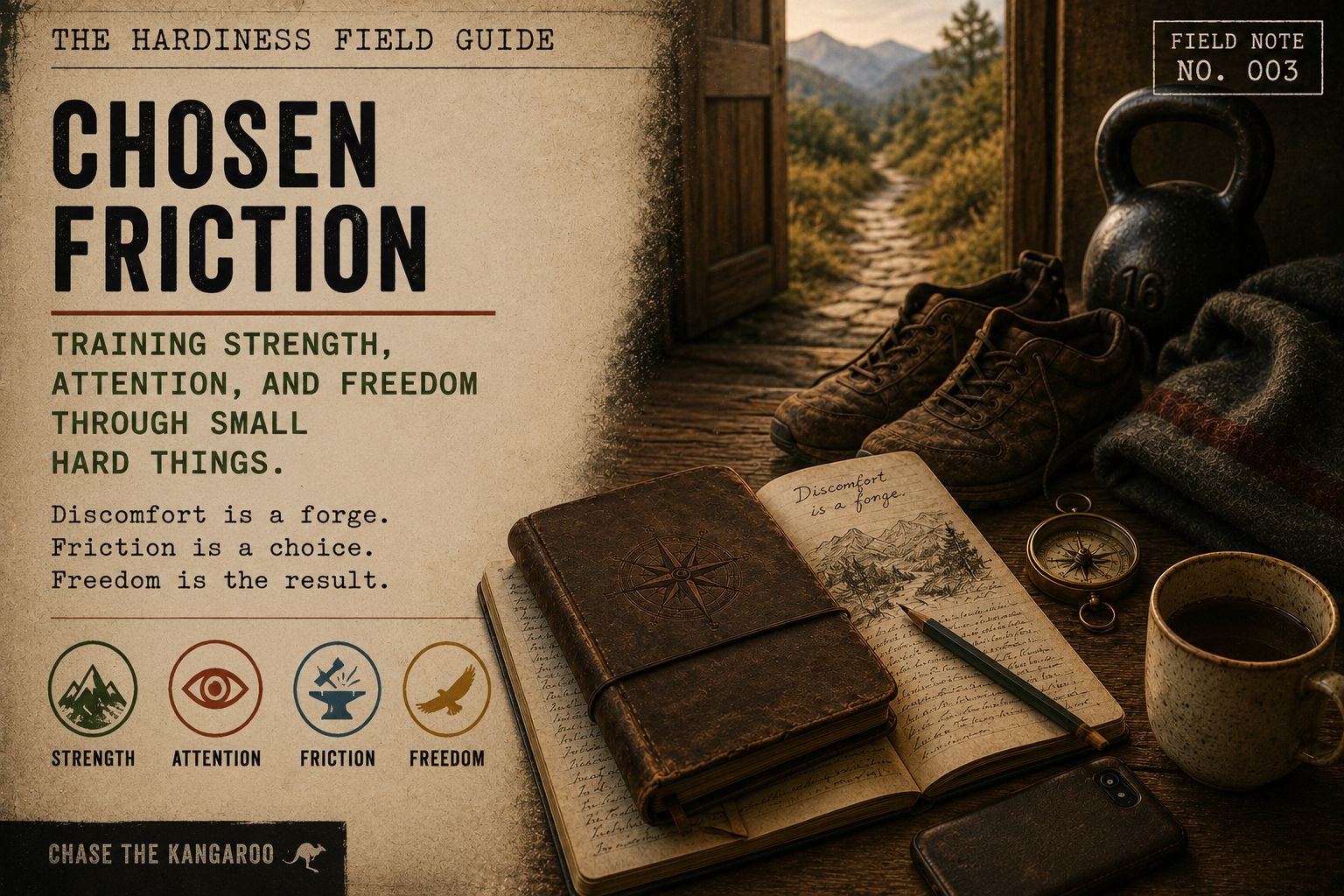
Training Strength, Attention, and Freedom Through Small Hard Things
In Comfort as Formation, we looked at how modern life trains us toward ease. In Digital Distraction and Resistance, we narrowed the focus to attention and the digital habits that keep pulling us away from presence. This third trailhead moves into a related but more practical question: if comfort is forming us, how do we begin to push back?
One answer is voluntary discomfort.
That phrase can sound suspicious, especially in an age that has turned “doing hard things” into its own little theater. There is a version of voluntary discomfort that feels less like wisdom and more like a man yelling shirtless at sunrise because the internet told him discipline requires poor lighting and a kettlebell. That is not what I mean. Chosen discomfort is not self-punishment. It is not recklessness. It is not a contest to see who can make life weirdest while pretending to be enlightened.
At its best, voluntary discomfort is the practice of choosing small, meaningful forms of resistance before life brings larger forms we did not choose. It is a way of training the body, mind, and will to remember that appetite is not king, ease is not lord, and every impulse does not deserve obedience.
Dr. Paul Taylor’s The Hardiness Effect helped reopen this trail for me. Taylor’s larger point is that the right kind of stress, in the right dose, can strengthen us. Too much stress can break us down, but too little stress can leave us undertrained. The human person needs challenge. Muscles need load. The mind needs effort. The will needs resistance. Character needs something to push against.
Modern comfort removes many of those pressures, which is both a blessing and a danger. It is good that we do not live in constant threat. It is good that most of us are not hunting dinner with a spear, sleeping in caves, or wondering if the neighboring tribe has a strong interest in our goats. But when comfort becomes constant, it does something subtle. It lowers our tolerance for difficulty. It makes ordinary effort feel unreasonable. It teaches us to treat inconvenience as injury.
That is where chosen friction becomes useful.
The Trouble with Constant Ease
The problem with ease is not that it feels good. The problem is that it keeps making promises it cannot keep. It promises peace but often produces restlessness. It promises recovery but often becomes avoidance. It promises freedom but can make us strangely dependent on preferred conditions.
A man who can only be kind when he is rested, fed, praised, comfortable, and undisturbed is not yet free. He is simply well-managed by circumstances. A man who can only focus when the room is perfect, the phone is silent, the chair is right, the playlist is curated, and the coffee has achieved the correct theological temperature has not built attention. He has built a fragile operating environment.
This is where modern life gets tricky. We are surrounded by tools and systems designed to smooth every edge. Food is faster. Entertainment is endless. Temperature is controlled. Shopping is frictionless. Communication is instant. Work can follow us everywhere. Discomfort, when it appears, feels like a violation of the contract.
But life never signed that contract.
Eventually the hard thing comes. A diagnosis. A betrayal. A difficult child. A financial strain. A season of grief. A long obedience. A body that no longer responds as quickly as it once did. A calling that requires more courage than mood. A relationship that cannot be healed through convenience.
When those moments arrive, the question is not whether we have read enough about resilience. The question is whether we have practiced meeting resistance before.
Chosen friction is practice.
Not Hardship for Hardship’s Sake
There is a foolish way to talk about discomfort. It makes hardship sound holy by itself. It treats softness as sin and difficulty as proof of virtue. That way of thinking can become its own vanity. A man can become proud of his cold plunge, proud of his fasting window, proud of his brutal workout, proud of how little sleep he gets, proud of how impressively miserable he has made himself. At that point, discomfort is no longer training freedom. It is feeding ego.
Wisdom matters.
The goal is not to make life harder in every possible way. The goal is to choose the right kind of difficulty for the right purpose. Voluntary discomfort should increase capacity, not create unnecessary damage. It should make us more present, more patient, more useful, more grounded, and more capable of love. If it makes us harsh, brittle, self-absorbed, or secretly impressed with ourselves, we have wandered off the trail and are now doing performance art with electrolytes.
The old disciplines understood something our age often questions. Why fast when food is available? Why choose silence when there is always something worth hearing? Why practice simplicity when convenience is within reach? Why guard Sabbath when there is more work to do and more life to optimize? These practices were never meant to make life smaller. They created space where desire could be examined and reordered. They taught the body and soul that not every appetite is an emergency, not every opportunity is an obligation, and not every form of rest is found by adding more comfort.
That is the heart of chosen friction. It is not contempt for comfort. It is freedom from being ruled by it.
The Whole-Life Practice of Resistance
When people hear voluntary discomfort, they may immediately think of cold showers, long runs, heavy lifts, fasting, or sauna sessions. Those can all have their place. The body is one of the most honest training grounds we have. It tells the truth quickly. Walk uphill long enough, and the body starts issuing formal complaints. Lift something heavy, and theory leaves the room. Step into cold water, and every philosophical abstraction becomes very specific.
Physical discomfort matters because we are embodied creatures. A sedentary, overfed, under-challenged body does not usually produce a clear and courageous mind. There are exceptions, of course, but the general pattern holds. Movement changes us. Effort steadies us. Strength work teaches us that adaptation often begins where comfort ends.
But chosen friction should not stay only in the physical realm. Some of the most important discomforts are quieter.
Chosen friction shows up in ordinary places: waiting without reaching for the phone, apologizing before pride has finished its closing argument, telling the truth when a softer half-truth would protect your image, or sitting in silence long enough to notice what is actually going on inside you. It can look like staying with a hard task after the first wave of resistance, letting someone speak without preparing your defense, turning off the noise and going to bed, or taking a walk before resentment has time to build a throne.
These are not mystical practices. Nobody is going to put them in a motivational montage. But they train something essential. They train the gap between impulse and obedience.
That gap is where freedom grows.
The Spiritual Shape of Chosen Discomfort
The spiritual life has always understood that desire must be trained. Not erased. Not despised. Trained. The problem is not that we want comfort, food, pleasure, recognition, entertainment, or relief. Many of these are good in their proper place. The problem is that disordered desire does not stay in its proper place. It expands. It negotiates. It begins to make claims.
This is why comfort can become so spiritually dangerous. It does not always lead us into obvious rebellion. More often, it makes obedience feel unreasonable. It makes patience feel like deprivation. It makes prayer feel inefficient. It makes service feel like an interruption. It makes sacrifice feel like a threat to the self we have been constructing around preference.
C.S. Lewis understood that temptation often works by tiny movements. John Mark Comer’s language of the world, the flesh, and the devil helps name the broader field. The world’s system does not need to convince us to reject goodness directly. It often only needs to keep us comfortable enough to delay it.
Chosen discomfort interrupts that pattern. It creates moments where appetite does not get the final word. It reminds the body that it can endure more than it thinks. It reminds the mind that boredom is not fatal. It reminds the soul that dependence on God is not the same as dependence on ideal conditions.
A man who practices small acts of resistance is not automatically virtuous. But he is less likely to be shocked when virtue requires resistance.
The Middle Way Between Softness and Stupidity
There are two ditches here.
One ditch is softness. This is the life of automatic ease, where every discomfort is avoided, every appetite is humored, and every inconvenience feels like persecution. This way slowly trains fragility. It leaves us dependent on comfort and irritated by reality.
The other ditch is stupidity. This is discomfort without wisdom, discipline without love, intensity without discernment. It is the man who injures himself trying to prove he is not soft, or who becomes impossible to live with because every family meal must now serve his heroic optimization protocol. Nobody wants to share a kitchen with a man who has turned breakfast into a moral tribunal.
The way forward is not softness or stupidity. It is wise resistance.
Wise resistance asks better questions. What discomfort would actually strengthen me? What appetite has too much authority? Where do I keep choosing escape? What hard thing am I avoiding that love requires me to face? What small practice would make me more present, more faithful, more courageous, or more useful?
That last word matters: useful.
Chosen friction is not about becoming impressive. It is about becoming useful. Useful to your family. Useful to your friends. Useful in your work. Useful in suffering. Useful in service. Useful when the easy path would make you less available to what matters.
A CTK Challenge: Seven Days of Chosen Friction
The point is not to admire the idea. The point is to practice. For the next seven days, choose one small act of voluntary discomfort each day. Keep it simple, wise, and concrete. Just practice.
Day 1: Leave one empty space empty. Wait in line, sit in the car, or stand in the kitchen without reaching for your phone. Let the small restlessness rise and pass.
Day 2: Move before comfort wins. Take a walk, ride, row, lift, stretch, or climb the stairs. Do something physical that asks a little more of your body than sitting still.
Day 3: Say no to one small appetite. Skip the unnecessary snack, the extra drink, the impulse purchase, or the reflexive scroll. Not because the thing is evil, but because freedom needs repetition.
Day 4: Do the avoided task. Answer the email, make the call, clean the thing, schedule the appointment, start the project, or handle the nagging responsibility you keep dragging behind you.
Day 5: Practice silence. Take ten minutes without input. No music, podcast, video, news, or background noise. Let your mind be noisy at first. It will settle if you stop feeding it more noise.
Day 6: Choose the hard relational good. Apologize, forgive, ask the honest question, listen without defending, or tell the truth kindly. Some of the hardest training happens in conversation.
Day 7: Recover Sabbath-like restraint. Create a small boundary around work, screens, consumption, or hurry. Let something remain undone so that something better can be received.
At the end of the week, do not ask whether the challenge was impressive. Ask what it revealed. Where did resistance show up fastest? What discomfort felt most threatening? Which appetite complained the loudest? What did you learn about the conditions you think you need in order to be steady?
That is useful information. It shows where training is needed.
The Freedom on the Other Side
Voluntary discomfort is not about loving hardship. It is about loving freedom.
The free person can enjoy comfort without being owned by it. He can receive good things with gratitude and still say no when no is needed. He can rest without disappearing, eat without obeying appetite, use technology without surrendering attention, work without worshiping productivity, and face difficulty without immediately looking for the exit.
That kind of freedom does not arrive through intention alone. It is practiced into being. It grows through small moments when we choose the better thing over the easier thing, not dramatically, not perfectly, but repeatedly enough that the soul begins to remember its shape.
Modern life will keep offering the smoother road. It will keep removing friction, selling convenience, and treating every limit as a problem to solve. Some of that is useful. Some of it is mercy. But not all friction is the enemy. Some friction is the road back to strength.
The challenge is not to reject comfort entirely. The challenge is to stop letting comfort make all the decisions.
Choose one small hard thing.
Then choose another.
The road will begin to train you.
Sources / Further Reading
Dr. Paul Taylor, The Hardiness Effect: Grow from Stress, Optimise Health, Live Longer
Chase the Kangaroo, “The Hardiness Effect: Choosing the Harder Road in an Age of Comfort”
Chase the Kangaroo, “Comfort as Formation: How Modern Life Trains Us Away from Resistance”
Chase the Kangaroo: “Digital Distraction and Resistance: Reclaiming Attention in an Age of Noise“


Leave a Reply