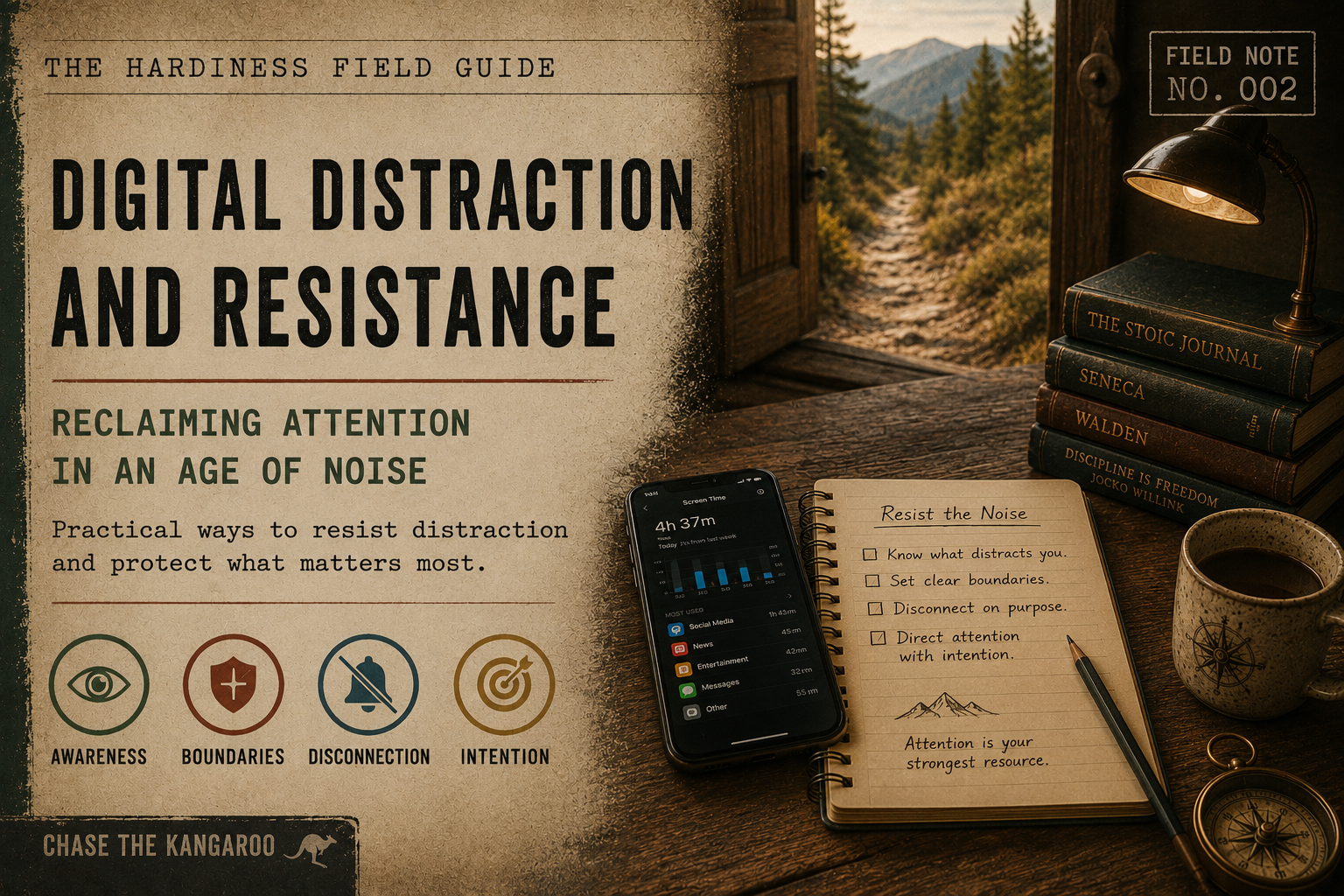
In Comfort as Formation, we looked at how modern life quietly trains us away from resistance. Comfort does not merely make things easier. It teaches us what to expect, what to avoid, and what to reach for when the first hint of discomfort arrives. Digital distraction may be the clearest and most aggressive example of that formation. It does not simply waste our time. It trains our attention.
That is the part we should take seriously. The problem is not merely that we spend too much time on screens, though many of us do. The deeper issue is that digital life has become a formation system for the mind and soul. It trains us toward interruption, speed, comparison, outrage, novelty, and escape. It teaches us to treat silence as emptiness, boredom as failure, and sustained attention as an unreasonable demand.
That may sound sharp. It should. We have become strangely casual about handing over the front door of the mind. We protect our bank accounts with passwords, two-factor authentication, and suspicious glances at every email from a prince with wiring instructions. But when it comes to our attention, we leave the gate open all day and act surprised when every stray noise in the digital neighborhood wanders in and starts rearranging the furniture.
The issue is not that technology exists. Technology is a tool, and good tools are gifts. A map, a calendar, a camera, a library, a notebook, a phone call, a weather report, a sermon, a song, a family photo, all of these can live inside the same device. That is part of the wonder and part of the danger. The phone is not one thing. It is a toolbox, a theater, a casino, a shopping mall, a newsroom, a confessional booth, a shouting match, and a vending machine for distraction.
No wonder we keep reaching for it. It offers nearly everything except peace.
The New Weather
Digital life is no longer something we visit. It is the weather we live in. Email follows us home. News finds us before breakfast. Streaming waits at the edge of fatigue. Podcasts fill the silence. Text messages arrive with the emotional force of tiny emergencies. Social media turns ordinary people into broadcasters, commentators, critics, and performers, often before they have finished their coffee.
The result is not always obvious collapse. It is usually a lower-grade problem: a thinning of attention, a scattered interior life, a mind that feels busy but not necessarily awake. We know more headlines but have less wisdom. We consume more commentary but have fewer convictions. We save more articles than we read, bookmark more ideas than we practice, and mistake being informed for being formed.
That distinction matters. Information can enter the mind quickly. Formation takes time. It requires repetition, silence, reflection, embodiment, and action. Digital life excels at the first and often sabotages the rest. It gives us fragments when the soul needs depth. It gives us stimulation when the body needs rest. It gives us reaction when the conscience needs examination.
There is a reason so many people feel tired after doing almost nothing. The body may have been still, but the nervous system spent the day sprinting through alarms, opinions, alerts, images, arguments, updates, and low-grade comparison. The mind was not resting. It was being pulled.
The Training of Interruption
The chief power of digital distraction is not entertainment. It is interruption. A distracted person is easier to steer because he rarely has time to ask where he is going.
Every notification says, “Look here.” Every feed says, “Keep going.” Every autoplay says, “Do not stop yet.” Every algorithm learns the shape of our appetite and returns with a better lure. This is not accidental. Much of the digital world is built on capturing and monetizing attention. That does not make every app evil, but it does mean we should stop pretending these platforms are neutral houseplants sitting quietly in the corner.
They want something from us.
They want time, attention, emotion, reaction, data, and habit. They want us to return often enough that returning becomes automatic. The most successful digital tools are not merely useful. They are sticky. They attach themselves to our boredom, loneliness, anxiety, curiosity, vanity, anger, and fatigue.
That is why distraction has become so ordinary. We do not only reach for the phone when we are bored. We reach when we are anxious, uncertain, tired, sad, awkward, or faced with a task that requires effort. We reach when an email makes us uncomfortable. We reach when a hard decision needs our attention. We reach when prayer gets quiet. We reach when the room asks us to be present.
The reach is the tell.
A man can learn a lot by noticing when his hand moves before his mind gives permission. That movement reveals training. It reveals where the will has surrendered ground. It reveals what we have taught the body to expect when discomfort appears.
This is not about guilt over screen time. Guilt is easy and usually lazy. It gives us a moment of self-disgust, then sends us right back to the pattern. The better question is more direct: What is this doing to my capacity for resistance?
The Loss of Interior Strength
Attention is not a small thing. It is the doorway through which formation enters. What we attend to, we eventually become shaped by. That is true of Scripture, friendship, music, work, nature, prayer, books, resentment, fear, outrage, pornography, envy, and every glowing invitation to look away from the life actually in front of us.
A distracted life does not remain neutral. It becomes shallow by habit. Not because the person lacks intelligence or sincerity, but because depth requires staying. You cannot skim your way into wisdom. You cannot scroll your way into courage. You cannot build a serious interior life in the leftover fragments between interruptions.
This is one of the quiet spiritual costs of our age. We have more access to truth than ever and perhaps less practiced ability to sit still long enough for truth to search us. We can pull up the Bible in seconds, but struggle to read without checking something else. We can listen to sermons all day, but avoid the silence where obedience becomes specific. We can read about discipline, save posts about discipline, share quotes about discipline, and still be trained by a device that has taught us to obey impulse.
That last sentence stings because it should.
The digital world does not need to make us wicked to make us weak. It only needs to make us scattered. A scattered person may still believe many true things. He may still have good intentions. He may even talk often about what matters. But when the hour comes to focus, endure, pray, create, lead, listen, repent, or love with patience, he finds the muscles undertrained.
Resistance is not built in theory. It is built in practice.
Outrage, Escape, and the Illusion of Engagement
Digital distraction does not always feel passive. Sometimes it feels like engagement. We read the news. We follow debates. We track the latest crisis. We develop opinions at a heroic pace. We can become morally exhausted by events we have no real relationship to, while avoiding the concrete duties sitting ten feet away.
This is one of the great tricks of the age. Outrage can imitate courage. Awareness can imitate action. Commentary can imitate wisdom. Constant concern can imitate love. But much of it is disembodied. It asks very little of us except reaction, and reaction is not the same as responsibility.
A man can spend an hour being furious about the state of the world and still not call his friend, apologize to his wife, take a walk, read a real book, clean the garage, pray for his children, or do the task he has been avoiding for three weeks. The digital world offers endless chances to feel engaged while remaining functionally absent.
There is a harsh mercy in admitting that. Not everything deserves our attention. Not every crisis is our assignment. Not every opinion needs to be formed today. Not every argument is a battlefield where our honor must be defended by thumbs.
Some of what we call staying informed is really staying inflamed. Some of what we call decompressing is really disappearing. Some of what we call connection is really performance with better lighting.
The older life of wisdom requires a different posture. It requires limits. It requires attention to what is near. It requires the humility to say, “This is not mine to carry,” and the courage to say, “This is mine, and I have been avoiding it.”
Resistance Begins With Attention
If digital distraction is a formation system, then resistance must begin with attention. Not dramatic rejection. Not panic. Not performative minimalism. The goal is not to become the sort of person who announces, with grave intensity, that he deleted every app and now only communicates by fountain pen and migratory bird.
The goal is recovered agency.
Agency begins when we stop treating every impulse as an instruction. The phone buzzes; we do not have to look. The feed tempts; we do not have to enter. The news agitates; we do not have to keep refreshing. The empty space opens; we do not have to fill it. A thought rises; we do not have to escape it.
That may sound small, but small is where the battle usually begins. The will is strengthened through repeated acts of rightly ordered attention. If we cannot resist the small summons, we should be honest about what that means. The small summons are training us.
This is where digital resistance becomes part of hardiness. Dr. Paul Taylor’s broader hardiness framework reminds us that people grow stronger through appropriately dosed stress and challenge. Digital restraint is one of those small modern stressors. It is not dramatic. Nobody is going to make a documentary about the man who did not check his phone during lunch. But the act matters because it reclaims a piece of attention from the machinery of impulse.
It says, “I am not available to everything.”
A CTK Challenge: Three Practices for Digital Resistance
The point of an essay like this is not to nod along, feel briefly convicted, and then return to the same patterns with better vocabulary. So here is a simple CTK challenge for the next seven days. Not a cleanse. Not a stunt. Just three practices of resistance.
First, create one daily no-reach space. Choose a recurring moment when you normally grab your phone and leave it alone. Waiting in line. First thing in the morning. Sitting in the car before going inside. The first ten minutes after work. Let that space remain empty. Notice the discomfort. Do not rush to fix it. Empty space is not wasted space. It is where attention begins to come back.
Second, practice one block of single-task work or presence each day. Twenty minutes is enough. Read without checking. Walk without listening. Eat without scrolling. Pray without multitasking. Work on one task without opening another tab every time your mind gets itchy. The point is not productivity. The point is staying.
Third, replace one digital escape with one embodied action. When you feel the urge to disappear into a feed, do something physical and real instead. Take a walk. Stretch. Wash the dishes. Step outside. Write three sentences in a notebook. Call someone. Lift something. Put your actual body back into actual life.
These practices will not fix everything in a week. That is not the goal. The goal is to expose the training. You will learn very quickly where the hooks are. You will see when you reach, why you reach, and what you are trying not to feel. That knowledge is useful. It turns vague guilt into specific agency.
And once you see the pattern, you can start choosing differently. Awareness brings choices.
The Life in Front of Us
The digital world is not going away, and nostalgia will not save us. We do not need to pretend the past was pure or that every modern tool is corrupt. That kind of thinking is too easy. The harder task is to live with tools without being ruled by them.
This requires a recovered sense of what attention is for. Attention is for love. It is for prayer, work, craft, friendship, study, reflection, delight, and presence. It is for noticing the person across the table, the state of your own soul, the beauty outside the window, the task under your hand, and the quiet voice you keep drowning out with noise.
Digital distraction is powerful because it offers escape from the weight of being present. Resistance is powerful because it returns us to reality. Not always comfortably. Not always easily. But truthfully.
There is a life in front of us that cannot be lived in fragments. It has to be entered with attention. The phone can help with many things, but it cannot do that part for us. The algorithm cannot choose courage. The feed cannot practice wisdom. The screen cannot become present on our behalf.
We have to choose the training.
And for many of us, the first act of resistance is embarrassingly simple.
Look up.
Sources / Further Reading
Dr. Paul Taylor, The Hardiness Effect: Grow from Stress, Optimise Health, Live Longer
Chase the Kangaroo, “The Hardiness Effect: Choosing the Harder Road in an Age of Comfort”
Chase the Kangaroo, “Comfort as Formation: How Modern Life Trains Us Away from Resistance”
Chase the Kangaroo: “Chosen Friction: The Wise Practice of Voluntary Discomfort”


Leave a Reply