Why We Resist the Very Things That Would Help Us Grow
The Things We Keep Putting Off
Most of us don’t run from the things that matter.
We postpone them.
The difficult conversation can wait until next week. The doctor’s appointment can wait until work slows down. We’ll start exercising on Monday, begin reading after vacation, repair the relationship when the timing feels right, and pray when our minds are less distracted. Rarely do we decide these things are unimportant. We simply convince ourselves that tomorrow will be a better day to begin.
Tomorrow has remarkable persuasive power. It promises more energy, more clarity, more confidence, and fewer interruptions. It assures us that the future version of ourselves will possess the discipline the present version somehow lacks. Yet tomorrow has a way of becoming next week, then next month, until what once felt urgent quietly becomes part of the landscape of our lives.
Paul Taylor touches on this throughout The Hardiness Effect. Hardiness is not simply the capacity to endure adversity after it arrives. It is the willingness to engage reality before avoidance becomes a habit. Resilient people do not possess a mysterious immunity to discomfort. They have learned, often through repeated practice, that leaning toward challenge produces more growth than stepping away from it.
That insight reaches far beyond physical resilience. We avoid difficult conversations because we fear conflict. We avoid meaningful work because we fear failure. We avoid silence because we are unsure what we might discover about ourselves. We avoid prayer because we suspect God may ask something of us that we’d rather postpone. Every act of avoidance offers immediate relief, but relief always carries a hidden cost. What we refuse to face rarely disappears. It simply waits for us, often growing larger while we look the other way.
This has been one of the quiet threads running through the Hardiness Field Guide. In Comfort as Formation, we explored how modern life gradually trains us toward ease. In Digital Distraction and Resistance, we considered how constant stimulation fragments our attention. Most recently, in The World’s System and the Slow Training of Appetite, we saw how repeated habits quietly shape what we love. Taken together, these essays reveal something important: avoidance is rarely an isolated weakness. It is often the natural outcome of the life we’ve been practicing.
When comfort becomes our highest value, engagement begins to feel optional. When distraction becomes our normal rhythm, important work is continually interrupted by less important things. When our appetites have been trained to seek immediate relief, almost every meaningful responsibility begins to feel heavier than it really is. We tell ourselves we’re waiting for the right moment, when in reality we’re slowly training ourselves to step away from whatever asks something of us.
Perhaps that’s why avoidance is so difficult to recognize. It rarely announces itself as fear. More often, it disguises itself as wisdom.
“This isn’t the right time.”
“I need to think about it a little longer.”
“I’ll be better prepared next week.”
Sometimes those reasons are legitimate.
Often, they’re simply more comfortable names for resistance.
The question, then, is not whether we avoid difficult things. The question is what our avoidance is quietly costing us.
Why We Avoid What Matters
Avoidance is rarely about laziness.
More often, it is an attempt to protect ourselves.
We postpone the difficult conversation because we fear rejection. We delay the project because failure feels personal. We ignore the doctor’s appointment because we don’t want bad news. We hesitate to confess our sin because we fear what honesty might require. Beneath almost every act of avoidance is the hope that if we wait long enough, the discomfort will somehow disappear.
It rarely does.
Instead, avoidance offers a short-term reward while quietly creating a long-term burden. Every time we step away from reality, reality continues moving toward us. The conversation grows more difficult. The work becomes more complicated. Relationships cool. Small problems become larger ones. What began as self-protection gradually becomes self-imprisonment.
Psychologists have observed this pattern for decades. We often mistake temporary relief for genuine resolution. The moment we avoid something unpleasant, our anxiety decreases. That relief feels like success, so the brain remembers it. The next time discomfort appears, avoidance feels even more natural. Without realizing it, we begin rehearsing retreat.
Paul Taylor’s work offers a different path. One of the hallmarks of hardy people is what he calls challenge—the willingness to see difficulty not primarily as a threat, but as an opportunity for growth. That does not mean pretending hardship is enjoyable. It means believing that engagement is usually more life-giving than escape.
Viktor Frankl arrived at a similar conclusion under circumstances far more severe. Reflecting on life after the concentration camps, he wrote, “When we are no longer able to change a situation, we are challenged to change ourselves.” (Man’s Search for Meaning). Frankl understood that while we cannot always choose our circumstances, we can choose our response. Responsibility, not comfort, is where human dignity begins.
Jordan Peterson has often made a similar observation. He argues that meaning is rarely found by pursuing happiness directly. Instead, it emerges when we willingly accept responsibility for what is ours to carry. That insight resonates because it runs against the instincts of modern culture. We are encouraged to ask what will make us feel better. Responsibility asks a different question: What has been entrusted to me today?
Theodore Roosevelt captured the same truth in his famous “Man in the Arena” speech. Honor belongs not to the critic watching safely from the sidelines, but to the one who enters the arena knowing he may fail. Engagement always carries risk, but it is also where character is forged.
This is why avoidance slowly erodes agency. Every retreat whispers the same lie: You can’t handle this. Every act of engagement answers with a different story: Perhaps, by God’s grace, you can.
That lesson echoes throughout the Hardiness Field Guide. In The Good Pressure we explored how the right kind of stress strengthens rather than weakens us. In The Four C’s, Taylor’s model reminded us that challenge, commitment, control, and confidence are not abstract ideas but habits cultivated through repeated action.
It is rarely discovered in one courageous moment. More often, it is built every time we stop postponing what we already know needs to be done.
The question, then, is not whether the next step feels uncomfortable.
It is whether avoiding it is costing us more than facing it ever will.
Sloth Is Not the Same as Laziness
The older Christian tradition had a word for the refusal to engage: acedia.
It is often translated as sloth, which makes many of us picture idleness, oversleeping, or someone avoiding work. But the early writers meant something deeper. Acedia was not simply the absence of activity. A person could remain extremely busy and still be governed by it. It was a resistance to the life, responsibility, and presence of God that had been placed directly before him.
The desert fathers sometimes called it the “noonday demon.” By the middle of the day, the monk’s cell felt unbearable. His work seemed pointless. His brothers appeared irritating. Another place, another task, or another life promised greater meaning. The temptation was not always to do nothing. It was to abandon the particular good that required his attention now.
That description feels surprisingly modern. We may not be sitting in desert cells, but we know the urge to escape the task in front of us. We open another tab, check another message, reorganize the desk, begin researching a better method, or convince ourselves that the real problem is our environment. Activity continues, but engagement disappears.
Thomas Aquinas later described acedia as sorrow in the face of spiritual good. The good asks something of us, and part of us resents the demand. Prayer requires presence. Reconciliation requires humility. Vocation requires patience. Love requires inconvenience. Rather than openly reject these goods, we drift away from them.
This helps explain why avoidance can coexist with competence. A man may work hard, meet deadlines, and remain outwardly responsible while still avoiding the conversation, confession, decision, or act of obedience that matters most. Busyness can become camouflage. Productivity gives him evidence that he is engaged with life, even while the deepest assignments remain untouched.
The parable of the talents carries a similar warning. The servant who buried what had been entrusted to him did not lose it through reckless living. He preserved it. He protected it. He avoided the risk of using it. His master’s rebuke in Matthew 25 is severe because fear had been allowed to disguise itself as caution.
Avoidance often sounds responsible in the beginning. It tells us to wait until we are certain, confident, rested, prepared, or safe. Wisdom does require patience, and not every hesitation is cowardice. But there comes a point when caution stops serving faithfulness and begins protecting us from it.
The opposite of acedia is not frantic activity. It is faithful engagement with the life in front of us. It is the willingness to remain present to God, to our responsibilities, and to the people we have been given, even when another place or another time appears more appealing.
Sometimes courage looks less like charging into battle and more like refusing to leave the room.
Agency Is Built One Decision at a Time
If avoidance shrinks our world, engagement expands it.
Every time we choose to face what we’ve been avoiding, something changes. The difficult conversation may still be difficult. The project may still require hard work. The apology may still feel uncomfortable. Yet we discover something avoidance could never teach us: we are often more capable than we imagined.
This is where Paul Taylor’s work begins to converge with one of the central themes of Chase the Kangaroo.
Agency.
In Franklin’s thirteen virtues, agency is not listed among the original virtues, yet it quietly supports all of them. It is the ability to respond instead of merely react. It is the willingness to accept responsibility for the next faithful step instead of waiting for perfect circumstances. As we explored in the Agency, agency grows whenever we choose engagement over excuse, responsibility over resignation, and action over avoidance.
Like any muscle, agency strengthens through use.
We often imagine that confident people act because they possess confidence. More often, the opposite is true. Confidence grows because they acted before they felt completely ready. The first difficult conversation makes the second one easier. The first act of forgiveness prepares us for the next. The first honest confession makes future honesty less frightening. Courage is rarely a prerequisite for action. More often, it is the fruit of repeated engagement.
Marcus Aurelius understood this. “The impediment to action advances action. What stands in the way becomes the way.” (Meditations, Book 5.20). Obstacles are not interruptions to the formation of character; they are often the means by which character is formed.
James echoes the same principle from a different perspective: “Be doers of the word, and not hearers only, deceiving yourselves” (James 1:22). Knowledge alone does not transform us. Truth becomes part of our lives only when it is embodied in action.
That is why agency is never built in the abstract. It grows through ordinary acts of faithfulness repeated over time. Answering the email you’ve been avoiding. Beginning the project instead of planning it for another week. Making the phone call. Scheduling the appointment. Asking for forgiveness. Opening the Bible before opening the news.
None of these decisions seems remarkable.
Together, they become a way of life.
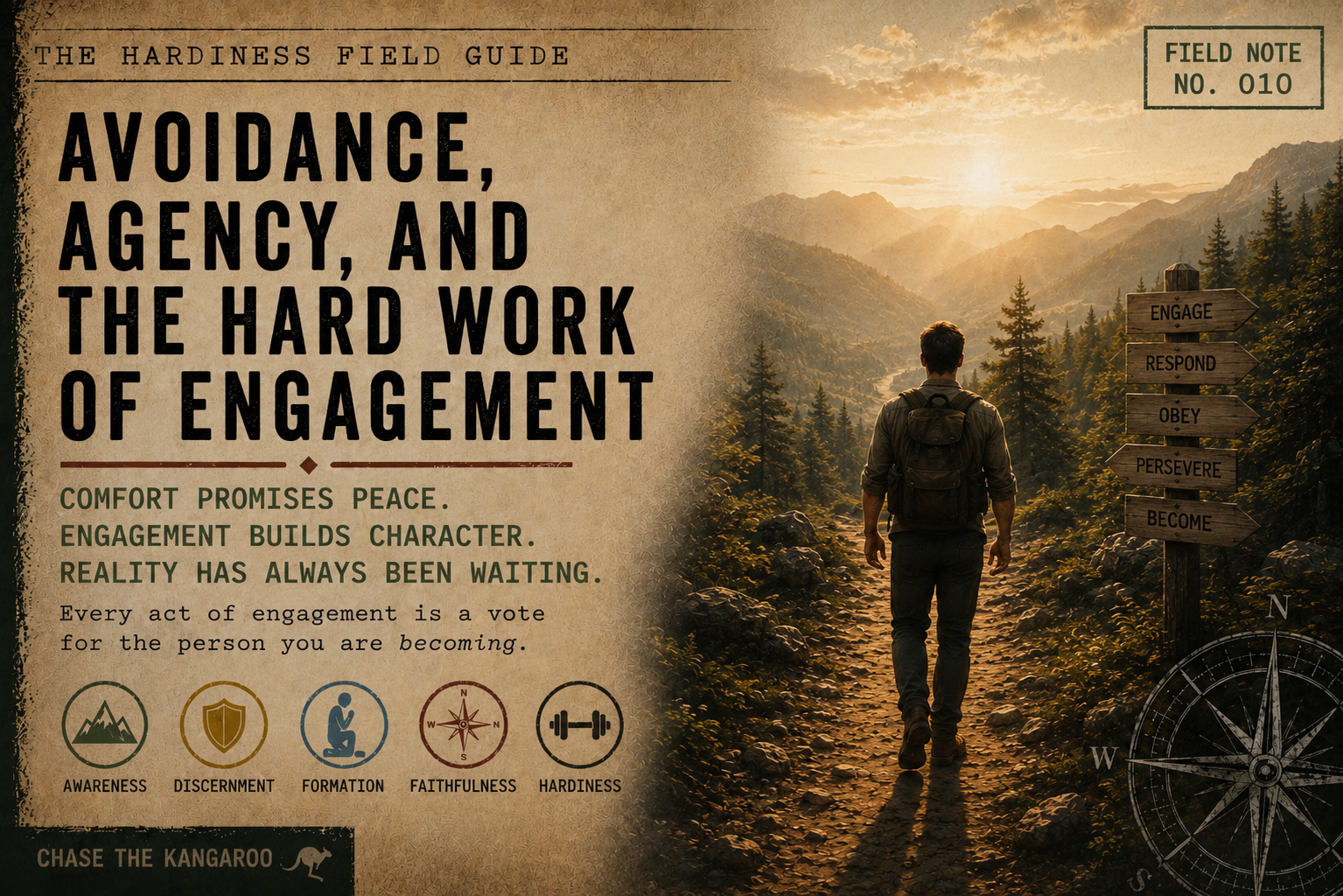
This has been the quiet lesson running beneath the entire Hardiness Field Guide. We become capable of what we repeatedly practice. Every act of engagement is a vote for the person we are becoming. Every avoided responsibility is also shaping us, just in a different direction.
The encouraging news is that agency does not require a dramatic new beginning.
It begins with the next faithful decision.
And then another.
And another.
Over time, those ordinary decisions become a life marked not by avoidance, but by engagement.
The Seven-Day Engagement Experiment
If you’ve followed the Hardiness Field Guide from the beginning, you’ve probably noticed a pattern. Every field note ends with a practice because ideas alone don’t change us. Insight may inspire us, but repeated action is what forms us.
This week, don’t try to change your entire life.
Choose one thing you’ve been avoiding.
It might be a difficult conversation. A lingering decision. A neglected project. An overdue apology. A doctor’s appointment. A budget you’ve been meaning to review. A chapter you’ve intended to read. A prayer you’ve struggled to pray.
Whatever it is, stop negotiating with tomorrow.
For the next seven days, ask yourself one question each morning:
What am I avoiding today that deserves my engagement?
Choose one answer.
Do it before noon.
Don’t optimize it. Don’t overthink it. Don’t wait until you feel motivated. Simply take the next faithful step.
At the end of the day, spend a few quiet minutes reflecting on what happened. Ask yourself:
- What resistance did I feel before I began?
- Was reality as difficult as I imagined?
- What did engaging this situation teach me about myself?
- What became possible once I stopped avoiding it?
You may discover something surprising.
The hardest part is often not the task itself.
It’s the story we’ve been telling ourselves about the task.
Avoidance has a way of enlarging obstacles in our imagination. Engagement usually returns them to their proper size. That doesn’t mean every problem becomes easy. Some conversations remain painful. Some responsibilities require months of perseverance. Some acts of obedience cost us dearly.
But they are no longer ruling us from a distance.
That is the quiet gift of agency. Every act of engagement reminds us that we are not merely reacting to life. By God’s grace, we are becoming active participants in it.
Don’t measure success by how much you accomplish this week.
Measure it by one simple question:
Did I move toward what mattered, or away from it?
Because every step toward reality is also a step toward becoming the person God is forming you to be.
The Work of Engagement
Avoidance promises peace, but it rarely delivers it. More often, it narrows the life we are willing to inhabit. The unanswered email becomes a source of dread. The unspoken truth gains weight. The neglected responsibility begins shaping the room around it. What we refuse to face does not disappear. It simply begins governing us from a distance.
Engagement breaks that spell. Not always by solving the problem immediately, but by returning us to reality. The conversation may still be hard. The diagnosis may still be frightening. The work may still be slow. Yet once we step toward what matters, fear no longer has the same authority. We become participants again.
That may be one of the clearest lessons in The Hardiness Effect. Hardiness is not numbness, and it is not the ability to avoid being affected by life. It is the capacity to remain present, responsible, and engaged when pressure arrives. Strength without engagement becomes control. Resilience without agency becomes endurance for its own sake. The goal is not merely to withstand life, but to meet it.
C.S. Lewis understood how easily a life can be lost through postponement. In The Screwtape Letters, the senior demon reminds his apprentice that the safest road to destruction is not spectacular rebellion but quiet drift: “The safest road to Hell is the gradual one—the gentle slope, soft underfoot, without sudden turnings, without milestones, without signposts.” (The Screwtape Letters, Letter XII).
Lewis’s point is unsettling because it sounds so ordinary. Most lives are not undone by one catastrophic decision. They are shaped by thousands of smaller ones. The prayer delayed until tomorrow. The apology postponed another week. The difficult conversation continually deferred. Drift is simply avoidance stretched over time.
John Mark Comer echoes this same concern in Live No Lies. Formation is happening whether we intend it or not. If we are not intentionally apprenticing ourselves to Christ, we will inevitably be formed by something else. Avoidance is never neutral. It is quietly teaching us the kind of people we are becoming.
The reverse is also true. Every faithful act of engagement trains the soul in another direction. We answer. We begin. We confess. We forgive. We remain. None of those actions feels extraordinary in the moment, but together they cultivate a life that is less governed by fear and increasingly marked by courage, presence, and love.
That is the hard work of engagement. It asks us to stop waiting for a version of ourselves who feels fully prepared. It asks us to move with the courage we have, not the courage we imagine we should possess. Often, the strength we need is found only after we take the step.
Most courage begins before anyone notices. It begins when we make the call, open the document, schedule the appointment, return to prayer, or speak the truth we have been rehearsing in private. Reality has been waiting for our participation.
The question is not whether there is something in your life asking for engagement.
There probably is.
The question is whether you will keep allowing avoidance to define the distance between you and it, or whether you will take the next faithful step toward what matters.


Leave a Reply