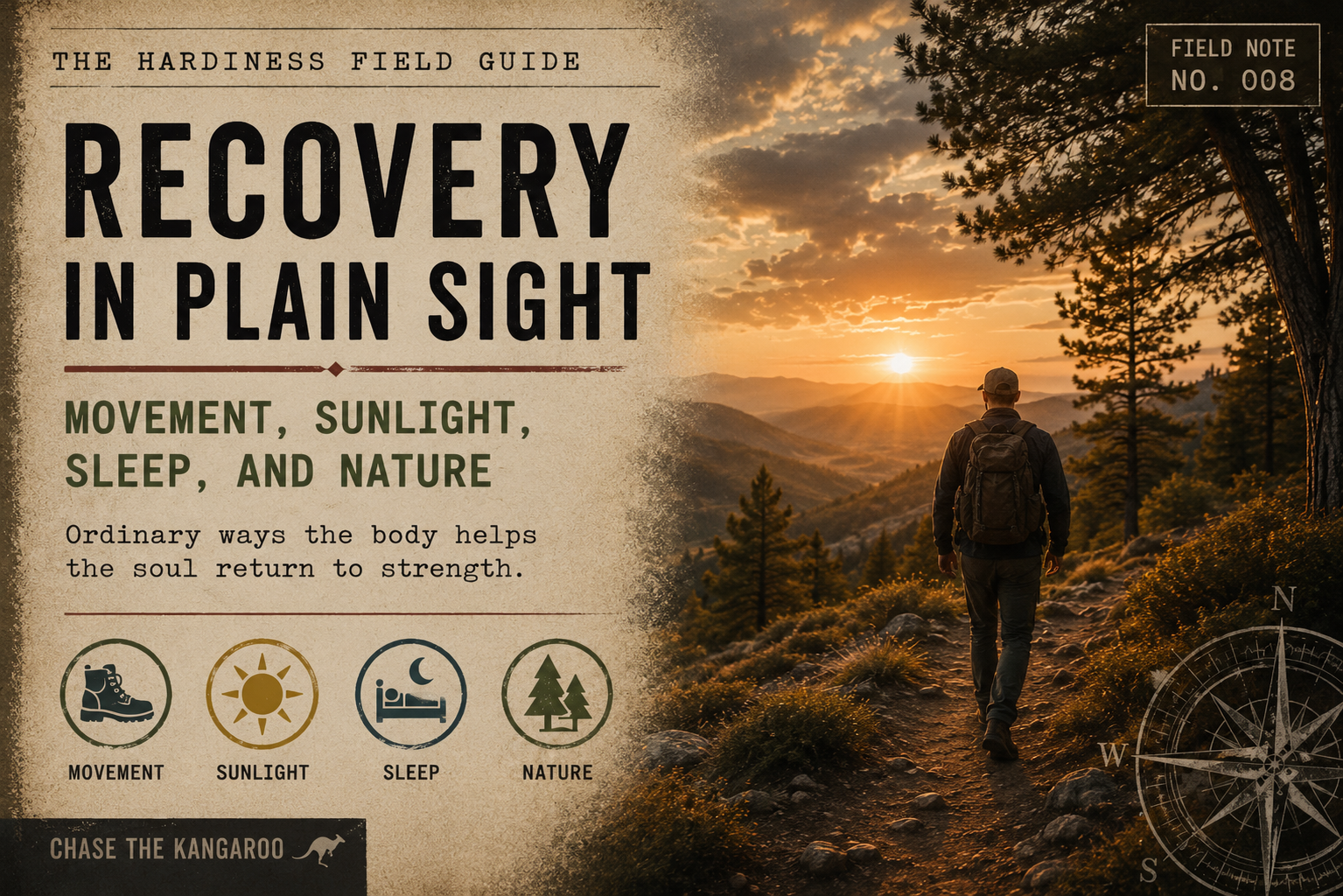
Ordinary Ways the Body Helps the Soul Return to Strength
Recovery Is Not Escape
Recovery is easy to misunderstand in a hardiness conversation.
Once we begin talking about stress, resistance, discipline, pressure, and the harder road, recovery can start to sound like the soft part of the story. The pause. The retreat. The permission slip. The thing we talk about after the real work has already been done.
But that is not how the body works, and it is not how a life becomes strong.
Dr. Paul Taylor’s work in The Hardiness Effect keeps returning us to a simple truth: stress can build us, but only when it is rightly held. Pressure without recovery does not become resilience. It becomes wear. The body can adapt to challenge, but it also needs space to repair, settle, absorb, and return.
That matters because modern life often gives us the worst combination. We are under-challenged in some ways and overstrained in others. We sit too long but feel constantly hurried. We move too little but carry too much mental noise. We are surrounded by convenience but starved for restoration. We have more ways to be entertained than any previous generation, yet many of us are tired in a way entertainment does not touch.
So recovery cannot simply mean escape. Escape numbs us from the pressure without helping us return stronger. It lets us disappear for a while, but often sends us back to life more scattered, more irritable, and less present than before. Recovery is different. Recovery restores capacity. It brings the body and soul back toward steadiness.
That is why this field piece belongs alongside the others. We have talked about comfort as formation, digital distraction and resistance, chosen friction, good pressure, the path of Aretê, and the practice of resistance. But if we only talk about resistance, we will distort hardiness. A hardy life is not a life of constant strain. It is not a life where every moment must be made harder to prove a point. That would not be wisdom. That would be spiritual CrossFit with worse lighting.
Hardiness requires recovery because human beings are not machines. We are creatures. We need rhythm, repair, light, sleep, movement, air, silence, food, friendship, and the created world. We need ordinary ways to come back from pressure before pressure becomes the atmosphere we breathe.
The good news is that much of this recovery is already in plain sight. It is not hidden behind a complicated system or reserved for people with unusual schedules, expensive equipment, or heroic discipline. It is often found in the humble practices we keep overlooking: a walk, morning sunlight, a full night of sleep, time outside, a quiet stretch of trail, a porch, a tree, a sky large enough to remind us we are not the center of everything.
Recovery is not the opposite of hardiness. It is one of the ways hardiness is built.
The question is not whether we need to recover. We do. The better question is whether our recovery is actually restoring us, or merely helping us hide from the life we are too tired to face.
Movement: The Body’s Way Back
Sometimes the way back to peace is not another thought. It is a walk.
That may sound too simple, especially in a world that likes its recovery complicated, branded, measured, and preferably synced to a device. But the body often knows things before the mind is ready to admit them. Anxiety tightens the chest. Resentment settles into the jaw. Hurry shortens the breath. Long hours indoors make the soul feel strangely airless. Pressure does not stay in the abstract. It takes up residence in the body.
Movement helps us return.
This does not have to mean a heroic workout. There is a place for training, strength, sweat, and effort. Taylor’s work certainly honors the role of physical challenge in building capacity. But recovery movement is something quieter. It is the walk after dinner. The slow stretch before bed. The easy ride. The yard work. The short hike. The light row. The trip around the block when the mind has been circling the same problem for too long.
Movement gives stress somewhere to go. It changes the inner weather without requiring us to solve everything first. A man may begin a walk irritated, crowded, and rehearsing the speech he will wisely never give, and return twenty minutes later with enough space to see the situation differently. The problem may still be there, but he is not quite the same man standing before it.
That matters because modern life often trains us to live from the neck up. We sit in chairs, stare at screens, answer messages, process information, manage tasks, carry invisible burdens, and then wonder why we feel both restless and exhausted. The body was not made to be dragged behind the mind like luggage. It was made to participate in life.
This is where ordinary movement becomes recovery. It reminds us that we are embodied creatures, not disembodied managers of anxiety. A walk can become a way of returning to the ground. A stretch can become a way of noticing what hurry has done to us. A slow bike ride can become a way of feeling wind, breath, and effort without turning the whole thing into another achievement.
The point is not calorie burn. The point is return.
Movement can also become a quiet form of prayer, though it does not need to be forced into pious language. Sometimes prayer happens with words. Sometimes it begins when the body finally slows enough for honesty to surface. A walk can make room for confession, gratitude, grief, or simple attention. It can turn the day from a knot into something that can be carried.
For many people, the practice does not need to begin with a program. It can begin with a rule of thumb: when pressure builds, move before you numb. Take ten minutes. Step outside. Walk without solving. Breathe without performing. Let the body help the soul come back online.
Recovery in plain sight often begins there, with the humility to stand up and move.
Sunlight: Receiving the Day Before Managing It
Morning sunlight is not a productivity hack. It is a way of letting the body know the day has begun.
That distinction matters because our age has a way of turning every good thing into a strategy. We do not merely walk; we optimize steps. We do not merely sleep; we track recovery. We do not merely sit outside; we improve protocols. There is nothing wrong with learning how the body works, and Taylor’s work helps us take that seriously. But recovery begins to lose something when every ordinary gift has to justify itself as a tool for performance.
Sunlight is one of those ordinary gifts.
Before the inbox, before the screen, before the demands of the day arrange themselves into a small kingdom, the body needs light. Not just brightness from a device or overhead glare from a room, but the old daily signal of the created world. Morning light tells the body that it is daytime. It helps anchor rhythm. It invites wakefulness without hurry.
There is a quiet mercy in that. To step outside early, even for a few minutes, is to receive the day before trying to manage it. The air may be cool or already warm. The street may be still. The trees may be barely moving. The sky may be plain, gray, gold, or startlingly clear. None of it asks us to produce anything. It simply gives us a world to stand in before we start reacting to the smaller world inside our devices.
This is where recovery becomes more than biology. Sunlight helps the body return to rhythm, but it also helps the soul remember reception. We do not begin the day as machines coming online. We begin as creatures being given another morning. That is not sentimentality. It is sanity.
Of course, a few minutes of sunlight will not solve every burden. It will not answer the difficult email, heal the strained relationship, or remove the responsibility waiting on the calendar. But it may return us to the day with a little more steadiness. It may remind us that life is larger than the first demand, the first notification, or the first anxious thought. It may help us enter the day instead of being ambushed by it.
This is one of the simplest recovery practices available to us, and it is often one of the first we neglect. We wake indoors, reach for the phone, borrow the mood of the internet, and let the day begin through someone else’s urgency. By the time we step outside, if we step outside at all, we have already been trained into reaction.
Morning sunlight interrupts that pattern. It does not need to be dramatic. Stand on the porch. Walk to the mailbox. Drink coffee outside. Take the dog around the block. Sit near a window if that is the best available option. Let your eyes and body receive the day before your mind begins managing it.
There is also an evening side to this wisdom. Recovery is not only about entering the day well. It is about letting the day end. As morning light signals wakefulness, evening dimness teaches the body to release. A darker house, a slower rhythm, fewer screens, and a quieter final hour can become a small act of mercy toward tomorrow’s self.
Sunlight is recovery in plain sight because it asks so little and gives so steadily. Step outside. Look up. Receive the day. Let the body remember what the soul keeps forgetting: you are not only a worker, a responder, a manager, or a mind full of unfinished business.
You are a creature in a world that was already shining before you woke up.
Sleep: The Quiet Discipline of Letting Go
Sleep may be the most ordinary recovery practice, and perhaps the most humbling.
Movement asks us to participate. Sunlight asks us to receive. Sleep asks us to surrender. For several hours each night, we stop producing, managing, responding, fixing, improving, defending, and performing. We become unavailable. We close our eyes and admit, whether we mean to or not, that the world can continue without our supervision.
That is not a small confession.
Modern life resists this confession. It trains us to stay available, stay lit, stay informed, stay entertained, stay reachable, and stay just a little more awake than wisdom allows. We push the day later because there is always one more message, one more episode, one more scroll, one more thought to chase around the room. Then we wake tired and call it normal.
But tired is not always normal. Sometimes tired is a message.
Taylor’s work on hardiness keeps recovery attached to adaptation. Stress without recovery does not become strength. It becomes accumulation. Sleep is one of the main places where the body repairs, the mind sorts, and the nervous system settles. It is where pressure has a chance to become capacity instead of simply becoming more pressure.
The spiritual meaning is just as important. Sleep reminds us that we are creatures with limits. We may spend the day carrying responsibilities, solving problems, making decisions, caring for people, and doing work that matters. But at some point, the faithful thing is not to keep going. The faithful thing is to stop.
That is hard for people who have confused vigilance with responsibility. It is hard for those who believe their worth depends on productivity, usefulness, or responsiveness. It is hard for anxious people, driven people, wounded people, and anyone who has learned to keep one hand on the wheel long after the road has disappeared into darkness.
Sleep is a daily invitation to release control. Not irresponsibly. Not lazily. Not as escape. But as trust. We do what is ours to do, and then we lay down what is not ours to carry through the night.
There is a reason the evening matters. A body cannot be shouted into rest at the last second after hours of light, noise, urgency, and stimulation. Recovery often begins before sleep itself. A darker house. A slower final hour. The phone set aside. A few pages of a book. A brief prayer. A simple review of the day. A willingness to stop consuming the world before trying to surrender it.
This is not about building a perfect routine. Perfect routines have a way of becoming one more thing to fail at. The point is gentler and more serious than that. Give sleep a path. Let the evening become less frantic. Let the body receive signals that the day is ending. Let tomorrow wait its turn.
C.S. Lewis once wrote about how ordinary temptations often come through small irritations and unmanaged appetites. Lack of sleep gives those irritations a larger stage. A tired man is more easily offended, more easily tempted, more easily discouraged, and more likely to mistake depletion for truth. Sometimes what looks like a spiritual crisis is being made worse by a body that has not been allowed to rest.
That does not reduce the soul to sleep habits. It simply refuses to separate the soul from the body God gave it.
Sleep is not weakness. It is not wasted time. It is not the opposite of discipline. Sleep is part of the rhythm by which strength becomes sustainable. It is one of the most ordinary ways we practice humility, trust, and recovery.
A hardy life is not a sleepless life. It is a life that knows when to carry weight and when to lay it down.
Nature: Recovery Without a Screen
Nature is not decoration.
It is easy to treat the created world as background scenery, something pleasant to look at when the schedule allows, a place for vacations, photographs, or occasional weekends when the weather behaves. But nature is not merely an escape from real life. It is part of real life. More than that, it is one of the ordinary places where the body and soul remember what kind of creatures we are.
A screen gives us a world we can scroll, arrange, refresh, and control. Nature gives us a world we must receive. The sky does not adjust itself to our preferences. Trees do not hurry because we are behind. Water does not care about our inbox. Wind, dirt, birds, clouds, shade, heat, rain, and stars all speak a slower language than the one most of us hear all day.
That slower language is part of recovery.
When we step outside without immediately turning the moment into content, something begins to loosen. The eyes lift. The breath changes. The body registers distance, texture, light, sound, and temperature. The mind, which has been living in tabs and tasks, remembers horizon. The soul, which has been crowded by urgency, begins to feel the size of the world again.
The created world has a way of making our problems smaller without making them meaningless.
Nature does not deny our burdens. It does not erase grief, repair conflict, pay bills, or answer every question waiting inside the mind. But it places those burdens within a larger frame. A trail, a creek, a field, a garden, an evening sky, or even a single tree outside the window can remind us that reality is bigger than our immediate pressure.
This is one reason nature belongs in a hardiness field guide. Recovery is not only rest from effort. It is return to reality. And many of us spend much of our day inside realities that are too small: the screen, the room, the problem, the argument, the feed, the list, the self. Nature gently pulls us outward.
That outward pull matters spiritually. Scripture does not treat creation as a disposable stage set for human activity. The heavens declare. The lilies teach. The birds become instructors in trust. Mountains, rivers, trees, fields, gardens, wilderness, and seas all carry some testimony that we did not invent and cannot control. Creation does not save us. But it can help us remember.
A walk outside without headphones may reveal how dependent we have become on being entertained. Sitting on a porch after dinner may show us how uncomfortable we are with quiet. Watching the light change through trees may feel useless at first, which may be exactly why it is needed. Not every moment has to be converted into output. Not every pause has to justify itself.
The practice does not need to be dramatic. Step outside in the morning. Eat lunch under a tree. Take a meeting as a walk if possible. Sit on the porch without the phone. Touch grass without making a joke about it. Watch water move. Notice the moon. Take the long way through the neighborhood. Let a trail, a yard, a park, a field, or a patch of sky become a place where the body can settle and the soul can return.
Recovery in nature is not about escaping responsibility. It is about returning to responsibility less frantic, less cramped, and less convinced that the whole world is contained inside whatever has been demanding our attention.
Sometimes grace comes through grand revelations. Sometimes it comes through light on leaves, breath in the lungs, and the quiet reminder that the world is still here, still held, still larger than our anxious little kingdoms.
Seven Days of Ordinary Recovery
The point is not to admire recovery as an idea. The point is to practice it.
For the next seven days, choose ordinary recovery before the body has to beg for it. Do not make this dramatic. Do not build a heroic routine. Do not turn it into a system with seventeen rules, three apps, a spreadsheet, and a new identity. The goal is not to become impressive. The goal is to return.
Start with movement. Move every day for at least twenty minutes, preferably outside. Walk if you can. Ride slowly. Stretch. Do yard work. Take the long way around the block. Let the body breathe, carry, loosen, and remember that it was made for more than sitting under fluorescent light while the mind tries to manage the universe.
Receive sunlight. Step outside within the first hour of waking if possible. Stand on the porch. Drink coffee near the morning. Walk to the mailbox. Let the day arrive through light before it arrives through a screen. This is not about perfection. It is about giving the body a simple signal: morning has come.
Protect sleep. Choose one small evening practice that gives rest a path. Set the phone aside thirty minutes before bed. Lower the lights. Read a few pages. Say a brief prayer. Write down the one thing you keep trying to carry into the night. Let tomorrow wait until tomorrow. Sleep is not the failure to keep going. It is the humility of laying the day down.
Touch nature. Sit under a tree. Notice the sky. Walk near water. Step into the yard. Eat lunch outside. Open a window. Watch the light change. Find some piece of the created world and give it your attention without needing it to entertain you.
Each evening, ask four questions.
Did I move my body today?
Did I receive light?
Did I protect sleep?
Did I spend even a few minutes with the created world?
Then ask the deeper question: did any of this help me return to God, to my body, to my people, and to the actual day I was given?
That last question matters because ordinary recovery is not just maintenance. It is formation. Movement can return us to embodiment. Sunlight can return us to rhythm. Sleep can return us to humility. Nature can return us to reality. These practices do not remove responsibility. They help us become more present to it.
At the end of the week, notice what changed. Maybe nothing dramatic happened. That is fine. Most good things begin without drama. Perhaps you were a little less reactive. Perhaps you slept a little better. Perhaps you noticed how quickly you reach for a screen before stepping outside. Perhaps you discovered that twenty minutes of walking did more for your mood than another hour of trying to think your way out of weariness.
The challenge is simple: recover before collapse. Move. Receive light. Protect sleep. Touch nature. Let ordinary gifts do their quiet work.
Recovery is already in plain sight.
The Body Helps the Soul Remember
Recovery is not retreat from the harder road.
It is how we become able to walk it. A body that never moves grows restless and weak. A body that never sees the morning becomes confused about rhythm. A body that never sleeps well begins to mistake depletion for truth. A soul that never steps outside can start believing the whole world is as small as the screen in front of it.
Movement, sunlight, sleep, and nature are not complicated. That may be why we overlook them. They are too ordinary to impress us, too available to feel profound, too humble to compete with the louder promises of modern life. But ordinary does not mean insignificant. Some of the deepest forms of recovery are not hidden from us. They are simply waiting to be received.
This is not a call to abandon discipline, pressure, resistance, or the harder road. It is a reminder that pressure must be held inside a larger rhythm of restoration. Taylor’s work helps us see that hardiness is not built through strain alone. The body needs recovery so stress can become adaptation rather than accumulation. The soul needs recovery so responsibility can become faithfulness rather than exhaustion.
That is why ordinary recovery matters. A walk can return us to the body. Morning light can return us to rhythm. Sleep can return us to humility. Nature can return us to reality. None of these practices save us. None of them remove the need for courage, obedience, repentance, work, or love. But they can make us more available to all of it.
We are not machines. We are creatures. And creatures recover through rhythm, light, movement, sleep, and the world God made.
Sometimes the faithful thing is to press on.
Sometimes the faithful thing is to return.
Recovery in plain sight begins when we have the humility to receive what has already been given.


Leave a Reply