The Forgotten System Behind Franklin’s Virtues
Many people know that Benjamin Franklin created a list of thirteen virtues. Far fewer realize that he built a system for practicing them.
Franklin did not intend the virtues to be admired from a distance. He designed them to be lived. In his early twenties, he created a simple structure for daily self-examination, focusing on one virtue at a time while tracking his progress across all thirteen.
As Franklin later wrote in The Autobiography:
“I made a little book in which I allotted a page for each of the virtues.”
The system was not theoretical philosophy. It was practical discipline.
Over the past several months, I spent thirteen weeks walking through Franklin’s system myself, focusing on one virtue each week and reflecting on how it holds up in modern life. Those essays form the Thirteen Weeks, Thirteen Virtues series here on Chase the Kangaroo.
This article explains the method Franklin used and how you can practice the virtues today.
What Are Benjamin Franklin’s 13 Virtues?
Franklin’s virtues were designed to build character gradually, beginning with discipline of the appetites and moving toward deeper habits of wisdom and humility.
Each virtue carries a short definition written by Franklin himself.
The virtues are:
- Temperance
- Silence
- Order
- Resolution
- Frugality
- Industry
- Sincerity
- Justice
- Moderation
- Cleanliness
- Tranquility
- Chastity
- Humility
Together they form a framework for daily character formation.
Why Franklin Built a Virtue System
Franklin believed good intentions alone rarely produce real change.
People resolve to improve themselves constantly. They promise to be more disciplined, more patient, more honest. But without structure, those intentions dissolve into routine.
Franklin’s solution was simple: measure behavior daily and focus attention deliberately.
In The Autobiography of Benjamin Franklin, he described this experiment as his attempt at “moral perfection.” He knew he would fall short, but he also believed that deliberate effort would make him a better man than drifting without discipline.
The 13-Week Virtue Practice Plan
Franklin did not attempt to master every virtue at once. Instead, he focused on one virtue per week.
Week 1 — Temperance
Week 2 — Silence
Week 3 — Order
Week 4 — Resolution
Week 5 — Frugality
Week 6 — Industry
Week 7 — Sincerity
Week 8 — Justice
Week 9 — Moderation
Week 10 — Cleanliness
Week 11 — Tranquility
Week 12 — Chastity
Week 13 — Humility
Each day he tracked his behavior across all thirteen virtues, but the weekly virtue received special attention and deliberate effort.
After thirteen weeks, the cycle began again.
Over time, Franklin believed this slow repetition strengthened character.
Franklin’s Virtue Tracker
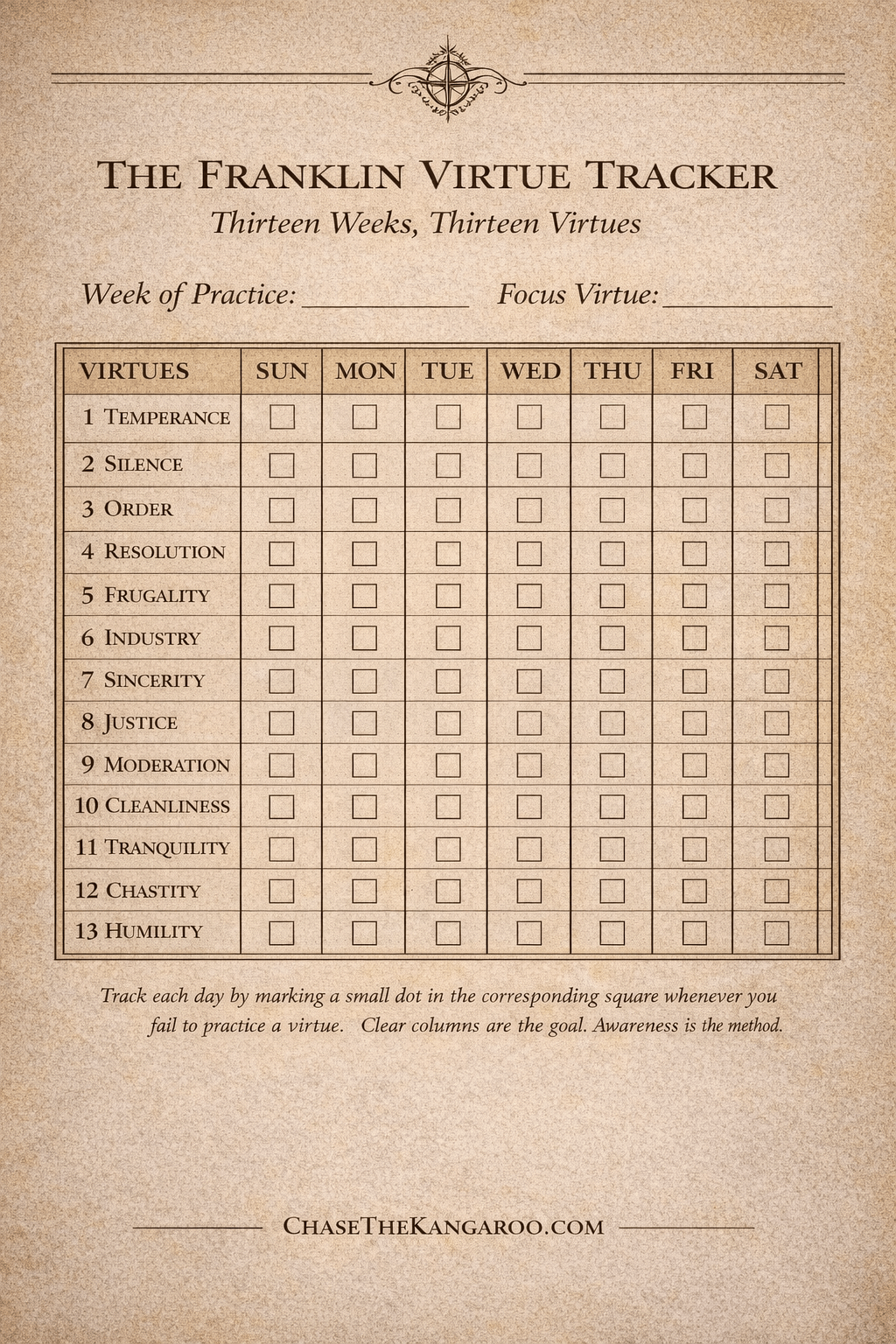
Franklin kept a small chart in a notebook. The virtues were listed along one side, and the days of the week across the top.
Each evening he examined his day. When he failed in a virtue, he marked a small dot in the corresponding square.
The chart did not record success. It recorded failure.
The goal was simple: fewer marks and clearer columns.
Over time, the tracker revealed patterns of behavior that might otherwise go unnoticed.
Download the Franklin Virtue Tracker
If you would like to try Franklin’s system yourself, I created a simple printable tracker modeled on his original method.
Use it for thirteen weeks, focusing on one virtue at a time while tracking your daily behavior across all thirteen.
Download the Franklin Virtue Tracker (PDF)
The download includes:
- a printable virtue tracking grid
- Franklin’s original definitions of each virtue
- space to mark the weekly focus virtue
Print a copy each week and begin the cycle.
Print the tracker. Choose the first virtue. Begin today.
You may find, as Franklin did, that the quiet discipline of daily examination changes more than you expect.
A Thirteen-Week Experiment
Earlier this year, I followed Franklin’s system myself, focusing on one virtue per week and reflecting on how each principle plays out in modern life.
Each essay explores Franklin’s original meaning, the historical background of the virtue, and what it looks like to practice it today.
You can read the full series here:
Benjamin Franklin’s 13 Virtues: A 13-Week Character Challenge
Explore the Virtues
If you would like to explore the virtues individually, each week of the experiment is documented in a separate essay.
Week 1 — Temperance
Week 2 — Silence
Week 3 — Order
Week 4 — Resolution
Week 5 — Frugality
Week 6 — Industry
Week 7 — Sincerity
Week 8 — Justice
Week 9 — Moderation
Week 10 — Cleanliness
Week 11 — Tranquility
Week 12 — Chastity
Week 13 — Humility
Each article explores Franklin’s insight and what that virtue looks like in daily life.
Why Franklin’s Virtues Still Matter
Modern culture often talks about values, but rarely about discipline of character.
Franklin’s system offers something refreshingly simple: a structure for self-examination and steady growth.
The virtues are not dramatic. They are quiet habits practiced daily.
Temperance.
Silence.
Order.
Resolution.
Practiced over time, they shape the kind of person a man becomes.
Begin the Practice
If you want to try Franklin’s system, start simply.
Choose a week.
Select the first virtue.
Track your behavior honestly.
After thirteen weeks, begin again.
Franklin never claimed he achieved moral perfection. Yet he believed the effort made him a better and happier man than he would have been otherwise.
That seems reason enough to try.


 Chase The Kangaroo
Leave a reply to Sunday Evening Collective ~ March 15th Edition – Chase The Kangaroo Cancel reply