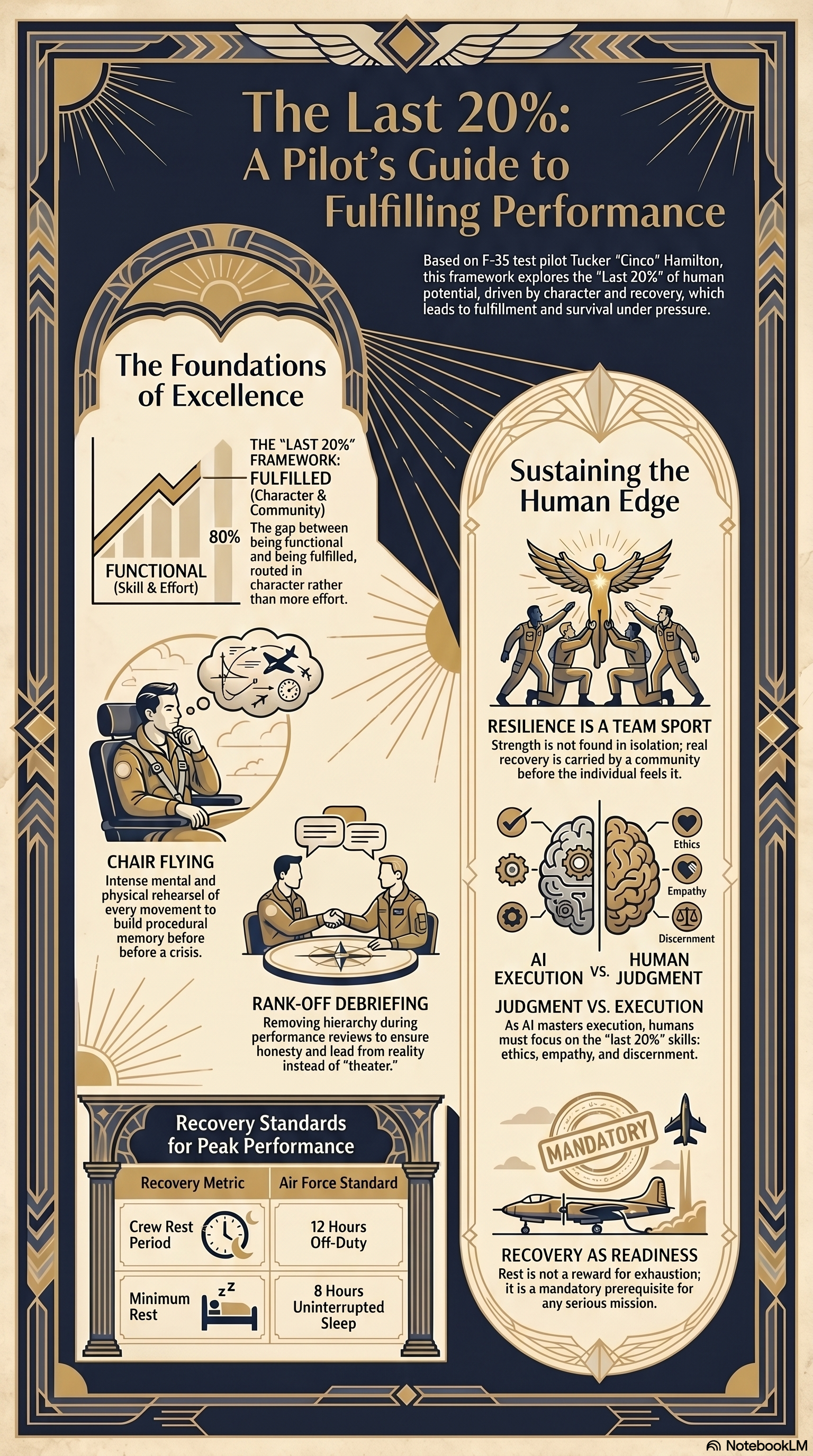
I came across a recent WHOOP Podcast interview between Emily Capodilupo, WHOOP’s SVP of Research, Algorithms, and Data, and Tucker “Cinco” Hamilton, a retired Air Force colonel, F-35 test pilot, and former Air Force Chief of AI Test and Operations. The conversation was framed around Hamilton’s idea of unlocking the “last 20%” of human performance, the gap between being good at what you do and becoming truly fulfilled in how you live.
That idea has some teeth.
Most people who care about performance already know how to work. They know how to push, produce, endure, and grind. They can fill a calendar, hit a deadline, finish the workout, answer the call, and stay functional under pressure.
But being functional is not the same as being whole.
That is where Hamilton’s point cuts through the noise. The last 20% is not simply more effort. It is not another productivity trick, another 4:00 a.m. wake-up call, or another layer of personal optimization stacked on top of an already overloaded life.
The last 20% is human.
It is character. Recovery. Honest feedback. Practiced readiness. Community. Purpose. The things that cannot be reduced to metrics, automated by machines, or faked under pressure.
Hamilton comes from a world where performance is not theoretical. Fighter pilots do not have the luxury of pretending fatigue does not matter. In aviation, recovery is not a self-care slogan. It is part of the mission. If the body and mind are not ready, the risk is not merely inconvenience. It can be catastrophic.
That is worth sitting with.
In much of modern work culture, exhaustion is still worn like a badge. Leaders push through. Parents push through. Athletes push through. Builders, managers, teachers, entrepreneurs, and public servants push through. There is honor in perseverance, but there is also foolishness in pretending the machine can run hot forever.
Recovery is not the opposite of discipline. It is one of discipline’s oldest requirements.
A sharpened axe cuts cleaner than a dull one swung harder.
Hamilton also talks about the practice pilots use called “chair flying,” a form of mental rehearsal where they walk through a mission before it happens. They rehearse movements, contingencies, decisions, and responses until the mind and body know the shape of the task before the pressure arrives.
That is an old truth in a modern cockpit.
You do not rise to the occasion as much as you fall back on your training. The moment of crisis reveals what has already been practiced. The hard conversation, the family emergency, the leadership decision, the moral test, the moment when you have to tell the truth or take responsibility, these do not usually give you time to become someone different.
You bring the person you have been building.
That is why the last 20% is not just about skill. It is about formation.
Another piece from the fighter pilot world is the debrief. In healthy squadrons, rank has to come off the table long enough for truth to be spoken. A junior pilot must be able to tell a senior officer what went wrong. Not with arrogance. Not with disrespect. But with clarity.
That may be one of the hardest leadership lessons in the whole conversation.
Most leaders say they want honesty. Fewer build the conditions where honesty can survive. If people only tell you what they think you want to hear, you are not leading from reality. You are leading from theater.
The best leaders do not merely invite feedback. They make it safe enough, normal enough, and useful enough that the truth has somewhere to land.
That takes humility.
And humility, as unfashionable as it may sound, is performance equipment.
Hamilton’s story also challenges one of our favorite myths: the lone resilient hero. We like the image of the person who gets knocked down and simply picks himself back up. It sounds strong. It looks good on a poster.
But most real resilience is not solitary.
People heal because someone stays close. People recover because someone tells the truth, brings food, makes the call, sits in the room, keeps watch, offers counsel, or refuses to let them disappear into the dark. Strength matters, but strength was never meant to become isolation.
Resilience is often carried by a team before it is felt by the individual.
That has implications for every serious life. If you want to become harder to break, do not merely build thicker walls. Build better bonds.
The AI portion of the conversation may be the most timely. Hamilton has worked close to the edge of advanced technology, including AI testing and operations. His warning is not anti-technology. It is more mature than that. As machines become better at execution, human beings will need to become better at judgment.
Ethics. Context. Courage. Empathy. Discernment. Responsibility.
The machine may help us move faster. It will not tell us what kind of people we ought to become.
That work remains ours.
So what do we do with this?
Start with recovery. Treat rest as part of readiness, not a reward for collapse.
Practice before pressure. Rehearse the conversation, the decision, the response, the habit. Do not wait for the crisis to discover your character.
Invite honest feedback. Especially if you lead. Especially if people are afraid to disappoint you.
Build community before you need it. Do not wait until the storm to start looking for shelter.
And finally, stop confusing achievement with fulfillment.
There is nothing wrong with achievement. Good work matters. Excellence matters. Discipline matters. But the final measure of a life is not whether you squeezed out more output than the next man or woman. It is whether your strength became service, whether your discipline formed character, whether your ambition was governed by purpose, and whether your performance left you more fully human.
The last 20% is not found by grinding harder.
It is found by becoming whole.


Leave a Reply