Companion article to Virtues Series | Week 8 – Justice
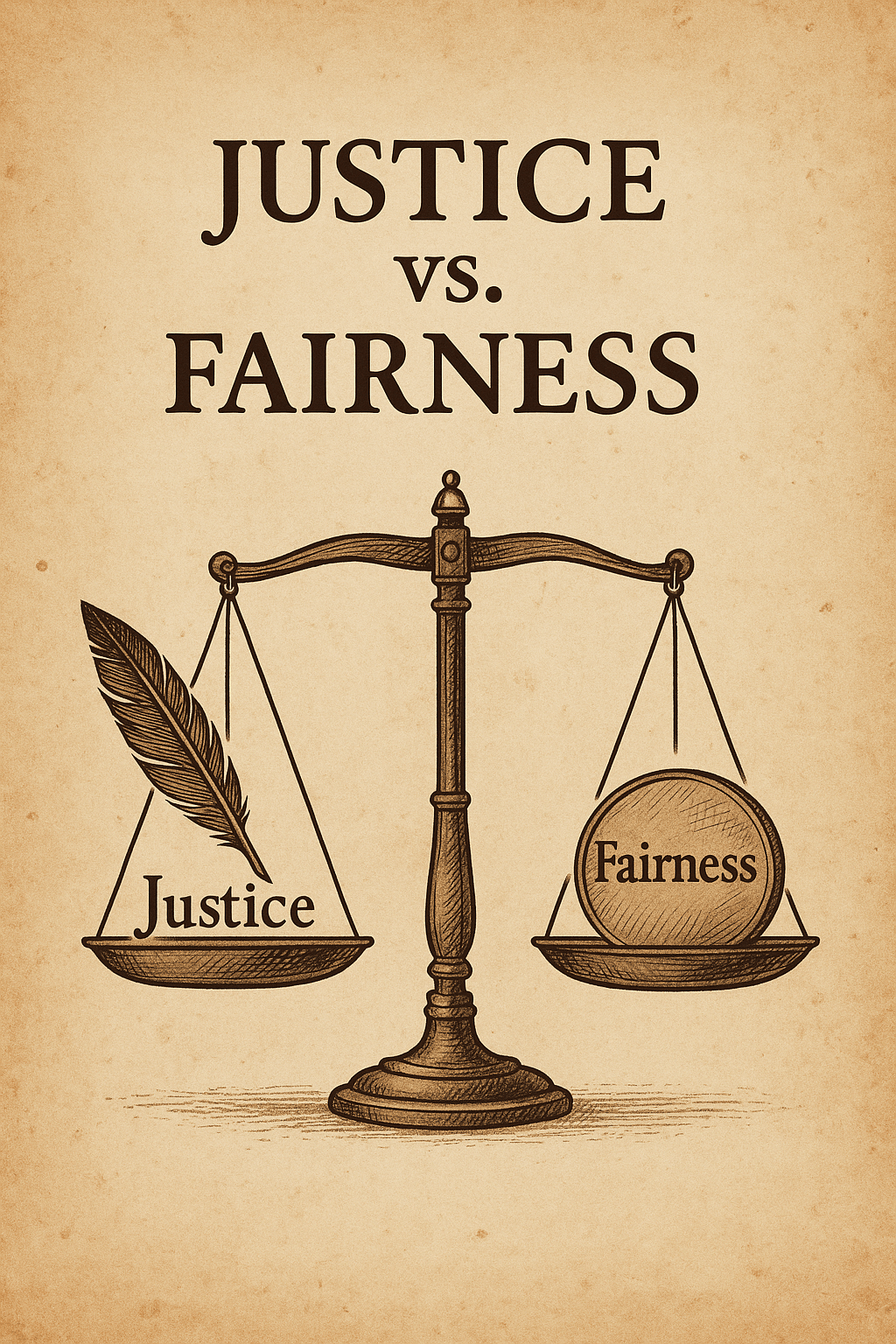
Fairness is one of those words that feels noble but often conceals a deeper confusion. We reach for it whenever something feels unequal. But equality and justice are not the same.
Fairness asks that all be treated alike.
Justice asks that all be treated rightly.
That difference is not small. It is foundational.
In modern culture, fairness has become a moral reflex. It promises balance. It promises protection. It promises that no one will be left behind. But justice, as Benjamin Franklin and the classical tradition understood it, demands something more demanding: moral discernment.
Justice is anchored in truth.
Fairness is anchored in comparison.
One requires conscience. The other requires consensus.
The Classical Foundation of Justice
In the ancient world, justice was not about leveling outcomes. It was about moral order.
Aristotle described justice as “complete virtue in relation to others.” It distributes goods proportionally, according to merit, responsibility, and circumstance. It does not flatten distinctions. It honors them.
The Roman jurists defined justice as giving each person what is due.
In Christian thought, Thomas Aquinas sharpened the definition: justice is the steady will to give each person their due.
Steady will. Not fluctuating sentiment.
Justice measures according to truth and proportion. Fairness, when detached from truth, measures according to feeling and appearance.
That is a decisive shift.
Equality of Worth vs Equality of Outcome
Justice affirms equality of worth. Every person bears dignity.
But justice does not guarantee equality of outcome.
Justice recognizes:
- Differences of effort
- Differences of virtue
- Differences of circumstance
- Differences of responsibility
Fairness, pursued to its extreme, erases these distinctions in pursuit of sameness.
When sameness becomes the highest moral good, excellence is often treated with suspicion. Effort becomes negotiable. Responsibility becomes transferable.
The language may sound compassionate. The effects are often corrosive.
This is not an argument against compassion. It is an argument for clarity.
Historical Drift: From Virtue to Mechanism
The older moral tradition located justice within the person. It was a cultivated virtue, formed through conscience, habit, and discipline.
Over time, particularly in the modern bureaucratic age, moral responsibility migrated outward. Justice became procedural. Fairness became administrative.
Institutions expanded. Systems multiplied. Language shifted.
Where earlier generations asked, “Am I acting justly?” modern society increasingly asks, “Is the system fair?”
The question is not illegitimate. But it is incomplete.
When justice moves from the soul to the structure, character weakens. Responsibility diffuses. What once required courage now requires compliance.
G. K. Chesterton observed the danger of confusing popularity with truth:
“Fallacies do not cease to be fallacies because they become fashions.”
~ G. K. Chesterton, Heretics
Moral error does not become virtue simply because it gains cultural approval.
When fairness becomes a moral fashion detached from truth, it risks becoming orderly injustice.
When Fairness Replaces Justice
When fairness becomes the dominant moral lens, personal agency weakens.
Responsibility shifts from individual conscience to impersonal systems. Institutions become the arbiters of what is “fair,” rather than individuals discerning what is “just.”
C. S. Lewis, in The Abolition of Man, warned of the loss of objective moral order. When moral judgments are reduced to emotional preference, power fills the vacuum. What begins as compassion can end as control.
The machinery of fairness may run efficiently. But efficiency without moral truth is not justice.
Franklin’s Vision: Justice Safeguards Liberty
Franklin’s understanding of justice depended on self-governed virtue. It assumed that a free people, disciplined by conscience, could discern and act rightly without coercion.
His definition remains clear:
“Wrong none by doing injuries, or omitting the benefits that are your duty.”
That definition places justice within reach of every person. It cannot be outsourced.
Justice safeguards liberty because it restrains both the individual and the state. It forms citizens capable of freedom.
Fairness, detached from truth, may promise protection. But without virtue, protection easily becomes control.
Justice Belongs to Souls
Fairness belongs to systems.
Justice belongs to souls.
Systems can enforce rules. They cannot produce character.
When people cease practicing justice in speech, in work, in family life, no policy can compensate for the loss.
Justice begins where fairness ends.
It begins with the courage to discern what is right, even when rightness is unequal.
If you have not read the primary essay on Franklin’s Virtue of Justice, begin there. This distinction rests on that foundation.
Justice is not about making everyone equal. It is about making each action right.
And that requires formed conscience, disciplined judgment, and steady will.


 Chase The Kangaroo
Leave a reply to Thirteen Weeks, Thirteen Virtues – Chase The Kangaroo Cancel reply