Following Through on What Matters Most
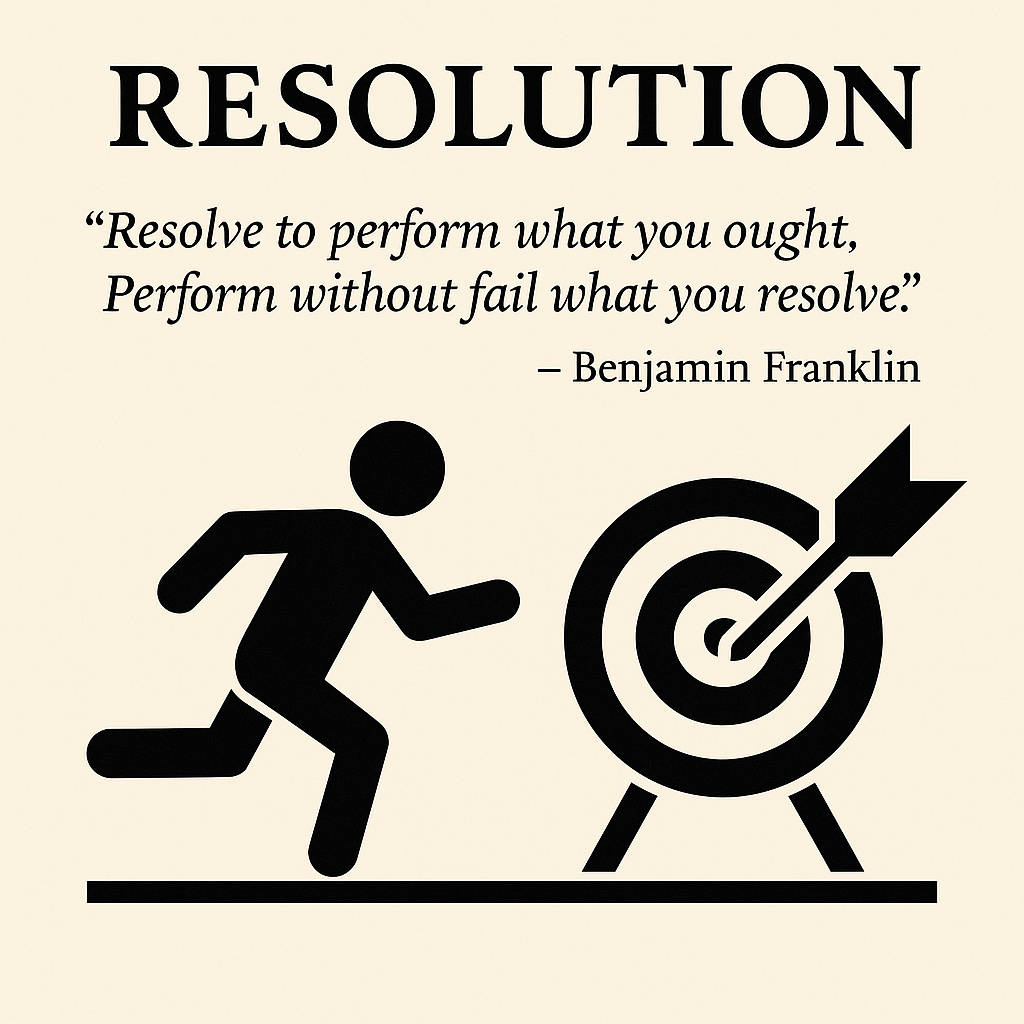
“Resolve to perform what you ought. Perform without fail what you resolve.” ~ Benjamin Franklin
When Benjamin Franklin drafted his list of thirteen virtues in 1726, he was not creating abstract moral theory. He was constructing a system for self-mastery. Each virtue was meant to strengthen the others. Resolution stands at the center of that structure.
Without Resolution, temperance fades. Silence becomes selective. Order dissolves. Good intentions multiply but never mature.
Benjamin Franklin’s Resolution was simple in wording and severe in demand: decide what is right, then do it. Not occasionally. Not when convenient. Without fail.
In a culture that rewards ambition but tolerates inconsistency, this virtue feels almost severe. Yet it is the hinge between intention and action. It is the difference between aspiration and integrity.
Resolution builds self-discipline. And self-discipline, practiced daily, becomes integrity in motion.
Franklin’s View of Resolution
Franklin placed Resolution fourth in his sequence, after Temperance, Silence, and Order. That order matters. A clear mind, guarded speech, and structured time create the conditions for decisive action.
In his Autobiography, Franklin admitted he struggled with inconsistency. He was brilliant but easily diverted. He understood that ideas were plentiful. Execution was rare.
Resolution, for him, was not stubbornness. It was moral follow-through. It safeguarded against drift. It prevented a man from promising more than he delivered.
Franklin lived during the Enlightenment, an era shaped by confidence in reason and civic virtue. Thinkers of the time believed character could be cultivated through discipline and habit. Virtue was not mystical. It was practiced.
Resolution fit squarely into that vision. It was rational will aligned with duty.
The Enlightenment Thread: Aristotle, the Stoics, and Franklin
Franklin did not invent Resolution. He inherited it.
Aristotle argued in the Nicomachean Ethics that virtue is formed through repeated action. We become just by doing just acts. We become disciplined by choosing disciplined behavior. Moral excellence, he insisted, is not a feeling. It is a habit.
The Stoics sharpened that idea. Epictetus urged his students: “First say to yourself what you would be; and then do what you have to do.” The order is deliberate. Decide. Then act.
Marcus Aurelius wrote reminders to himself in his Meditations: stop postponing. Act according to reason. Fulfill the task in front of you. Do not be ruled by distraction or discomfort.
For the Stoics, freedom was not the absence of obligation. It was mastery over hesitation.
Franklin absorbed this current of thought. His Resolution was Enlightenment virtue translated into daily life. Not grand speeches. Not heroic moments. Simply the steady refusal to let resolve collapse into delay.
Resolution, in this tradition, is disciplined agency. It is choosing action over excuse.
Biblical Echoes and Christian Witness
The Scriptures press the same point.
James writes plainly: “Be doers of the word, and not hearers only” (James 1:22). Hearing truth without acting on it is self-deception. Knowledge alone does not transform.
Hebrews urges believers to “run with endurance the race set before us” (Hebrews 12:1). Endurance assumes difficulty. Faith must be carried forward, not merely affirmed.
Christian writers across centuries have echoed this call.
C. S. Lewis insisted that virtue is built in small, repeated choices. Character is formed in the ordinary moments where resolve is tested.
G. K. Chesterton viewed keeping one’s word as a quiet act of rebellion in an age of fluctuation. Commitment stands firm when moods shift.
George MacDonald described obedience as courage. Doing what is right often requires strength long before it receives applause.
Resolution, then, is not merely psychological discipline. It is moral faithfulness.
Resolution and Personal Integrity
Every man knows the gap between what he intends and what he completes.
We resolve to repair strained relationships. To make the phone call. To finish the project. To schedule the appointment we have postponed. To train our body. To pray consistently. To lead steadily.
Then distraction enters. Or fatigue. Or perfectionism disguised as caution.
Often we chase secondary tasks to avoid the one that truly matters. We tidy the desk instead of writing the hard email. We scroll instead of deciding. We “plan” instead of act.
Resolution confronts this pattern directly.
It asks a blunt question: Did you do what you said you would do?
Self-discipline is not intensity. It is alignment. It is the steady practice of matching action to conviction.
Where Resolution is absent, credibility weakens. At work, inconsistency erodes trust. At home, unpredictability unsettles those who depend on us. In leadership, unfulfilled commitments create doubt.
Integrity in action means others can rely on your word. It means your private commitments match your public posture.
Resolution does not guarantee perfection. It demands persistence.
The Cost of Inaction
The cost of broken resolve is rarely dramatic. It accumulates quietly.
Delayed decisions compound stress. Unfinished tasks breed anxiety. Promises deferred create distance.
Over time, a pattern forms. A man begins to doubt his own word. Confidence shrinks. Hesitation grows.
Franklin understood this danger. Enlightenment thinkers believed liberty required disciplined citizens. A free society depends on individuals who govern themselves.
Resolution is self-government at the personal level.
Without it, we drift.
Strength in Steady Practice
Resolution does not require conquering everything at once. It often begins with small, disciplined victories.
Completing the task that has lingered. Guarding time for what matters. Following through on daily habits that build clarity and strength.
The practice itself strengthens the will. Each kept promise reinforces identity. You become the kind of man who does what he says he will do.
That is self-discipline. And self-discipline practiced long enough becomes integrity embodied.
Practical Focus Map: Practicing the Virtue of Resolution
Morning Intentions
Write down three commitments that genuinely matter today. Not ten. Three.
Time Boundaries
Block time for those commitments and protect it.
Language Shift
Replace “I’ll try” with “I will.”
Distraction Audit
Identify your common derailers. Name them. Plan around them.
Accountability
Share one meaningful commitment with someone you respect.
Evening Review
Ask: Did I keep my word today? If not, why?
Stack Small Wins
Finish what you start, especially in modest tasks. Momentum compounds.
Resolution grows through repetition.
Closing Charge: Integrity in Motion
Benjamin Franklin’s Resolution is not dramatic. It is demanding.
Decide what you ought to do. Then perform it without fail.
The world does not lack intention. It lacks follow-through.
The Virtue of Resolution calls us to close that gap. To govern ourselves before we attempt to influence others. To build self-discipline that expresses itself in dependable action.
When resolve becomes habit, integrity is no longer theoretical. It is visible.
And visible integrity is strength.
Franklin’s 13 Virtues Series | Week 3 Order | Week 5 Frugality


 Chase The Kangaroo
Leave a reply to The Virtue of Order: How Franklin’s Third Principle Creates Freedom Through Structure – Chase The Kangaroo Cancel reply