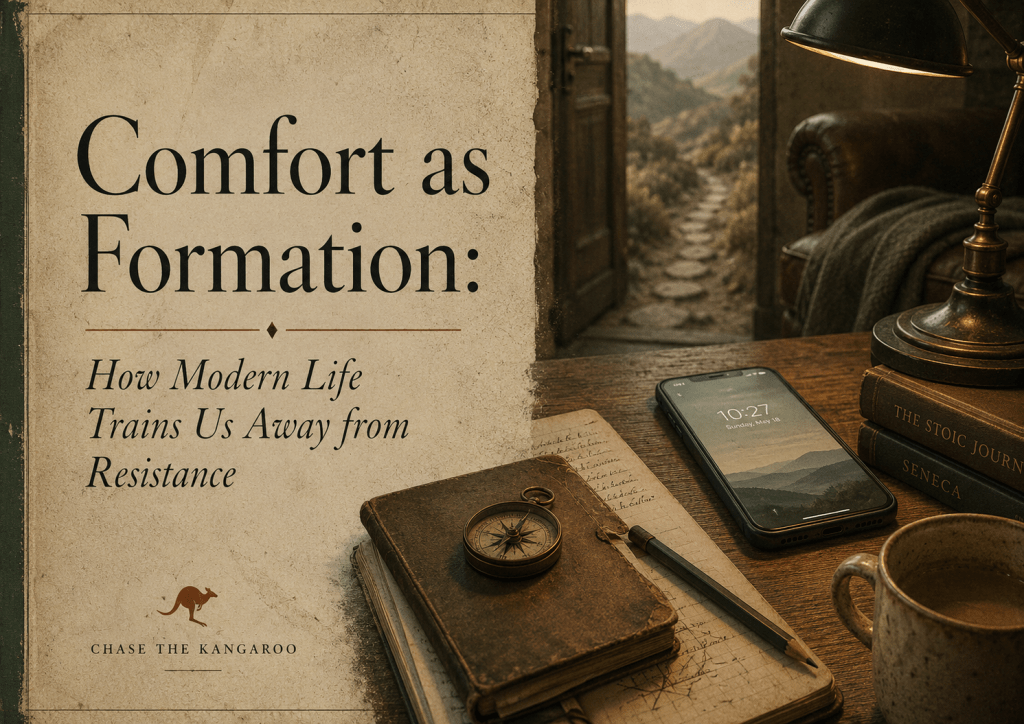
In my review of Dr. Paul Taylor’s The Hardiness Effect, I kept circling one idea: modern comfort is not neutral. Taylor approaches that idea through stress adaptation, hardiness, and the body-brain connection. His argument is that the right kind of stress, in the right dose, helps us grow stronger. Remove too much resistance, and the human system begins to soften.
But the idea reaches beyond health and performance. Comfort does not simply remove difficulty from life. Over time, it forms us. It teaches us what to expect, what we reach for first, how long we can wait, how much discomfort we can tolerate, and whether we still know how to sit quietly with our own thoughts without reaching for a glowing rectangle like a pacifier with apps.
We live in an age where nearly every friction point has been targeted for elimination. Food can arrive without cooking. Entertainment can begin without waiting. Questions can be answered without study. Products can appear without leaving the house. Opinions can be expressed without reflection. Boredom can be killed in under three seconds. The modern world is not merely convenient. It is formative. And much of what it forms in us is not strength.
The Comfort Around Us
Comfort used to be occasional. Now it is ambient. We do not simply enjoy comforts. We live inside systems built to anticipate appetite and remove resistance before we even notice it. The thermostat keeps the room pleasant. The algorithm keeps the feed moving. The streaming service starts the next episode. The delivery app asks whether we would like our cravings brought to the door.
The problem is not that these things exist. I am not trying to become the patron saint of inconvenience. I like air conditioning. I like grocery stores. I like not having to send a letter by horse. But the problem begins when convenience quietly becomes our tutor. It teaches us that waiting is unnecessary, that effort is optional, that hunger should be answered immediately, that silence is awkward, that boredom is a malfunction, and that every desire deserves a shortcut.
Then life eventually refuses to cooperate. A relationship requires patience. A body requires discipline. Prayer requires stillness. Grief requires endurance. Obedience requires sacrifice. A difficult conversation waits in the next room, and suddenly the old muscles feel weak. We were trained for ease, then surprised by difficulty.
That is the quiet danger of comfort as formation. It rarely announces itself as decay. It usually presents itself as relief. A little more convenience here. A little less effort there. A few more nights of passive entertainment. A few more mornings surrendered to the snooze button. None of it seems dramatic in the moment, which is exactly why it works. Formation is not usually loud. It is repetitive.
The Phone as Training Ground
Digital life is the clearest example because it sits closest to us. The phone is not just a tool. It is a portable escape hatch. It rescues us from boredom, discomfort, silence, loneliness, awkwardness, waiting, prayer, thought, and any moment in which we might have to face ourselves without a distraction within thumb’s reach.
That sounds harsh until you watch what happens in a checkout line, a waiting room, an elevator, a red light, a restaurant, a church lobby, or your own living room. We reach. Not always because we need information. Not always because something important happened. Often we reach because a tiny space opened up, and we no longer know what to do with unoccupied attention.
That is formation. The device trains immediacy. The feed trains comparison. Notifications train reactivity. Infinite scroll trains appetite without satisfaction. Streaming trains passive consumption. The algorithm studies desire, then sells it back to us with better lighting. It would almost be impressive if it were not slowly turning us into people who cannot wait twelve seconds for anything without checking weather in a city we do not live in.
The danger is not technology itself. Tools are not the enemy. A good tool extends human ability. A bad relationship with a tool begins to redirect human desire. The issue is not whether we own a phone, use a streaming service, order groceries, or enjoy the occasional mindless video. The issue is whether those tools still serve our purposes, or whether they have begun quietly assigning them.
A hammer does not ask for your soul. The phone is less polite.
The Spiritual Cost of a Cultural Pattern
The push away from spiritual and moral formation rarely arrives as a direct argument. Modern culture does not usually say, “Stop praying.” It says, “Stay busy.” It does not say, “Reject discipline.” It says, “You deserve ease.” It does not say, “Ignore your soul.” It says, “Here is something else to watch.” It does not say, “Become shallow.” It says, “Keep scrolling.”
That is why comfort is so effective. It does not need to destroy conviction in one dramatic moment. It only needs to keep us distracted, tired, overfed, amused, reactive, and just comfortable enough to avoid asking harder questions. A man does not have to renounce everything he believes in order to drift. He only has to keep postponing the practices that would make those beliefs solid.
C.S. Lewis understood this pattern in The Screwtape Letters. Temptation does not always need to look dark. Sometimes it looks ordinary, mild, reasonable, and forgettable. A little delay here. A little distraction there. A little resentment left unchecked. A little appetite indulged. A little duty postponed until the will loses its edge.
John Mark Comer, in Live No Lies, describes the spiritual battle through the devil, the flesh, and the world. That last category, the world’s system, matters here. The world’s system forms us through patterns we mistake for normal life. It does not need to convince us to love evil. Often, it only needs to keep us comfortable enough to avoid the good.
This is where modern comfort becomes dangerous. Not because every couch is wicked. Not because every phone is demonic. Not because every convenience is a compromise. The danger is that comfort can become a complete curriculum. It can teach us to avoid pain, resent limits, distrust silence, and treat every interruption to personal ease as an injustice.
At some point, the issue is no longer whether we believe certain things. The issue is whether our daily habits are forming us into the kind of people who can live them.
Formation Requires Friction
Formation requires resistance. Patience requires waiting. Courage requires fear. Self-control requires appetite. Forgiveness requires offense. Prayer requires attention. Endurance requires strain. Love requires inconvenience. Remove the friction, and the virtue has nowhere to grow.
This is one reason modern life can feel spiritually strange. The older disciplines now seem almost foreign. Silence feels like deprivation. Fasting sounds extreme. Sabbath sounds inefficient. Solitude feels lonely. Confession feels unsafe. Deep reading feels slow. Prayer feels unproductive. Physical effort feels optional unless a doctor, mirror, or pair of pants says otherwise.
But these disciplines were never meant to be decorative. They were training grounds. They gave the soul a way to practice freedom. A man who cannot say no to a notification will have a hard time saying no to a stronger appetite. A man who cannot sit in silence for ten minutes will struggle to hear anything beneath the noise. A man who always chooses escape when discomfort rises should not be shocked when courage feels unavailable under pressure.
This is not about becoming severe. It is not about despising pleasure or manufacturing misery. Nobody needs to turn life into a spiritual obstacle course where every breakfast is a test of suffering and every warm shower is viewed with suspicion. The point is simpler. We need some chosen friction, not because discomfort is holy by itself, but because comfort is always training something. If ease has become the automatic path, small acts of resistance help recover agency.
A Few Ways Back
The way back does not require smashing your phone, moving to a cabin, and becoming the sort of person who says, “I do not own a television,” with suspicious intensity. It begins more quietly. It begins by noticing where comfort has become automatic and then putting a little space back into the system.
Wait in line without reaching for the phone. Let a small empty space remain empty. Take ten minutes without music, podcasts, videos, or background noise. Walk after dinner. Lift something heavy. Take the stairs. Say no to some small craving, not because the thing is evil, but because freedom needs exercise.
There are other ordinary ways back. Make the call. Have the conversation. Answer the email. Apologize. Tell the truth. Do the task you keep dragging from one day to the next like a dead branch. Create a few places where tools return to being tools. Put the phone away during meals. Let walks be walks. Let people be people. Let silence do its old work.
None of this is impressive, which is part of the point. The formation we need most often begins in small, unimpressive acts of recovered attention. It is not always heroic. It usually looks like choosing the better thing before the easier thing becomes automatic.
Choose the Training
We are always being formed. Modern culture has a vision of the good life, even if it rarely states it plainly. Its vision is frictionless, entertained, optimized, distracted, and endlessly convenient. It promises freedom but often produces dependency. It promises connection but often leaves us isolated. It promises rest but often leaves us more tired.
The older path is harder, but it is better. Attention over distraction. Effort over drift. Silence over noise. Reality over simulation. Resistance over automatic ease. Not all the time. Not theatrically. Not to prove anything. But enough to remain free.
Comfort is forming us. So must courage.
Sources / Further Reading
Dr. Paul Taylor, The Hardiness Effect: Grow from Stress, Optimise Health, Live Longer
Chase the Kangaroo, “The Hardiness Effect: Choosing the Harder Road in an Age of Comfort”
C.S. Lewis, The Screwtape Letters
Marcus Aurelius, Meditations
Cal Newport, Digital Minimalism
Cal Newport, Deep Work


 Chase The Kangaroo
Leave a comment