Following Through on What Matters Most
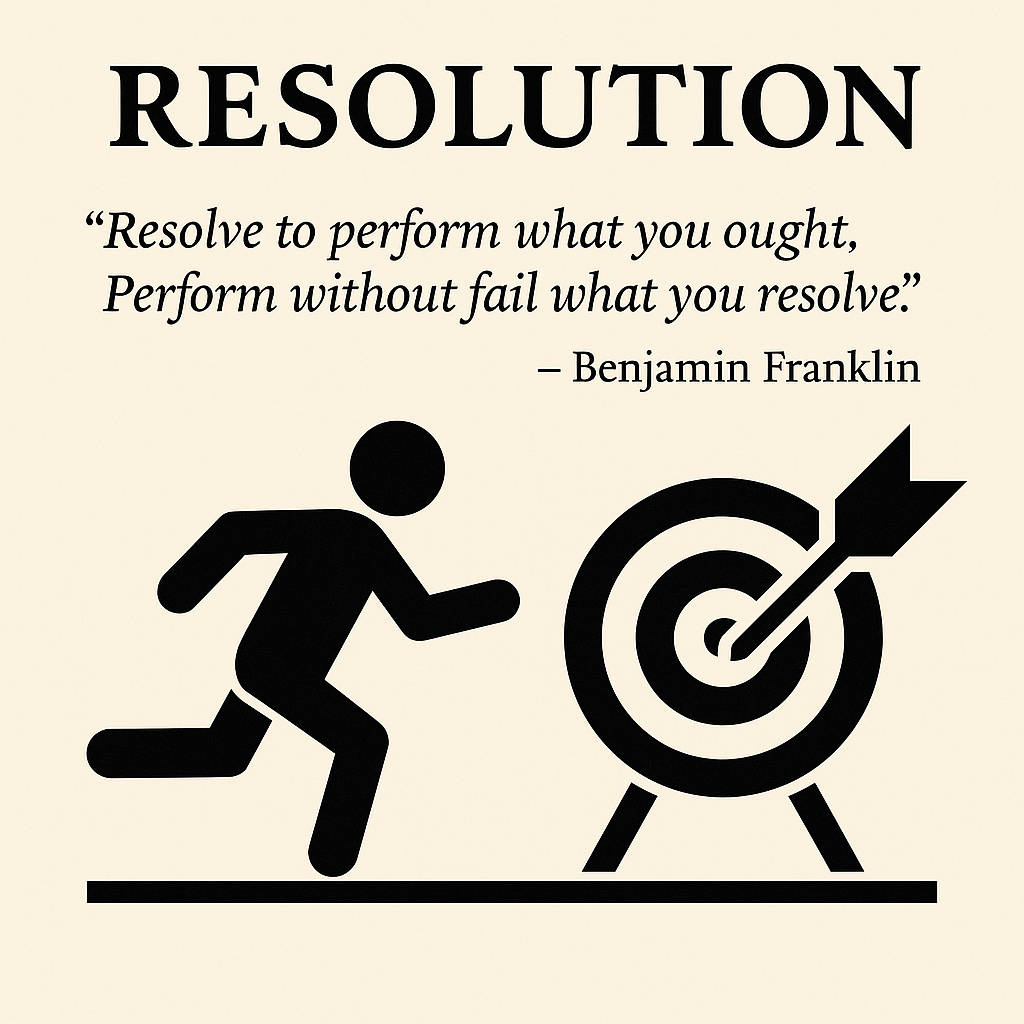
“Resolve to perform what you ought. Perform without fail what you resolve.” ~ Benjamin Franklin
Resolution is the bridge between intention and action. Franklin understood that good intentions are useless unless carried out with determination. He placed Resolution fourth in his list of virtues, knowing that without it, even the best plans would wither into procrastination.
Franklin’s View of Resolution
Franklin saw this virtue as a safeguard against drifting, quitting, or losing focus. He struggled with disorder and inconsistency in his own life, yet he recognized that a resolute spirit could steady a wavering will. To him, Resolution was not about stubbornness but about integrity—keeping promises to oneself and others.
Wisdom from the Stoics
The Stoics echoed this principle. Epictetus urged: “First say to yourself what you would be, and then do what you have to do.” Marcus Aurelius reminded himself to act according to reason and duty without delay. For them, Resolution was freedom—the power to act rightly, without being enslaved by fear or distraction.
Biblical Echoes
The Bible also ties virtue to action. James wrote: “Be doers of the word, and not hearers only.” (James 1:22). The book of Hebrews calls believers to “run with endurance the race set before us.” (Hebrews 12:1). In both cases, faith is authenticated by follow-through. Resolution is perseverance in practice.
Voices from Christian Writers
- C.S. Lewis stressed that virtue is formed in the small, daily choices. Resolution requires repetition, not just inspiration.
- Chesterton saw commitment as a radical act in a world of fickleness. To keep one’s word was to swim against the current of modern drift.
- George MacDonald described obedience as courage—the willingness to do what is right even when it is difficult.
My Experience with Resolution
This week forced me to look closely at my own inconsistencies. I began with three clear responsibilities: find a therapist as part of my recovery plan, sort the piles of paperwork that fuel anxiety, and finish the work tasks I had committed to. Each mattered deeply. My marriage depends on the first. My peace of mind depends on the second. My integrity at work depends on the third.
I made progress, but I also stumbled. I resolved to organize our taxes and did begin, but I allowed other distractions to pull me away before finishing. This is a pattern I recognize: when tasks are unfamiliar or intimidating, I often procrastinate. Fear and perfectionism disguise themselves as caution, when in reality they paralyze me. I know in my head that doing something imperfectly is better than not doing it at all. But I still hesitate.
Strength in Persistence
Even so, I have seen where persistence pays off. My evening routine has become a non-negotiable anchor. Even when a late Austin FC match kept me up well past 10 p.m., I still followed through: playing with the dog, cleaning the cat box, journaling, reading, meditating. Persistence is about mindset. Once the resolution is set, determination carries me through.
What Distracts Me
Distractions are always waiting: work, laziness, fear, selfishness, perfectionism. Sometimes I chase lesser tasks just to avoid the one that really matters. I know better planning and habits would help. But more than that, I need to weigh the cost of not following through. What is the price of delay? What is the impact on those who depend on me?
Small Wins
Resolution also revealed itself in small victories. Completing work tasks that had been hanging over me. Finishing a home project I had put off. Setting goals for mowing the lawn, fixing the Ring, going couch shopping with Jo, and even pushing my heart rate into zone 4 on the bike. These were modest, but they mattered. They showed me that resolution does not have to mean conquering everything at once—it can also be the steady stacking of small wins.
The Cost of Inaction
But there are deeper costs when I fail to be resolute. At work, I hold it together “more or less.” At home, inconsistency has hurt my marriage. My wife does not always feel safe. Her trust wavers. She wants to count on me, and she wants me to lead, but too often I have failed to follow through. Resolution here is not optional—it is essential. If I were resolute, I would be dependable. She would feel secure. And I would carry myself with greater confidence.
Practical Focus Map: Practicing Resolution
| Area | Practice |
| Morning Intentions | Write down 3 resolutions each morning that truly matter. |
| Time Boundaries | Block time for important commitments and guard it. |
| Self-Talk | Replace “I’ll try” with “Iwill.” |
| Accountability | Share resolutions with Jo or trusted friends. |
| Distraction Audit | Identify daily derailers and plan how to avoid them. |
| Small Wins | Celebrate progress in small but steady tasks. |
| Evening Review | Reflect: Did I keep my word today? Where can I improve tomorrow? |
Closing Thought
Resolution is not about rigid willpower. It is about integrity—the faithfulness to keep promises to ourselves and others. Franklin knew the danger of letting intentions die in delay. This week reminded me of the same. When I am resolute, I am dependable. And dependability is love in action.


 Chase The Kangaroo
Leave a comment